


Three AI Assistants Went Down Together. Your Assignment Named One of Them.
Thursday morning, inside the same few hours, Grok started failing at about 9:30 Eastern, ChatGPT began returning errors around 11, and Claude went down alongside Claude Code and the API. Anthropic marked it resolved about 12:15. Three companies, three separate stacks, one morning, and no evidence the three were related.
Then Friday made the same point a different way. GPT-6 Astra shipped to business customers first and left Plus and Pro subscribers waiting, and Sam Altman spent the morning apologizing for a rollout he called messy.
So inside forty eight hours the tools your students use failed twice for two completely different reasons. Once because infrastructure broke. Once because a company decided who goes first.
The post is not an argument for banning AI in coursework. It is a much smaller point: when you wrote use ChatGPT into an assignment, you made a procurement decision, and you made it without a contract, without an SLA, and without anyone knowing you did.
Read it: https://www.harvestkernel.com/three-ai-assistants-down-your-assignment-named-one/
New on the blog: ChatGPT Ads Hit $1 Billion. Your Assignment Still Asks for the Answer.
OpenAI published its ChatGPT Ads numbers on August 31. Everyone quoted the revenue figure. The line that matters for teaching is in the last section, where the company says it will explore new ways for businesses to interact with people in more native ways inside ChatGPT.
Ads today are labeled and separate from the answers, and OpenAI says advertising does not influence those answers. Take that at face value. The label is doing the work. Native means the label stops being the separation.
The response is not a ban and it is not a detector. It is one editing pass on the assignment.
https://www.harvestkernel.com/chatgpt-ads-assignment-decision-path/
Fabricated Authors Now Carry Real DOIs. Your Source Check Passes Them.
A preprint posted to arXiv this summer found 1,655 ghost authored records on Zenodo, the repository CERN operates. Nonexistent journals. Fabricated publication dates. 991 of them registered in a single month. Every one carrying a real DOI.
They pass the four checks most of us teach. DOI, indexed, other publications, collaborators. Four for four, and no person wrote any of them.
Today's post walks the five questions that still work, and why every one of them is about something outside the record rather than inside it.
Read it: https://www.harvestkernel.com/fabricated-authors-real-dois-source-check/
New on the blog.
OpenAI Economic Research and Bocconi University ran a randomized experiment with more than 1,000 first year undergraduates. Four groups: ChatGPT access, training in causal reasoning, both, or neither. Same real business case. Trained human graders on one five point rubric, plus automated text analysis on the same submissions.
The ChatGPT group scored almost a full point higher.
The causal reasoning group produced a wider range of more distinct ideas and scored no higher at all.
Two instruments pointed at the same stack of student work, and only one of them saw the thinking.
The post walks through what the rubric caught, what it missed, why the Berkeley grade inflation paper is the same finding from the other direction, and the one row to write before your next stack lands.
Read it: https://www.harvestkernel.com/rubric-rewards-polish-openai-bocconi-study/
The free working session that goes with it: https://www.harvestkernel.com/the-missing-row-rubric-audit/
MIT released its AI committee report yesterday and every headline used the word watershed.
The part that actually lands on a desk is smaller. Instructors were told the same day that guidance was coming for writing an AI policy into the classes they teach this fall.
Then section 3.2.3 turns the policy around. If you present content substantially generated by AI, or use AI in evaluation, grading or feedback, the committee strongly recommends you be transparent with students about how and why.
The report also advises against relying on AI detectors, and records that instructors said policing unauthorised AI use was harming their connection to students.
So the enforcement door closes and a writing assignment opens, and the policy has two halves.
Today's post walks through both, with the report quoted rather than summarised.
https://www.harvestkernel.com/mit-syllabus-ai-policy-instructor-disclosure/
Today on the blog. One university has told every academic department to write its own AI policy this semester, and those policies are expected in every course syllabus.
The part worth reading twice is the guideline they were handed. It does not ask for a rule about AI. It asks each department to address student use of generative AI, agentic AI and assistive AI, separately, in course components, and to hold students accountable for infractions.
Three columns. Most syllabus policies have one.
The assistive column is the one that collides with your accessibility statement if you write it carelessly. The agentic column is the one with no precedent, because an agent does not hand a student a draft, it takes actions and reports back.
Read it here: https://www.harvestkernel.com/ai-policy-department-three-kinds-of-ai/
Open your syllabus and read your AI paragraph. Which of the three does it actually name: generative, assistive, or agentic?
New on the blog. AI Study Tools Just Shipped Without You. Your Syllabus Is the Input.
Three student facing AI products went live in forty eight hours this week, all timed to the opening days of the semester. On August 18 OpenAI launched ChatGPT for Teens. On August 19 Google announced a dedicated student hub in Gemini and shipped five learning features in Search.
Two of them read a syllabus as structured data. The Gemini hub pulls dates out of it and puts them in a student's calendar. Search takes it as a source for a study notebook.
Extraction is lossy. It finds every line with a date attached. It does not find the sentence explaining why the second essay comes before the midterm, or the late policy written as a paragraph, or the reason the reading load drops in week nine.
So the student arrives in week two holding an accurate calendar built from your course, and missing the entire argument of it.
https://www.harvestkernel.com/ai-study-tools-your-syllabus-is-the-input/
The free working session that goes with it, The Syllabus Extraction Test, is in SeedStacking Resources.
Open your syllabus. How many things in it matter and carry no date? One number.
AI Did Not Make Grant Proposals Worse. It Made Them Average.
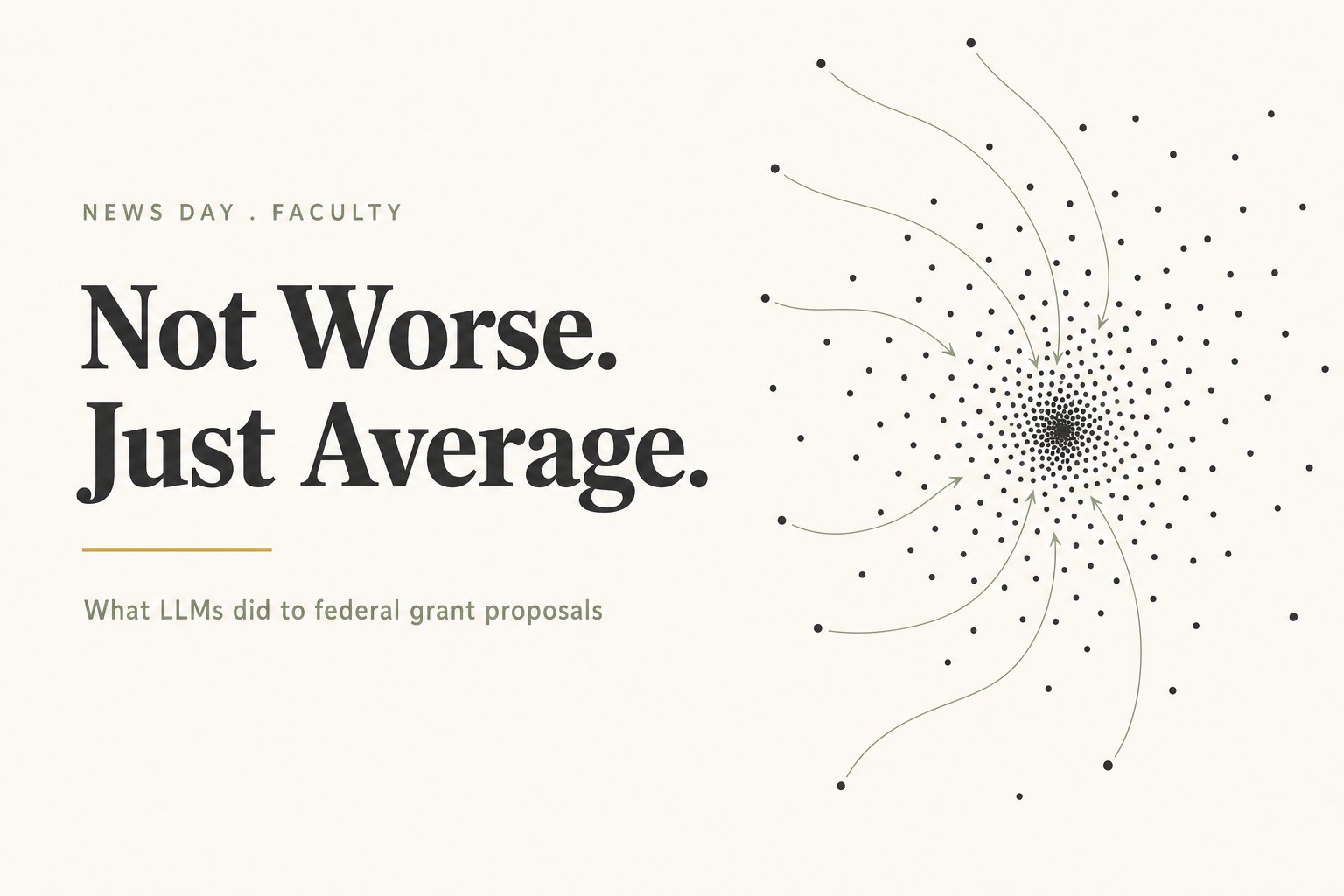
A PNAS paper published August 11 looked at confidential NSF and NIH proposal submissions from two large research universities, plus every publicly released award from both agencies. Higher language model involvement was consistently associated with lower semantic distinctiveness, positioning proposals closer to recently funded work within the same agency.
Not sloppier. Not less rigorous. Closer to the middle. In a funding system, that is the more expensive failure, and it is the one nobody was watching for.
Today's post walks through the bimodal split, the NIH and NSF asymmetry, and why the model returning the center is the design working correctly rather than breaking.
Read it: https://www.harvestkernel.com/ai-grant-proposals-not-worse-just-average/
Waterloo built an AI certificate where the first skill is deciding whether the problem needs AI at all.
On August 6 the University of Waterloo announced a certificate developed with Cohere. No prompt engineering module. No platform certification. The modules are human centred design, ethics, change management and business strategy.
Dr. Edith Law, who runs the Future of Work Institute there, said the part worth keeping. AI adoption is not the point, but solving problems is.
Today's post takes that order of operations and runs it on a course you are teaching this term.
https://www.harvestkernel.com/ai-certificate-bottleneck-before-the-tool/
New on the blog. Two studies this year, at opposite ends of the academy, found the same shape.
Berkeley: across more than 500,000 grades, the share of A grades in AI exposed courses rose thirteen percentage points, about thirty percent against the 2022 baseline. The increase was biggest where homework carried the most weight.
Northwestern, published this week in PNAS: grant proposals showing stronger signs of AI assisted writing were four percentage points more likely to be funded at NIH, were measurably less distinctive, and the extra output landed in lower impact papers.
Nobody in the second study broke a rule. That is the point. The problem is not sitting in anyone's ethics. It is sitting in the instrument.
The free working session that goes with it: The Distinctiveness Criterion