


Today's question comes from something I keep bumping into when I talk to other educators about AI.
Most of us default to the same starting point: "How can I use AI in my class?" It feels productive. But it actually anchors you to your current lesson plan and just makes it faster.
The shift that changed everything for me was asking a different question first: "What should my students be able to DO after this lesson?" That one change reframes AI from an efficiency tool to a design partner.
I broke down three specific practices in today's blog post. But before you read it, I want to hear from you:
When you sit down to build something with AI, what's the first question you ask yourself? Do you start with the tool, the task, or the student outcome?
Friday question for the community.
Anthropic just published a study of 81,000 AI users that turned up something uncomfortable. The workers most anxious about AI are the ones with the highest exposure to it. Familiarity breeds fear, not comfort.
But the same study found that the workers capturing the biggest productivity gains are people who have built a working relationship with AI. Software developers. Customer service reps. Delivery drivers running side businesses. What they share is not income or education. It is fluency.
Here is the question: when you look honestly at your own AI practice, are you on the fluency side of that divide or the anxiety side? And what is the one habit you could change this week that would move you further in the right direction?
I will kick it off in the comments with mine.
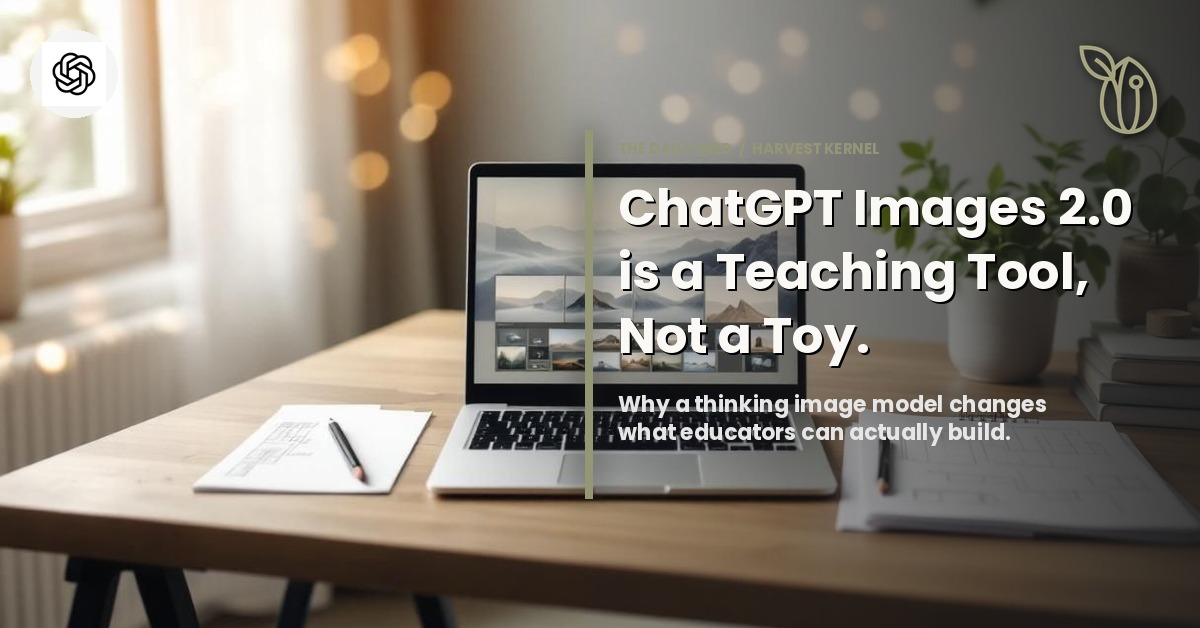
Today's topic: OpenAI released ChatGPT Images 2.0 on Monday, and it's the first image model with "thinking" built in.
What that means in plain English: the model plans the image before it draws. It can search the web for references, reason through layout, and double-check its own output. Text on images renders correctly. Characters stay consistent across multiple images from one prompt. Non-Latin scripts (Japanese, Korean, Chinese, Hindi, Bengali) actually work now.
Instant mode is on the free ChatGPT tier. Thinking mode comes with Plus.
For educators, this is the release that turns AI image generation from a novelty into a real teaching tool. Slides with readable labels. Consistent cartoon characters across a whole lesson. Language-classroom materials in the actual target language.
Here's my discussion question for today:
What's one thing you've tried to make with AI image generation that turned out faster to do by hand? That's the exact problem this new model is built to fix, and I want to collect real teacher workflows we can stress-test.
Drop them below. If you run one against ChatGPT Images 2.0 this week, come back and tell us whether it worked.
Plant ideas. Cultivate skills. Harvest results.
Wednesday Daily Discussion:
If a Microsoft bootcamp, free AI curriculum, GitHub Copilot Pro, and real labor-market data showed up at your institution tomorrow, fully funded, no procurement required, what would actually happen?
Would it get used? Would it sit in an inbox? Would one faculty member run with it while the rest shrugged?
I am asking because that is basically what just happened for every community college in the country through NAAIC, and the difference between institutions that will turn this into something and the ones that will not is going to come down to which faculty member picks up the phone first.
I wrote up the full breakdown on the blog today: Every Community College Just Got Free AI Training. Here's What That Actually Means.
But I want to hear your take first. What is the bottleneck at your place? Is it time, money, buy-in, or something else? Drop a comment. Curious what this looks like across different kinds of institutions.

Quick Tuesday teaching moment for anyone who uses Claude regularly.
When you look at Claude, it's easy to get caught up in the feature list. Extended thinking. Artifacts. Projects. Tool use. MCP connectors. New things keep showing up, and it can feel like a treadmill.
Here's what actually changes the way you use the tool.
Claude wasn't built around features. It was built around three words. Helpful. Harmless. Honest. That framework is called Constitutional AI, and it's the anchor for every behavior you see.
When Claude asks a clarifying question before it starts, that's honest in action. When it flags its own uncertainty on something, same thing. When it pushes back on a request that feels off, that's harmless doing its job. When it builds you a persistent artifact instead of just answering in chat, that's helpful made concrete.
Once you see the three values, the features stop surprising you. Every new one is an extension of something you already understand. You're not learning a new tool every quarter. You're watching the same principles get applied in new places.
That's what I mean when I say design literacy beats prompt collecting.
I'm curious where this shift has happened for anyone here. Was there a specific moment where Claude stopped feeling unpredictable and started feeling like a tool you could actually trust with something important?
Drop your answer below. Even one sentence counts.
Today's question is for anyone who teaches, trains teachers, or remembers what it was like to be a brand new teacher walking into your first classroom.
A new NEA report surfaced a split among aspiring educators. Some see AI as an equity tool. Others have been burned by hallucinations and do not trust it. Both camps have real points. But almost nobody in the conversation is naming the actual issue:
Most pre-service programs are not teaching AI literacy as a structured part of the training.
Today's question: what would you put in a single semester-long AI literacy course for future teachers? Not a workshop. A full course. What would they practice, and what would they read? What would the final project look like?
I wrote the full piece today if you want the backstory on the NEA report: https://www.harvestkernel.com/aspiring-educators-ai-preservice-training-nea/
Drop your curriculum ideas below. The best conversations in this community come from the real experience, not the hot takes.

New post up that I want your honest reactions on.
Anthropic cofounder Jack Clark, who majored in literature and has no CS degree, just told young people the most AI-useful skills come from synthesis across disciplines and asking better questions. He explicitly said "rote programming" is something he would avoid. An Anthropic cofounder said this, about the company that built Claude.
That reframes twenty years of career advice.
Read the full breakdown: https://www.harvestkernel.com/anthropic-cofounder-advice-what-to-study-college-ai-era/
Two questions for the community this weekend:
-
If you were advising a high school senior right now, what would you tell them to study based on what you actually see in your work?
-
What is ONE skill you picked up outside your formal education that has been more valuable than anything in your degree?
Drop your thoughts below. The best conversations in this community come from the real stories, not the hot takes.
Today's Daily Seed: Developing a second brain with Obsidian.
Your best ideas are dying. Right now. Quietly. Not because they're bad. Because you didn't write them down fast enough.
A second brain isn't a note-taking app. It's a capture-first workflow. Here's the whole thing:
1. Capture daily. One inbox file. No tagging. No filing. Just dump the thought and keep moving.
2. Harvest weekly. 15 minutes every Friday. Three buckets: seed, sprout, or trash. That's it.
3. Connect over time. In Obsidian, two brackets around a word becomes a link. Your ideas start talking to each other in ways you couldn't see coming.
The reason most people fail isn't the tool. It's that they try to organize AT the moment of capture, which kills the capture. Capture and organize are two different activities on two different schedules. Separate them.
The question I'd love your answers on:
What's the one productivity tool or system you keep trying to make work that never quite sticks? I'm collecting patterns for a future deep-dive on what actually sticks vs. what just looks good.
Drop yours below. Even one word answers count.
Plant Ideas. Cultivate Skills. Harvest Results.
Professor Dean
Something worth sitting with today.
66% of secondary teachers in the UK say they have already seen a decline in critical thinking among their students because of AI use. Two thirds. Not a projection. An observation from the classroom.
But here is the counterpoint: a handful of professors built AI tools specifically designed to make students think harder. Voice-based debate partners that refuse to give answers and push back on weak arguments. The students who used them showed up to class better prepared and more willing to engage with opposing views.
Same technology. Opposite outcomes. The difference was entirely in the design intent.
So here is the question for our community: When you use AI in your own learning or work, do you tend to use it to get answers faster, or to test and sharpen your own thinking? Be honest. There is no wrong answer, but the distinction matters more than most people realize.
Today on The Daily Seed, we're breaking down Perplexity AI, the search engine that's quietly changing how millions of people find information.
Here's the short version: instead of giving you a list of links to sort through, Perplexity reads the web for you and gives you a direct answer with citations you can click to verify. Think of it as the difference between being handed a stack of library books and being handed a research summary with footnotes.
What makes it worth your time:
Pro Search runs a multi-step research process (it might even ask you a clarifying question before searching)
Spaces let you set up dedicated research areas with custom instructions
Focus Modes let you filter by source type (Academic, Reddit, YouTube, and more)
Pages turn any research thread into a shareable document with one click
The free version works right now at perplexity.ai. No account needed.
Here's my question for you: what's one thing you search for regularly where Google's results have been getting worse? Try running that same search in Perplexity and tell us what you find.