


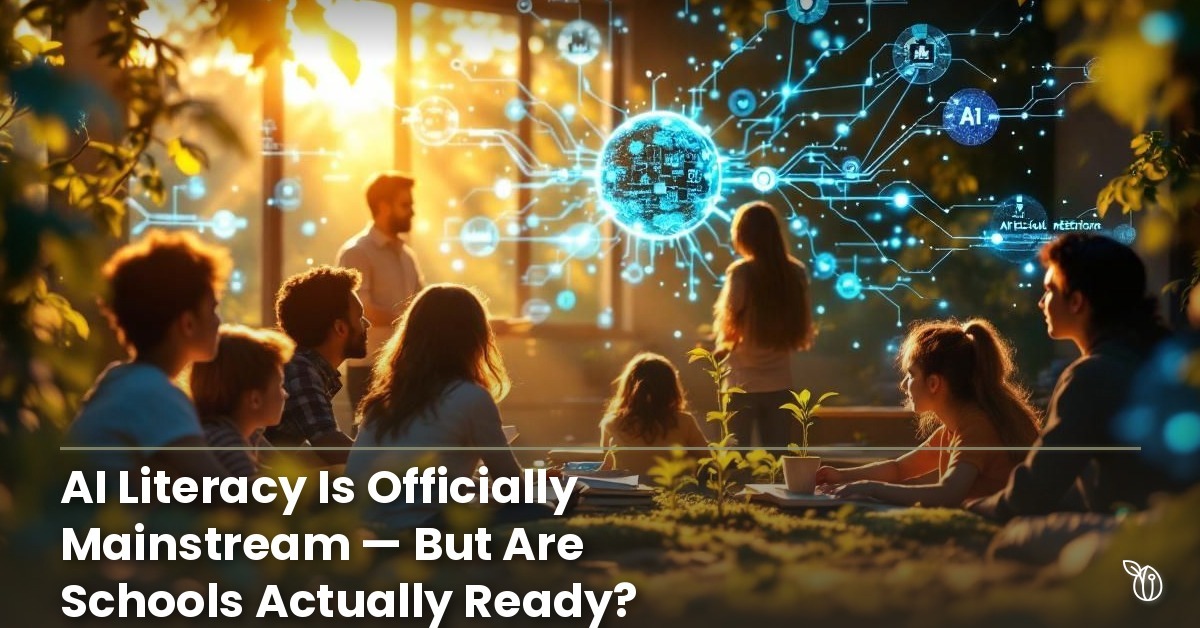
Today's discussion: The EdWeek Research Center surveyed 499 educators and found that 79% of high school students are getting AI literacy lessons. That's progress worth celebrating.
But the data also reveals a blind spot — the elementary cliff. Only 8% of pre-K through 3rd grade students are receiving any AI instruction.
Here's my question for the community: At what age should AI literacy start? And what does age-appropriate AI education even look like for a kindergartner vs. a high schooler?
Drop your thoughts below. There's no wrong answer — this is exactly the kind of conversation we need to be having.
Read the full analysis: https://www.harvestkernel.com/ai-literacy-schools-edweek-data/
Today I am diving deep into Gamma AI — an AI-powered presentation builder that generates complete, professionally designed slide decks from a single prompt in under 60 seconds.
Here is what blew me away: Gamma just launched an AI Agent that lets you edit your entire deck through natural conversation. No menus. No dragging. Just tell it what you want and it does it.
The free plan gives you 400 AI credits to test it out — no credit card needed. If you want to try it yourself, here is my link: https://try.gamma.app/Harvest-Kernel
But here is my honest take: it is incredible for first drafts and fast iteration. If you need pixel-perfect control, you will still want Canva or PowerPoint for final polish.
Today's question for the community:
What is the one thing about building presentations that eats the most of your time? Is it the design? The content? Getting started? I want to hear what your actual pain point is — because that tells us which AI tool fits your workflow best.
Drop your answer below. No wrong answers here — just real talk from real educators and professionals figuring this out together. 🌱
🌾 Would your institution invest $150K/year in AI?
Indian River State College just committed to institution-wide AI integration — making them the first open enrollment state college to go all-in. They embedded Superhuman (formerly Grammarly) into Canvas, Google Docs, email, and admin systems. Not as an optional tool. As infrastructure.
Here is what caught my attention: they are not just deploying AI for students. Faculty workflows and administrative operations are covered too. When everyone from the registrar to the English department is using AI daily, you are building a culture — not just checking a box.
Two questions for the community:
-
If you could embed AI into ONE system at your institution tomorrow, what would it be — your LMS, your email, or your student information system?
-
What is the biggest argument against institution-wide AI adoption that you hear from colleagues? How would you counter it?
Dive deeper in today's blog post: One State College Just Went All-In on AI →
Hot take or not: teens who learn AI through trial and error — without any formal instruction — will end up more fluent than adults who take courses. Agree or disagree?
Here is a question that hit me this morning: if only 5 percent of the American workforce qualifies as AI fluent, what does that tell us about the education they received?
Walmart just committed to training all 1.6 million of its employees on AI through a Google certification program. Over 400 CEOs signed a letter demanding AI be part of every students curriculum. China is teaching AI concepts starting in kindergarten.
Meanwhile, many of us in education are still figuring out where AI fits into our own workflows, let alone our students learning.
I am not pointing fingers. Most educators have never received formal AI training themselves. The support systems just have not kept pace with the technology. But the gap is real, and it is getting wider every semester.
Here is what I want to know: What is the biggest barrier you face when it comes to building your own AI literacy? Is it time, access, confidence, institutional support, or something else entirely?
No wrong answers. I am genuinely curious whether we are all hitting the same walls.
New Pew Research shows 64% of teens use AI chatbots — but only 51% of parents realize it. That 13-point gap is the story of our generation in one number.
What struck me most: 12% of teens have turned to AI for emotional support. When the adults don't understand the tools, the kids stop asking for guidance.
Whether you're a parent, an educator, or both — have you had the "show me what you're using" conversation yet? What did you learn?
Today's Daily Seed episode digs into this. What's your take?
🌱 Daily Discussion — February 25, 2026
Pew Research just published a study that found 64% of teens use AI chatbots — but only 51% of their parents know about it.
Even more interesting: one-third of teens think AI is better than humans at teaching a skill.
What would you do differently as an educator (or parent) if you knew your students were using AI every single day?
Share your thoughts below. No wrong answers — just real talk.
If you could automate ONE thing in your work this week using AI, what would it be?
Not the big dream automation — just one small, annoying, repetitive task.
I'll start: I automated my weekly content calendar. What used to take 90 minutes on Friday afternoons now takes about 25 minutes with a Claude skill I built. Your turn.
If you haven't read this week's blog post yet — "When AI Starts Talking to AI: What Moltbook Teaches Us" — it raises a question worth discussing here:
When 770,000 AI agents join a social network and start debating philosophy, what does that tell us about the tools we're building into our classrooms and workplaces?
Read the full post in Blog Posts and share your take here.
Today's thought: The best AI skill isn't prompting — it's knowing WHEN to use AI and when not to.
Here's what I mean: AI is incredible at drafting, summarizing, and brainstorming. But it's terrible at knowing what matters to YOUR audience, YOUR students, or YOUR business.
Where do you draw the line? What do you always do yourself, and what do you hand to AI?