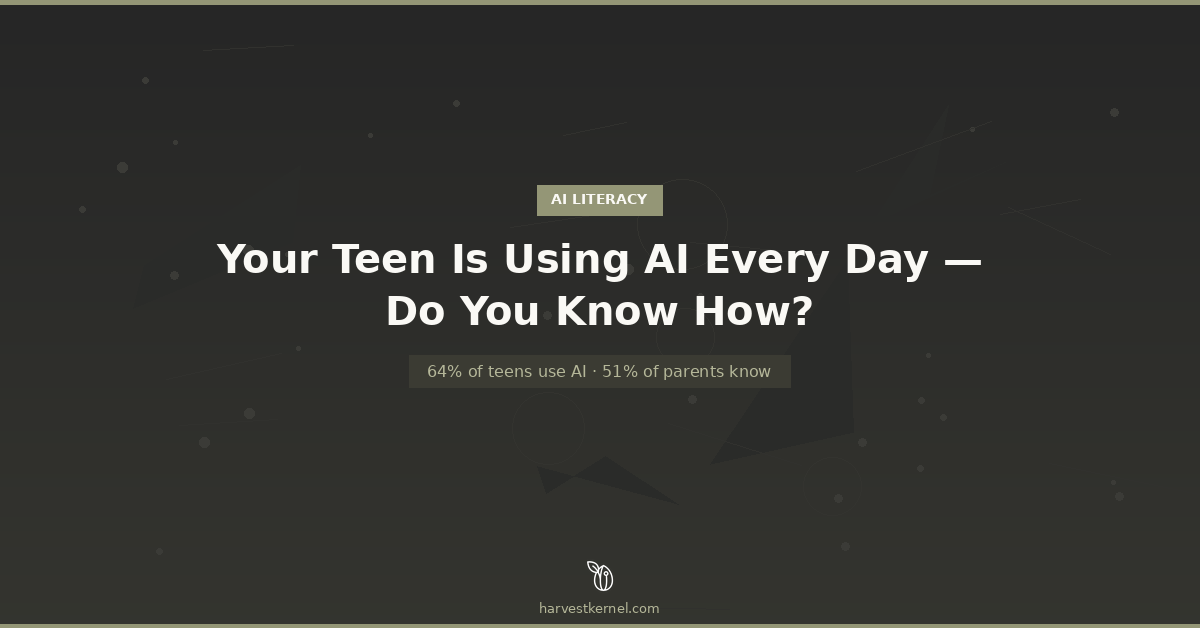
Your Teen Is Using AI Every Day — Do You Know How?
Here’s a conversation that’s happening right now in millions of American homes: a teenager sits at the kitchen table, laptop open, working on homework. Their parent walks by, sees the screen, and assumes it’s Google or maybe YouTube. What they don’t see — and what the teen isn’t volunteering — is that a chatbot is doing the heavy lifting.
This isn’t speculation. It’s what researchers at Pew Research Center found when they surveyed 1,458 U.S. teens and their parents last fall. The results, released this week, paint a picture that should get the attention of every parent, educator, and school administrator in the country.[1]
The headline number is striking, but the gap beneath it is what should keep us up at night.
Teens who say they use AI chatbots vs. parents who think their teen does
That 13-point perception gap represents millions of families where AI has already moved in — and nobody’s talking about it. Nearly three in ten teens reported using chatbots daily, and over a quarter of parents said they were flat-out “unsure” whether their teen used these tools at all.[2]
If you’re an educator, a parent, or anyone who works with young people, this gap isn’t just a data point. It’s a signal that the most transformative technology of our generation is being adopted by an entire generation — without the guardrails of informed adults around them.
Feeling behind on AI? You’re not alone — and that’s exactly why Harvest Kernel exists. Join the Learning Community →
What Teens Are Actually Doing With AI
Let’s set aside the panic for a moment and look at what teens themselves report. The uses aren’t as alarming as the headlines might suggest — but they’re far more embedded in daily life than most adults realize.
According to the Pew study, the top reasons teens use chatbots are practical: searching for information (57%), getting help with schoolwork (54%), and entertainment (47%). About four in ten use them to summarize content or create and edit images.[1]
These are productivity behaviors. Teens aren’t just playing with chatbots — they’re integrating them into how they learn, research, and create. When you look at it through that lens, what you see is a generation that is figuring out AI fluency on their own, through trial and error, without a curriculum.
But there’s a quieter number in this study that deserves attention: 12% of teens say they’ve used chatbots for emotional support or advice.[1] That’s roughly one in eight teenagers turning to an AI when they need someone to talk to. Not a friend. Not a counselor. Not a parent. A language model.
“Technology is not just a teen issue or a parent issue — it’s a family issue.”
— Colleen McClain, Pew Research Center Senior Researcher
That 12% isn’t a crisis — yet. But it points to something important: when young people don’t have informed adults to talk to about AI, they fill the gap themselves. Sometimes with the AI itself.
The Schoolwork Battleground
If the perception gap between parents and teens is the headline, the classroom is where the consequences play out in real time.
One in ten teens told Pew researchers they do all or most of their schoolwork with chatbot assistance. Another 21% said “some” and 23% said “a little.” That means roughly half of American teens have used AI in their academic work to some degree.[1]
And here’s the uncomfortable truth that educators are living with every day: 59% of teens say AI-assisted cheating happens at their school at least “somewhat often,” with a third saying it happens extremely or very often. Among teens who have used chatbots for schoolwork, that number jumps to 76%.
Schools are crafting AI policies on the fly, trying to draw lines between “using AI as a tool” and “using AI to cheat” — while students have already decided the tool is part of their workflow. The problem isn’t that teens are cheating. The problem is that we haven’t given them a framework for using AI with integrity. And you can’t build that framework through prohibition alone. You build it through literacy.
This is exactly the pattern we explored in AI Anxiety Is Spreading to Every Industry — fear fills the vacuum when understanding is absent. The same dynamic playing out in corporate boardrooms is happening in classrooms. Different setting, same root cause: a literacy gap.
SeedStacking™ makes AI literacy manageable. One small win per day. No overwhelm. No jargon. Start your first stack →
Why Teens Are More Optimistic Than You’d Expect
Here’s something the fear-driven coverage is missing: teens are more hopeful about AI than pessimistic. When asked about AI’s impact over the next 20 years, 36% of teens predicted it would be positive for them personally, while only 15% said negative.[1]
Their optimism is grounded in practical experience. Teens who see AI positively talk about efficiency, faster learning, and access to information. They see a tool that meets them where they are. The skeptics worry about overreliance, job displacement, and the erosion of critical thinking — concerns that mirror what adults have been debating for years.
What’s remarkable is that teens are forming these views through direct experience with the technology, not through media coverage or workplace anxiety. They’re building their mental models of AI by actually using it. That’s a fundamentally different — and in many ways healthier — starting point than what most adults have.
One data point that should give every educator pause: when asked whether AI could outperform humans at various tasks, the only area where more teens said AI would do better than humans was teaching a skill. A third of teens think AI is a better teacher than a person.
That’s not an insult. It’s feedback. And if we’re paying attention, it tells us that personalized, on-demand, patient instruction — the thing AI chatbots do well — is something teens value. The question for educators isn’t whether to compete with AI. It’s how to bring the best of both human and AI instruction together.
The Conversation That Isn’t Happening
Perhaps the most actionable finding from the entire study is this: only four in ten parents say they’ve talked to their teen about using AI chatbots.[2]
Sixty percent of parents haven’t had the conversation. Meanwhile, their teens are using these tools daily, forming habits, making judgments about what AI is good for and what it isn’t — all without adult input.
Compare this to how we handled previous technology waves. Most parents eventually had conversations about social media safety, screen time, and online strangers. Those conversations weren’t perfect, but they happened. With AI, the majority of families haven’t even started.
The Pew data shows this isn’t a partisan issue — it cuts across demographics and political lines. Pew’s researchers emphasized that concerns about teen AI use transcend political affiliation.[2] It’s a universal challenge that requires a universal response.
And here’s the bridge for educators: you’re already in the room with these teens every day. You don’t have to wait for parents to start the conversation. You can model what AI literacy looks like — how to evaluate chatbot outputs, when to rely on AI and when not to, and what intellectual honesty means in an AI-augmented world. This is the approach we outlined in The K-Shaped AI Economy — the people who build literacy now end up on the right side of the divide.
Bridge the AI Literacy Gap — Starting Today
The Harvest Kernel Learning Community gives educators, parents, and lifelong learners the tools and conversations they need to build real AI fluency. SeedStacking™ methodology. Community forum with real practitioners. Weekly challenges that build confidence, not overwhelm. Free account. No credit card.
Five Seeds to Plant This Week
Data without action is just decoration. Here’s how to turn the Pew findings into something real — whether you’re a parent, educator, or someone who works with young people:
🌱 The Harvest Kernel Takeaway
1. Start the conversation. If you haven’t asked your teen (or your students) how they use AI, do it this week. Not as an interrogation — as genuine curiosity. “What’s the coolest thing you’ve used a chatbot for?” opens more doors than “Are you cheating with AI?”
2. Use it together. Sit down with a teen and try a chatbot side by side. Ask it something. Evaluate the answer together. Talk about what it got right and what it got wrong. This is SeedStacking™ in action — one small experience that builds AI literacy for both of you.
3. Reframe the cheating conversation. Instead of “don’t use AI,” try “show me how you used AI on this assignment.” The distinction between using AI as a shortcut and using AI as a thinking tool is one that teens can learn — if someone teaches them.
4. Address the emotional use case. If 12% of teens are turning to chatbots for emotional support, that’s a signal, not a scandal. Check in. Make sure the human support systems are visible, accessible, and judgment-free.
5. Build your own literacy first. You can’t guide someone through territory you’ve never explored. Spend 10 minutes with a chatbot today. Ask it a question about your field. Evaluate what you get back. Now you have standing to join the conversation.
The Pew data makes one thing clear: the teens are already in the water. The question is whether the adults in their lives are going to stand on the shore watching — or get in and help them navigate.
AI literacy isn’t a school subject. It isn’t a parenting hack. It’s a shared responsibility that starts with one honest conversation and builds from there. That’s the SeedStacking™ way — and it’s never too late to plant the first seed.
Ready to start? Join the Harvest Kernel Learning Community — it’s free, it’s practical, and it’s built for people exactly like you. www.harvestkernel.com →
🌱 Ready to Build Real AI Literacy?
The Harvest Kernel Learning Community is where educators, business owners, and lifelong learners build AI fluency together — one small win at a time. SeedStacking™ methodology. Real community. Weekly challenges. Free to join.
Harvest Kernel · Plant Ideas. Cultivate Skills. Harvest Results.
www.harvestkernel.com