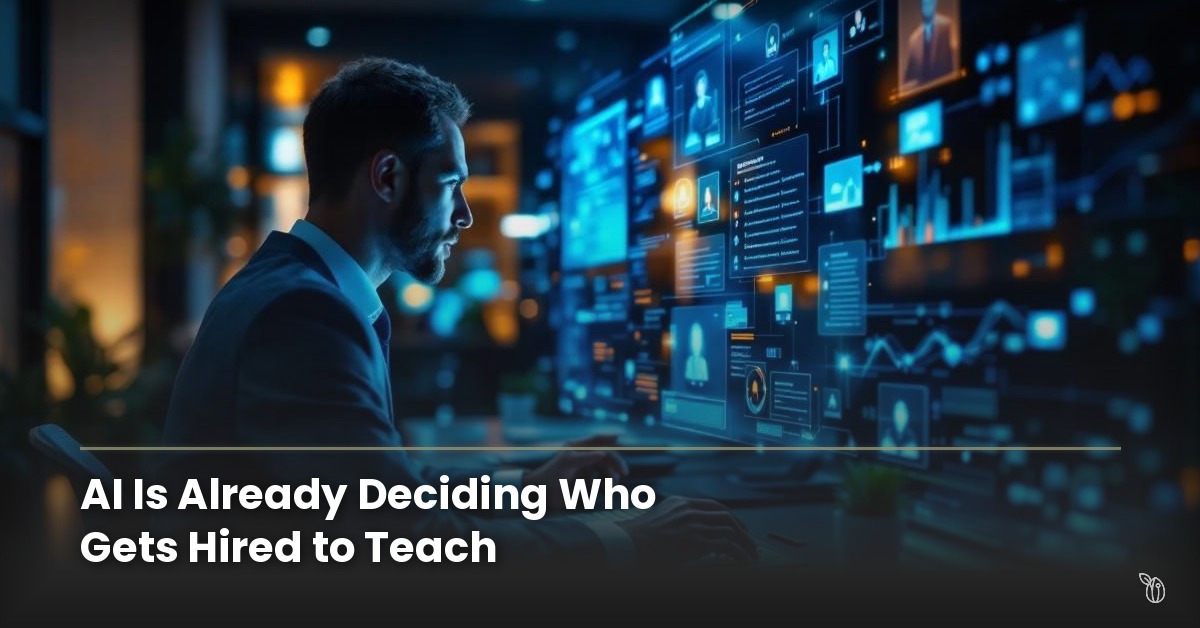
AI Is Already Deciding Who Gets Hired to Teach. Most Teachers Have No Idea.
If you applied for a teaching job in the last year, there’s a better than even chance that an AI system screened your resume before a human ever read it. And there’s an almost certain chance nobody told you.
That’s the quiet shift happening across school districts right now. According to new data from the EdWeek Research Center, more than half of districts are using AI tools somewhere in their teacher hiring pipeline. A third of recruiters across all industries now use AI in their processes, according to Criteria Research’s 2026 hiring benchmarking report. The technology has become what HireVue’s chief science officer calls “essential infrastructure.”
Now, you might be thinking: so what? If AI can screen resumes faster, that’s a win for everybody. And you’d be half right. The speed is real. The efficiency is real. What’s missing is the conversation about what gets lost when algorithms start making the first cut.
The Invisible Interview That Happens Before the Real One
Here’s what most educators don’t realize about the modern hiring pipeline. Before your cover letter reaches a principal’s desk, it may have already been scored, ranked, and categorized by software you’ve never heard of. Platforms like PowerSchool’s Applicant Tracking and HireVue use AI to match candidates against job requirements, flag top applicants, and even generate interview questions tailored to the specific position.
That stat alone should change how you think about your next job application. If you’re writing your resume and cover letter for a human reader, you may be optimizing for the wrong audience. AI systems parse language differently. They look for keyword alignment, measurable outcomes, and specific competency markers that a principal scanning your application might naturally infer from context.
The result is what I call the Screening Gap: the distance between what makes a great teacher and what makes a teacher’s application survive algorithmic sorting. Those aren’t always the same thing.
One District’s Experiment Shows Both the Promise and the Problem
In Morton Grove, Illinois, Golf Middle School Principal David Norman has been working with AI to solve a real and pressing challenge. His 600-student district has no dedicated human resources department. Hiring falls entirely on principals and administrators, alongside everything else they do.
Norman’s team developed structured AI prompts to screen resumes and generate targeted interview questions. For a science teacher position, the AI identified that candidates emphasized coaching and curriculum development but rarely mentioned differentiation strategies for English learners or students with disabilities. So it generated an interview question specifically probing that gap.
That’s a legitimate win. The AI found a blind spot in the process that busy administrators might have missed. Norman reported that the tool helped his team have deeper, more substantive conversations with candidates.
Because there’s a flip side to Golf’s story that applies across the field. If AI is generating your interview questions, it’s also shaping what gets asked and what doesn’t. If the algorithm doesn’t flag “builds trust with families from underserved communities” as a priority competency, that question never gets asked. The candidate who excels at relationship building in challenging contexts never gets to demonstrate it.
Like what you’re reading? Get insights like this delivered daily.
The 30% Problem: When the Process Drives Talent Away
Efficiency gains mean nothing if the process itself repels strong candidates. And there’s evidence that’s exactly what’s happening. In Teach Away’s 2026 survey of international educators, 30% of teachers reported withdrawing from a job application because the process felt “too impersonal.”
Think about what that means for a profession already in a workforce crisis. We’re not talking about unqualified applicants dropping out. We’re talking about experienced professionals who evaluated the process, decided it didn’t respect their time or expertise, and walked away.
The educators most likely to walk away from an impersonal process are often the ones you most want to hire: experienced, confident, and with options. They’re not going to jump through algorithmic hoops without knowing why. Meanwhile, the candidate who stuffs their resume with keywords might rank higher than the veteran teacher whose best qualities show up in a conversation, not a character count.
The Transparency Fix That Costs Nothing
Here’s where the opportunity sits, and it’s one of those rare situations where the right thing to do is also the easiest. Districts using AI in hiring should tell candidates. Clearly. Before the process starts.
Not buried in terms of service. Not hinted at in a FAQ. A straightforward statement: “We use AI tools to help screen applications and develop interview questions. Here’s what that means for you.”
That one sentence would accomplish three things simultaneously. First, it levels the playing field. Candidates who understand the process can present their qualifications in ways that both humans and algorithms can evaluate fairly. Second, it builds trust. Educators are being asked to teach students about AI transparency and ethical technology use. When districts practice what they preach, it reinforces the credibility of the entire institution. Third, it improves outcomes. When candidates know AI is involved, they can provide more structured, specific information about their practice. That gives the AI better data to work with, which gives administrators better candidates to interview.
The SeedStacking Takeaway
AI in hiring isn’t going away. But AI literacy doesn’t stop at the classroom door. If you’re an educator, understanding how these systems evaluate you is the same skill set you’re building when you learn to work with AI in any other context: know what the tool is optimizing for, give it good input, and never assume the output is the final word. That’s the Sprout phase of SeedStacking applied to your career.
What to Do If You’re Job Hunting Right Now
If you’re applying for teaching positions this spring, here are three concrete adjustments informed by how AI hiring systems actually work.
Mirror the job posting language. AI matching systems compare your application against the posting’s specific terms. If the position mentions “differentiated instruction,” use that exact phrase in your resume. Don’t assume the system will understand your synonym. This isn’t gaming the system. It’s communicating clearly in the language the system was trained to recognize.
Quantify your impact. AI systems weight measurable outcomes heavily. Instead of “improved student performance,” try “students in my sections showed a 23% increase in reading comprehension scores over the semester.” Numbers give algorithms something concrete to rank, and they give human reviewers a faster path to understanding your value.
Ask the district directly. There’s no rule that says you can’t ask whether AI is used in the screening process. If you’re interviewing with a district, it’s a reasonable question: “Can you tell me about the tools used to evaluate applications?” That question demonstrates your AI literacy and your attention to process. Both are qualities districts should want in their teachers.
Ready to go beyond reading and start building AI fluency?
Join a community of educators, professionals, and lifelong learners who are building real AI literacy through daily practice. Free courses. Live discussion. No gatekeeping.
Sources
1. EdWeek Research Center (2026). AI use in teacher hiring survey data. Education Week.
2. Criteria Research (2026). 2026 Hiring Benchmarking Report.
3. Teach Away (2026). International teacher hiring experience survey.
4. Sparks, S.D. (2026). “AI Is Changing Teacher Hiring. Here’s How.” Education Week, April 2.