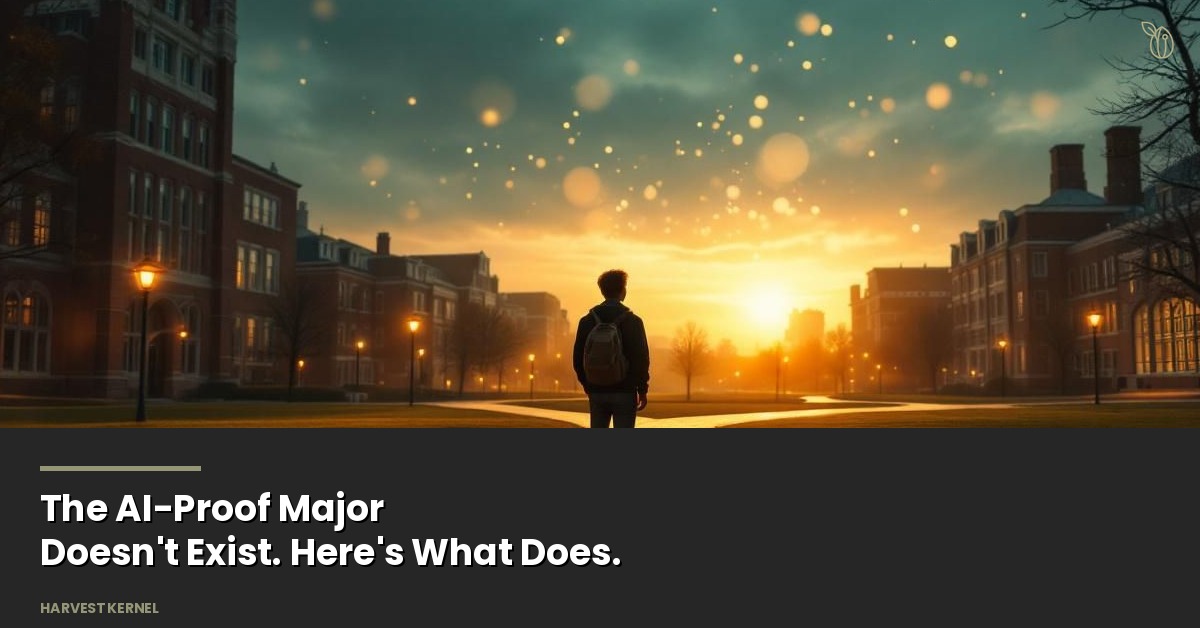
The AI-Proof Major Doesn’t Exist. Here’s What Does.
Josephine Timperman declared business analytics as her major, figuring statistical analysis and data skills would give her a competitive edge after graduation. Then AI arrived. The same skills she was learning to differentiate herself could now be automated by tools any employer could access for a fraction of the cost.
So she switched to marketing. Her logic? Build the skills AI can’t replicate: critical thinking, interpersonal communication, relationship-building.
Timperman is not alone. She’s part of a national wave of college students scrambling to find what they’re calling “AI-proof” majors, degrees they hope will insulate them from displacement. According to an Institute of Politics poll at Harvard Kennedy School, 70% of college students now view AI as a direct threat to their job prospects. A recent Gallup poll of Generation Z found that 48% of Gen Z workers believe AI’s workforce risks outweigh its benefits.
This anxiety is real. But the response to it is dangerously wrong.
The Myth That’s Costing Students Their Careers
Here’s the problem nobody wants to say out loud: there is no AI-proof major. Not marketing. Not nursing. Not studio art. Not computer science. The students who are switching majors to avoid AI are solving the wrong problem. They’re building walls when they should be building fluency.
Courtney Brown, a vice president at education nonprofit Lumina, put it bluntly at a recent higher education panel: “Students are having to navigate this on their own, without a GPS.” And when students asked professors, advisors, and parents for guidance? Nobody had answers. Even Brown University President Christina Paxson admitted at a Stanford panel, “None of us know” which skills will be most valuable in 10, 20, or 30 years.
But we do know one thing with certainty. The data is not ambiguous. The divide that’s forming in the workforce is not between “safe” and “unsafe” majors. It’s between people who build AI fluency and people who don’t.
The Real Divide: Fluency vs. Avoidance
The 2026 Stanford AI Index documented something that should alarm every student, parent, and educator: four out of five U.S. high school and college students are already using AI for schoolwork. But only half of middle and high schools even have AI policies, and just 6% of teachers say those policies are clear. Students are using tools nobody has taught them how to use well.
That pattern repeats in the workforce. DataCamp’s 2026 State of AI Literacy Report surveyed 500+ enterprise leaders and found that 59% report an AI skills gap in their organization, despite the fact that most are already investing in some form of AI training. The gap isn’t from lack of access to AI. It’s from lack of applied fluency. Leaders identified the biggest capability breakdowns not in engineering or programming, but in foundational areas like evaluating whether AI outputs are accurate, knowing when to use AI versus human judgment, and integrating AI into existing workflows.
Meanwhile, Anthropic’s fifth economic impact report found that early AI adopters are pulling dramatically ahead of newcomers. They use AI as a thought partner for iteration and feedback, not just a search replacement. They get significantly more value from the same tools. The divide is widening, and it has nothing to do with what anyone majored in.
Like what you’re reading? Get insights like this delivered to your inbox every week.
What Actually Protects Careers (The Fluency Advantage)
The numbers tell a clear story about where the real career protection lives. PwC’s 2025 Global AI Jobs Barometer found that workers with AI skills command a 56% wage premium over comparable peers. That’s not a marginal difference. That’s a different salary class for doing fundamentally the same work, with one addition: knowing how to work alongside AI.
The World Economic Forum projects a net increase of 78 million jobs globally by 2030. Not a decrease. A net increase. But the skills required for those roles will be fundamentally different from today’s. IDC estimates that sustained AI skills gaps are costing the global economy $5.5 trillion in unrealized productivity. Organizations with structured AI upskilling programs are nearly twice as likely to see significant return on their AI investments.
This isn’t abstract. Ben Aybar, a 22-year-old computer science graduate from the University of Chicago, applied for 50 jobs in software engineering and didn’t get a single interview. He pivoted to AI consulting instead. His insight captures the shift perfectly: “People who know how to use AI will be very valuable. Being able to talk to people and interact with people in a very human way is more valuable than ever.”
Aybar didn’t change his major. He added a skill layer on top of it. That’s the difference between running from AI and running with it.
The SeedStacking Response: Small Skills, Compounding Returns
The students switching to studio art because “if I’m going to be unemployed, I might as well do something I love” are responding to real fear with the wrong strategy. The fear is valid. The labor market is uncertain. Entry-level jobs are being compressed. But treating AI as an unavoidable threat rather than a learnable skill is the single most career-limiting decision a student can make right now.
This is exactly why AI fluency needs to be treated as a daily practice, not a one-time course. The SeedStacking approach breaks AI literacy into small, daily skills that compound over time, the same way financial literacy or physical fitness works. You don’t become AI-fluent by taking one semester-long class. You become fluent by using AI intentionally every day, evaluating its outputs critically, and building your own judgment about when it helps and when it doesn’t.
An Anthropic cofounder recently advised young people that the most valuable skill isn’t knowing how to build AI. It’s knowing how to think clearly about complex problems while working alongside it. That’s not a technical credential. It’s a practice.
What Students (and Everyone Else) Should Actually Do
Stop searching for the AI-proof major. Start building the AI-fluent career, regardless of what you’re studying. The research is consistent: the people who thrive alongside AI aren’t the ones with specific degrees. They’re the ones with three compounding advantages.
First, they develop applied AI fluency by using AI tools in their actual work, not just experimenting with them casually. The Anthropic research showed that power users don’t just use AI more. They use it differently, as a collaborative thinking partner rather than a glorified search engine.
Second, they strengthen distinctly human capabilities. Critical thinking, communication, relationship-building, ethical reasoning. These aren’t soft skills. They’re the skills that make AI outputs useful instead of generic. Timperman’s instinct to build interpersonal skills was right. Her mistake was thinking she had to abandon analytics to do it.
Third, they treat AI learning as ongoing, not terminal. The DataCamp findings are clear: 82% of organizations offer some AI training, but only 35% have mature, organization-wide programs. The people who keep building AI skills consistently, even 15 minutes a day, pull ahead of everyone who took one workshop and stopped.
56%
Wage premium commanded by workers with AI skills over comparable peers without them (PwC 2025 AI Jobs Barometer)
The Career Your Major Can’t Guarantee (But Your Habits Can)
The uncomfortable truth behind the “AI-proof major” panic is that no degree has ever been a guarantee of employment. What has always mattered is the ability to learn faster than your environment changes. AI just made the speed of change visible in a way that a generation of students can feel in real time.
That visibility is a gift, not a curse. Students who see AI as a threat to prepare for rather than a wave to avoid are already positioning themselves better than their panicking peers. The skills gap isn’t between majors. It’s between mindsets.
So whether you’re studying business analytics, studio art, nursing, or computer science, the question isn’t “Is my major safe?” The question is “Am I building AI fluency into my daily practice?” Because five years from now, nobody will care what you majored in. They’ll care whether you know how to work with the tools that define your industry.
And that’s something you can start building today.
Ready to go beyond reading and start building AI fluency?
The Harvest Kernel community is where educators, professionals, and lifelong learners build real AI skills together. Free courses. Daily practice. Expert guidance. No gatekeeping.