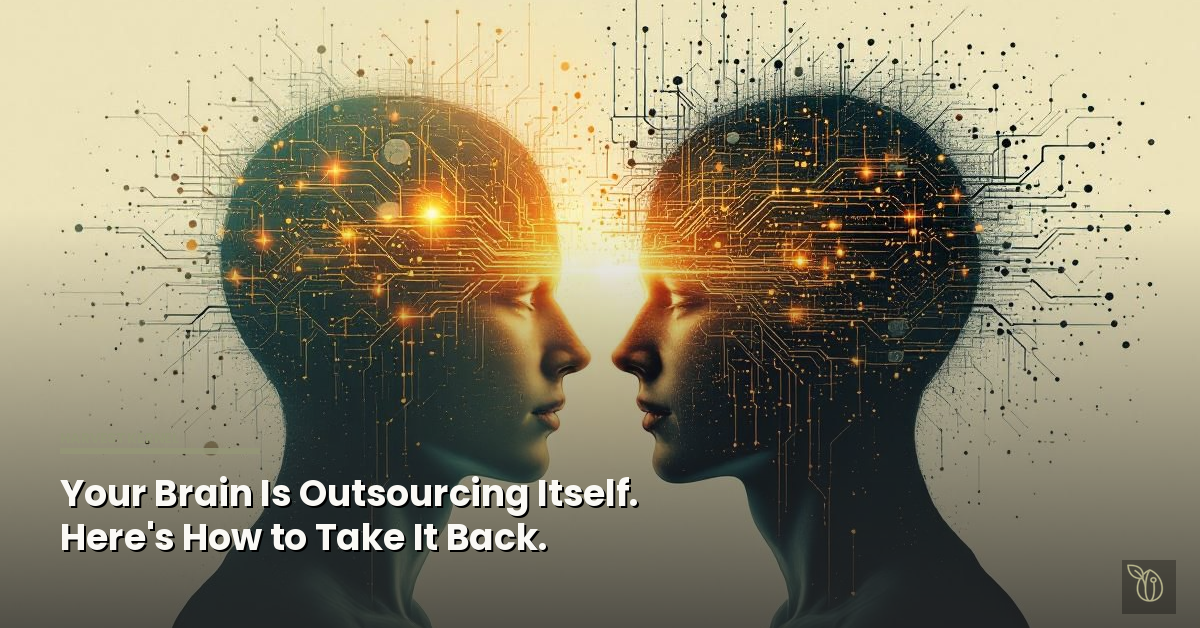
Your Brain Is Outsourcing Itself. Here’s How to Take It Back.
Here is a question nobody is asking loudly enough: what happens to your brain when you stop making it work?
Not in some abstract, philosophical sense. In a measurable, observable, happening-right-now sense. Researchers at the University of Pennsylvania just coined a term for it. They call it cognitive surrender. And if you use AI regularly, you have almost certainly done it without realizing.
Time Magazine published a deep investigation this week into how AI is reshaping human cognition. The findings should concern anyone who teaches, learns, or builds skills for a living. The core insight is this: AI is no longer just a tool that helps you think. It is becoming a tool that thinks instead of you. And the difference between those two modes determines whether AI makes you smarter or quietly makes you weaker.
The Moment You Stop Thinking for Yourself
Cognitive offloading is not new. You have been doing it your entire life. You write notes so you do not have to memorize everything. You use a calculator so you do not have to do long division in your head. You check a map so you do not have to remember every turn. These are healthy extensions of your cognition. They free up mental bandwidth for harder problems.
But something changed. Evan Risko, a cognitive scientist at the University of Waterloo who studies offloading, told Time that AI has crossed a threshold previous tools never reached. It is not just handling discrete tasks anymore. It is handling the thinking itself. Summarizing. Analyzing. Generating ideas. Making decisions. As Risko describes it, AI is creeping into the cognitive territory we thought was uniquely ours.
The Penn researchers drew a sharp line. Offloading is when you use external tools but retain agency over the outcome. Surrender is when you accept the output without scrutiny. When you paste an AI response into an email without reading it critically. When you let it decide what matters in a document. When you accept its framing of a problem without asking whether the framing is right.
Steve Shaw, who co-authored the Penn paper, put it bluntly: for structured tasks with clear right answers, AI is often the better choice. But for decisions that have no objective answer, decisions that define who you are and what you value, outsourcing them to a machine is not efficiency. It is erosion.
912
students across 3 continents in a 2026 study showing how AI partnership orientation predicts deeper learning
The Paradox That Changes Everything
If this were a simple story about AI making people dumber, the solution would be obvious: use less AI. But the research says something far more interesting.
Wang and Zhang published a study in 2026 that surveyed 912 students across China, Europe, and the United States. They expected to find that students who offloaded more thinking to AI would learn less. That is the intuitive prediction. Instead, they found a paradox.
Students who treated AI as a partner rather than a tool activated two cognitive pathways simultaneously. They became more critical of AI outputs AND they delegated more strategically. Both pathways independently predicted deeper learning. The students who offloaded the most also questioned the most. And the combination produced the strongest learning outcomes of any group in the study.
Read that again. The students who used AI the most effectively were not the ones who used it least. They were the ones who used it with intention.
Like what you’re reading? Get insights like this delivered to your inbox.
Why “Use AI Less” Is the Wrong Answer
Most of the public conversation around AI and cognition lands on a predictable conclusion: we need to unplug, go analog, rediscover the beauty of hard thinking. And while there is value in cognitive friction (the struggle of working through a hard problem is where deep learning happens), the research does not actually support a retreat from AI. It supports a different relationship with AI.
The distinction matters enormously for educators, professionals, and anyone building skills right now. The researchers found that scattered, small AI assists produce the worst outcomes. A little help here, a quick answer there, a summary when you are feeling lazy. That pattern creates the maximum cognitive cost: you still carry the full mental load of the task, but you lose the learning that comes from completing it yourself.
The best outcomes came from deliberate, complete delegation of specific categories of work, combined with deep personal engagement on the thinking that matters. In other words, you do not use AI for everything a little bit. You use it for specific things completely, and you do the rest yourself, thoroughly.
This is not a minor distinction. It is the difference between an AI habit that builds your capacity and one that quietly erodes it.
The SeedStacking Framework Already Solves This
When I designed the SeedStacking methodology, I did not have the term “cognitive surrender” in my vocabulary. But the framework was built to prevent exactly what the researchers describe.
SeedStacking works in four phases: Seed, Sprout, Grow, Harvest. Each phase deliberately structures the relationship between the learner and the tool. In the Seed phase, you learn what AI is and what it can do. You are building foundational knowledge that cannot be outsourced. In Sprout, you begin experimenting with AI under guided conditions, developing the metacognitive awareness the researchers say is the single most important skill in this era. By Grow, you are integrating AI into real workflows with critical evaluation built into every step. And in Harvest, you are teaching others, which is the ultimate proof that you own the knowledge rather than renting it from a machine.
The Wang and Zhang study validated this progression without knowing it existed. Their finding that partnership orientation predicts both increased delegation AND increased critical evaluation is the Grow phase in action. The students who learned the most were doing what SeedStacking teaches: using AI deliberately, evaluating its outputs critically, and building their own expertise in the process.
THE SEED
Cognitive surrender happens when you let AI think instead of thinking with it. The research is clear: the learners who build the deepest skills are the ones who use AI the most deliberately, not the ones who avoid it. The question is not whether to use AI. It is whether you are building a partnership or creating a dependency.
Three Things You Can Do This Week
If you are an educator, a professional, or anyone who uses AI regularly, here is what the research suggests you do right now.
First, audit your surrender points. For one day, notice every time you accept an AI output without evaluating it. Every email you paste without editing. Every summary you trust without reading the source. Every recommendation you follow without questioning. These are your surrender points. You cannot fix what you do not see.
Second, categorize your AI use. Separate your tasks into two buckets: tasks where AI should do the work completely (scheduling, formatting, data lookups) and tasks where you should do the thinking with AI as a sounding board (writing, analysis, decision-making, creative work). Stop using AI for a little bit of everything. Start using it deliberately for specific categories.
Third, practice verification as a skill. The Wang and Zhang study found that critical evaluation of AI outputs was the single strongest predictor of deep learning. This is not about being suspicious of AI. It is about treating every AI output the same way you would treat advice from a smart colleague: valuable, but worth pressure-testing before you act on it.
The researchers are right that we are at a turning point. AI is already more capable than most humans at many cognitive tasks, and the gap is widening. But capability is not the same as wisdom. The tools will keep getting smarter. The question is whether you will too.
Ready to go beyond reading and start building AI fluency?
The Harvest Kernel community is where educators, professionals, and lifelong learners build AI skills together. Free courses. Daily discussion. A methodology that turns curiosity into competence.