The College Conveyor Belt Won’t Save You From AI
The Career Playbook Just Got Rewritten
For decades, the formula was simple. Study hard. Get into a good school. Land a stable corporate job. Climb the ladder. Retire with a pension or a 401(k) and a gold watch.
That formula is breaking — and the people who followed it most faithfully are now the most exposed.
Venture capitalist Bill Gurley, the Benchmark Capital general partner behind early investments in Uber and Zillow, recently appeared on the On with Kara Swisher podcast with a warning that should stop every working professional in their tracks. The workers most vulnerable to AI disruption aren’t the ones who took risks. They’re the ones who played it safe.
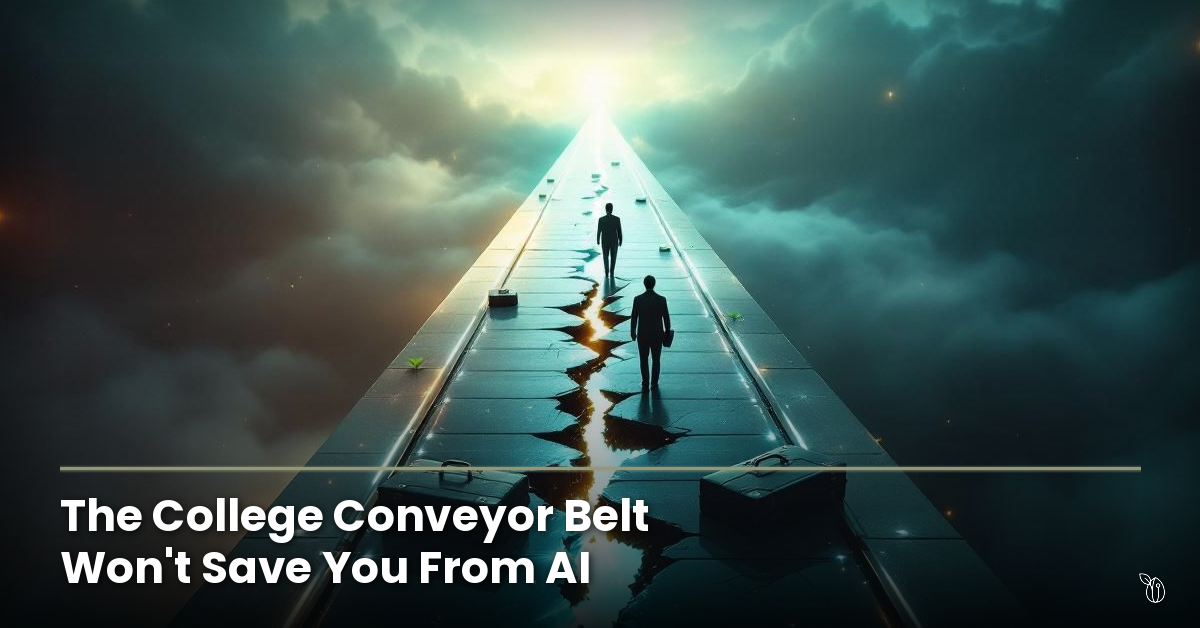
Gurley calls it the “college conveyor belt” — the system that programs young people from childhood to optimize for credentials, prestige, and safety rather than passion, purpose, and adaptability. And he believes that system is now producing the exact kind of worker AI replaces first.
Feeling like the ground is shifting under your career? Join the Harvest Kernel Learning Community — where professionals build AI literacy together, one day at a time.
The Conveyor Belt Trap: Why Safe Isn’t Safe Anymore
Here’s the uncomfortable truth most career advice still ignores: the “safe” path — the one your parents and counselors and LinkedIn influencers recommended — was designed for an economy that no longer exists.
Gurley put it bluntly: the people most at risk are the ones sitting idle in roles they don’t care about, coasting on the credential that got them in the door. He described a generation of professionals who were funneled through a pressure cooker of resume optimization, early major declarations, and career-path anxiety — and came out the other side working jobs they never actually wanted.
Now, you might be thinking: But I went to a good school. I have ten years of experience. Surely that counts for something?
It does — but not the way it used to. Experience in a role you’re disengaged from doesn’t compound the way experience in a role you love does. And AI doesn’t care about your diploma. It cares about whether it can do your tasks faster, cheaper, and more consistently than you can. If the answer is yes and you’re not actively evolving, you’re in the crosshairs.
The people that are most at risk are the ones sitting idly in the job and don’t really have a why or a purpose for it.
— Bill Gurley, Benchmark Capital
This isn’t fear-mongering. This is pattern recognition from someone who has spent three decades identifying which companies — and which workers — survive disruption. The pattern is clear: adaptability beats credentials every single time.
Passion Isn’t a Luxury — It’s Career Insurance
Most articles about AI and jobs stop at the problem. Here’s where Gurley’s argument gets genuinely useful — and where it maps directly onto what we teach at Harvest Kernel.
Gurley makes a counterintuitive case: the workers most likely to survive AI disruption aren’t necessarily the most technically skilled. They’re the most passionate. Because when you love what you do, skill development isn’t a chore you schedule — it’s something that happens naturally, constantly, almost involuntarily.
He calls this the “free honing” advantage. For people who care deeply about their work, improvement is effortless. They read about their field on weekends. They experiment with new tools because they’re curious, not because their manager told them to. They develop judgment that can’t be automated because they’ve spent years deeply engaged with the nuances of their craft.
LinkedIn CEO Ryan Roslansky reinforced the same idea: the future of work belongs to people who are adaptable, forward-thinking, and ready to embrace new tools — not the people with the fanciest degrees. Stanford’s Fei-Fei Li, widely known as the “Godmother of AI,” says tech-savviness now matters more than any other credential.
This isn’t about abandoning your career. It’s about reigniting your relationship with it. The question isn’t “Will AI take my job?” The question is: “Am I building the kind of capability that AI amplifies instead of replaces?”
That’s exactly what SeedStacking is designed for. Small daily AI wins that compound into genuine fluency — no overwhelm, no jargon, just one stack at a time.
AI as Jet Fuel — But Only If You’re Already Moving
Gurley offered one more piece of advice that deserves its own spotlight. For workers who can’t change industries or go solo, he said: become the most AI-aware person in your job.
He compared AI to “jet fuel” — a capability multiplier that rewards people who are already in motion. If you’re curious, engaged, and building skills, AI turbocharges your output. You can learn faster, produce more, and solve problems that would have taken a team of five a decade ago. That makes you the last person your employer wants to lose.
But jet fuel in a parked car just evaporates. If you’re coasting, disengaged, doing the minimum — AI doesn’t amplify you. It replaces you. That’s the K-shaped reality we’ve been documenting at Harvest Kernel: AI is simultaneously the greatest career accelerant and the greatest career threat, depending entirely on how you engage with it.
The critical skill isn’t learning one specific AI tool. It’s developing the habit of learning — the daily practice of experimenting, adapting, and growing that we call SeedStacking. One tool will be obsolete in six months. The habit of learning never will.
The SeedStacking Advantage
SeedStacking isn’t about mastering every AI tool overnight. It’s about building a daily practice — 15 to 20 minutes — where you experiment with one AI capability, reflect on what worked, and stack that knowledge onto yesterday’s. Over weeks and months, these small wins compound into the kind of genuine fluency that no credential can replicate and no AI can replace. The workers Gurley describes as “ripe for disruption” are the ones who stopped stacking years ago. The ones who’ll thrive are the ones who start today.
Start your first SeedStack today — free, no credit card, no jargon. Join the Harvest Kernel Learning Community
What This Means for You — Right Now
Let’s get concrete. Whether you’re a mid-career professional worried about the next round of layoffs, an educator preparing students for a workforce that’s changing faster than the curriculum, or a parent wondering what skills actually matter for your kid’s future — Gurley’s warning applies to all of us.
Here’s the honest truth: nobody is coming to rescue the workforce. Gurley himself is skeptical that government regulation or large-scale retraining programs will move fast enough. The national AI training gap is real, and the institutions designed to close it are still figuring out what AI literacy even means.
That means the responsibility falls on you. Not to become an AI engineer. Not to learn to code. But to become the kind of learner who doesn’t freeze when the tools change — because the tools will keep changing, and the pace will only accelerate.
The college conveyor belt promised certainty. AI delivered uncertainty. The people who thrive in uncertainty aren’t the ones with the best resumes. They’re the ones with the best learning habits.
The Article Gives You the What. The Community Gives You the How.
Join thousands of educators, professionals, and lifelong learners building genuine AI literacy through the SeedStacking methodology. Free account. No credit card. No overwhelm. Just one stack at a time.
Sources
1 Gurley, B. (2026). Interview on On with Kara Swisher podcast. Via Fortune, March 3, 2026.
2 McKinsey & Company (2025). “The State of AI in 2025.” McKinsey Global Survey.
3 Roslansky, R. (2025). Fireside chat at LinkedIn San Francisco office. Via Fortune.
4 Li, F.-F. (2025). Stanford AI researcher and CEO of World Labs. Via Fortune.
5 Miessler, D. (2026). “The Great Transition.” Unsupervised Learning. Via Fortune, March 5, 2026.