


A PNAS study out last week found that grant proposals written with heavier AI involvement were not worse. They were less distinctive. They sat closer to what the agency had already funded.
The model was not failing. Hand it a topic and nothing else and it returns the center of everything already written. In a system trained on public award abstracts, that center is literally what already got funded.
Which puts the whole thing back on what you put in the box first.
So here is today's question, and it takes one sentence to answer.
What is the one thing your lab, your classroom or your caseload has seen that has never been written down anywhere?
That is the sentence a model cannot give you, because it is not in the training data yet. It is also the first box in today's free session: https://www.harvestkernel.com/twenty-minutes-before-you-prompt/
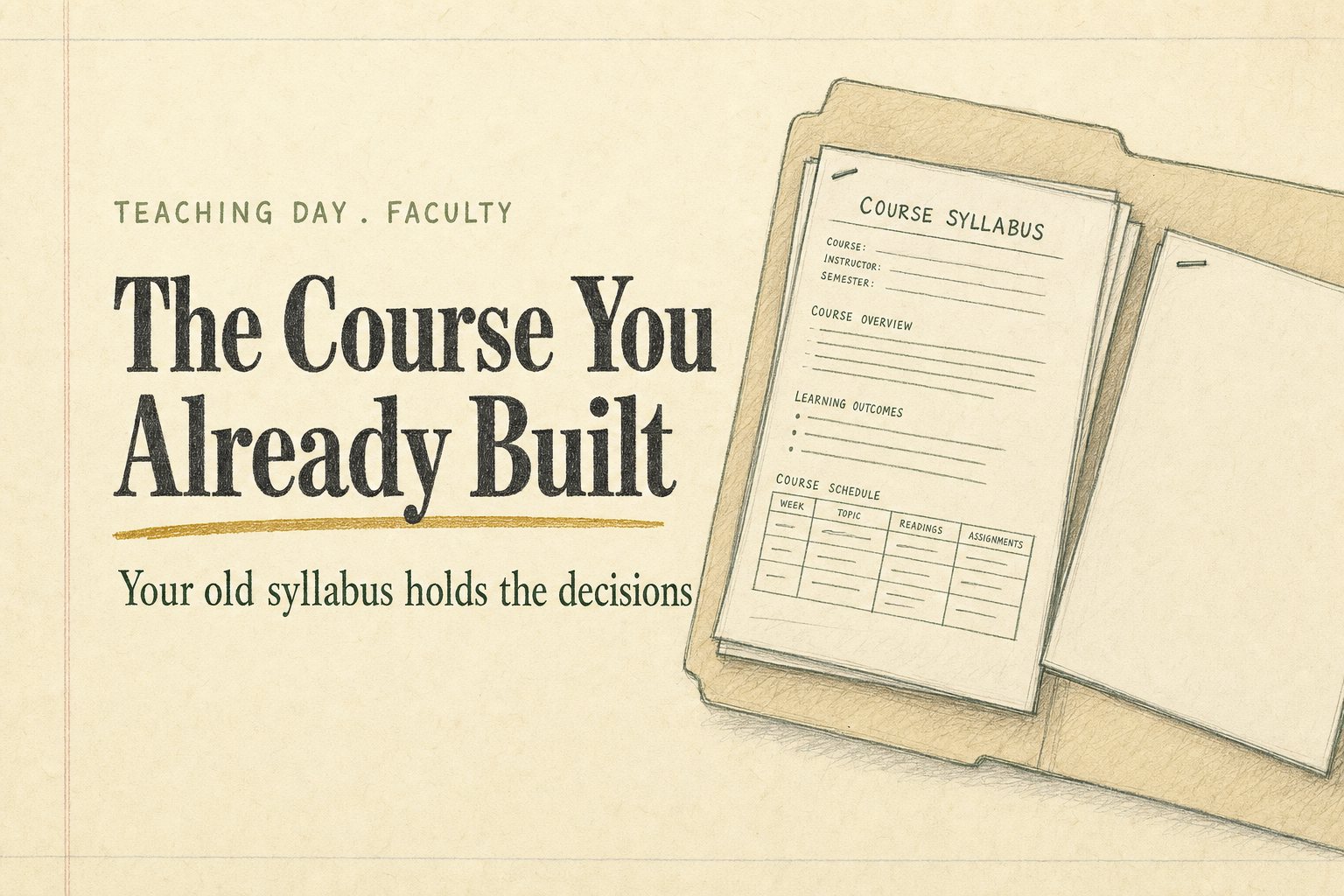
Teaching Day, faculty. The Course You Already Built.
Your shell is open and empty. The section you taught last spring is in a folder called FINAL FINAL v3. You hit copy, the dates came over, and none of the sense did.
Here is the part almost nobody does. Open that old syllabus and read it as evidence instead of as a document. The unit order is a decision. The late policy is a decision. Requiring a draft before the final paper is a decision, and it exists because of one semester where you did not.
Write those decisions on one page and you have a Course Record. Paste it in front of any tool before you ask for anything, and the output stops sounding like a stranger wrote it.
Today's free working session builds one, by hand, in about twenty minutes: Build Your Course Record By Hand
One question, and it takes one sentence to answer.
What is the one thing in your course you never let slide, and where is it written down right now?
That second half is the whole point. Most of us have an answer to the first part and no answer at all to the second.
Waterloo just built an AI certificate where students learn to diagnose the organizational bottleneck before anyone picks a tool. The professor running it said AI adoption is not the point, but solving problems is.
Most campus AI work does the reverse. A tool arrives, a committee forms, a policy gets written, and nobody names the thing that is actually broken.
So let us do the harder version here.
In the course you are teaching this term, what is the one place where the most of your time goes or the most students stall? One sentence. No solution, just the name of it.
I will go first in the replies.
Two studies, opposite ends of the academy, same shape. Undergraduate A grades up thirteen points without matching learning gains. Federal grant proposals with heavier AI involvement funded more often at NIH, and measurably less distinctive.
Nobody in the grant study cheated. Using a model to draft a proposal is normal and often encouraged. The distinctiveness still dropped.
Which means the thing to change is not the policy. It is what the rubric rewards.
Today's question, and it takes one sentence to answer:
What is the one thing on your rubric that a student could only write if they had actually been in your room this term?
Full argument here: the post. The twenty minute working session: The Distinctiveness Criterion.
Today's teaching session is for students, and it lands on the one week nobody schedules: orientation.
Registration gave them class times. It did not give them a week. That gap, between having four class times in an email and knowing what Monday morning actually looks like, is where the first month of college quietly goes.
The session names one thing and asks them to protect it. The wreck hour. One hour, placed on purpose, that carries the reading for the class that meets when they are worst. Protect it and it carries them. Leave it unassigned and it is the hour that comes apart around week six.
The free working session is live: Your Wreck Hour, A First Week Map. Twenty minutes, done by hand, and they finish holding a written week they can follow Monday morning.
Faculty, this one is worth forwarding. It is not a study skills lecture. It is twenty minutes of your students doing the thing you wish they had done in August.
One question, and I want a specific answer. Open your schedule, or think about the schedules your students carry. Find the gap, the space between two classes that are not back to back. What is your biggest one, and what usually happens to it? One sentence. I read every reply.
Anthropic switched on watermarking for Claude output this month. Its own documentation says a mark means the content may have been processed by Claude. Not that Claude wrote it. And the mark disappears if the text is paraphrased, translated, or mixed into other writing.
Which means the student who pastes an answer gets flagged and the student who runs it through a second tool does not.
I wrote up why the fix is a different request rather than a better detector: https://www.harvestkernel.com/claude-watermark-authorship-not-detection/
One question for you, and it takes one sentence to answer:
What is the single assignment in your course where you would have no idea whether the student actually did the thinking?
Name it. That is the one worth rebuilding first, and I will tell you exactly where I would start with it.
Teaching Day. Your syllabus is not a contract.
It is convocation week. Your syllabus is due to the department before a single student walks in, and you already know how the term goes from here: eleven pages, a grading table, and a week two inbox full of questions that were answered on page four the whole time.
We tell ourselves students do not read. Try the test before you accept that. Open your own syllabus on your phone, do not scroll, and count the words a student passes before they reach one sentence about what this course will make them able to do.
If that sentence is on page two, it was never a reading problem. It is a layout problem, and it takes about thirty minutes to fix without deleting one thing your department requires.
Today's free working session walks you through it on one real syllabus: The First Screen Rewrite. Thirteen questions, nothing saved to a server, and you finish holding a finished first screen you can paste into the file you are submitting this week.
One question, and it takes one sentence to answer: what is the very first line a student actually sees on your syllabus right now, before any scrolling? Paste it exactly as it reads. No editing it first.
94 percent of higher education staff used an AI tool for work last year. 46 percent could not name their institution's AI policy.
The usual read is that people are ignoring the rules. I think that is wrong. Almost half a workforce does not accidentally miss a policy. If half cannot find the rule, the rule is not written where the work happens.
One question, one sentence, and you do not need to have read anything to answer it:
Where would you look first if you wanted to know your institution's AI policy right now?
Question for anyone who teaches, and I want a specific answer.
This fall the first fully AI native students arrive. They never had the argument we are still having about whether AI belongs in school. They assumed it does.
So pick one assignment you already grade most weeks. One. Now tell me in one sentence what it is actually supposed to prove about the student who turns it in.
If an AI can already do that thing start to finish, you just found the assignment that needs rewriting before day one. I will go first in the replies.
Today's post has the two hour fix: https://www.harvestkernel.com/first-ai-native-class-week-one/
Today's question, and I want a specific answer, not a mood.
The singularity is the idea that machine intelligence eventually outruns ours so fast the world past it is unpredictable. Kurzweil dates it to 2045. Real researchers call it overheated hype. Nobody actually knows.
So forget the date. The question that matters whether or not it ever arrives is this:
Name one task you own where AI can now produce a fluent answer. Then tell me the last time that fluent answer was confidently wrong, and whether you caught it.
That second part is the whole thing. Not whether AI helps. Whether your judgment is sharp enough to catch it when it is wrong.
I will go first in the replies. Then look for today's kit, The Horizon Drill, in the SeedStacking Resources space.