


Quick one for today. When AI generated content is indistinguishable from human work, total cynicism and total trust fail the same way. Both outsource your judgment.
The middle path is discernment, a thirty second check sized to the stakes. Who is the source. What is the original. What would this look like if it were fabricated.
Try it once today on something you almost shared without thinking. What did you find?
Here is a five minute experiment for today. Open whichever AI you use most, find the memory or personalization settings, and read the summary of what it believes about you.
Most people who do this for the first time get surprised twice. Once by how much the tool picked up without being told, and once by what it got slightly wrong. An old job. A project you finished months ago. A preference you mentioned one time in passing that it treats as gospel.
With OpenAI shipping its new Dreaming memory system this week, that hidden profile is about to start steering more of your answers than ever.
So here is the question: what is the most surprising, outdated, or flat-out wrong thing your AI remembered about you? And did you correct it or leave it?
I wrote up the full habit here if you want the playbook: https://www.harvestkernel.com/chatgpt-dreaming-memory-upgrade-memory-hygiene/
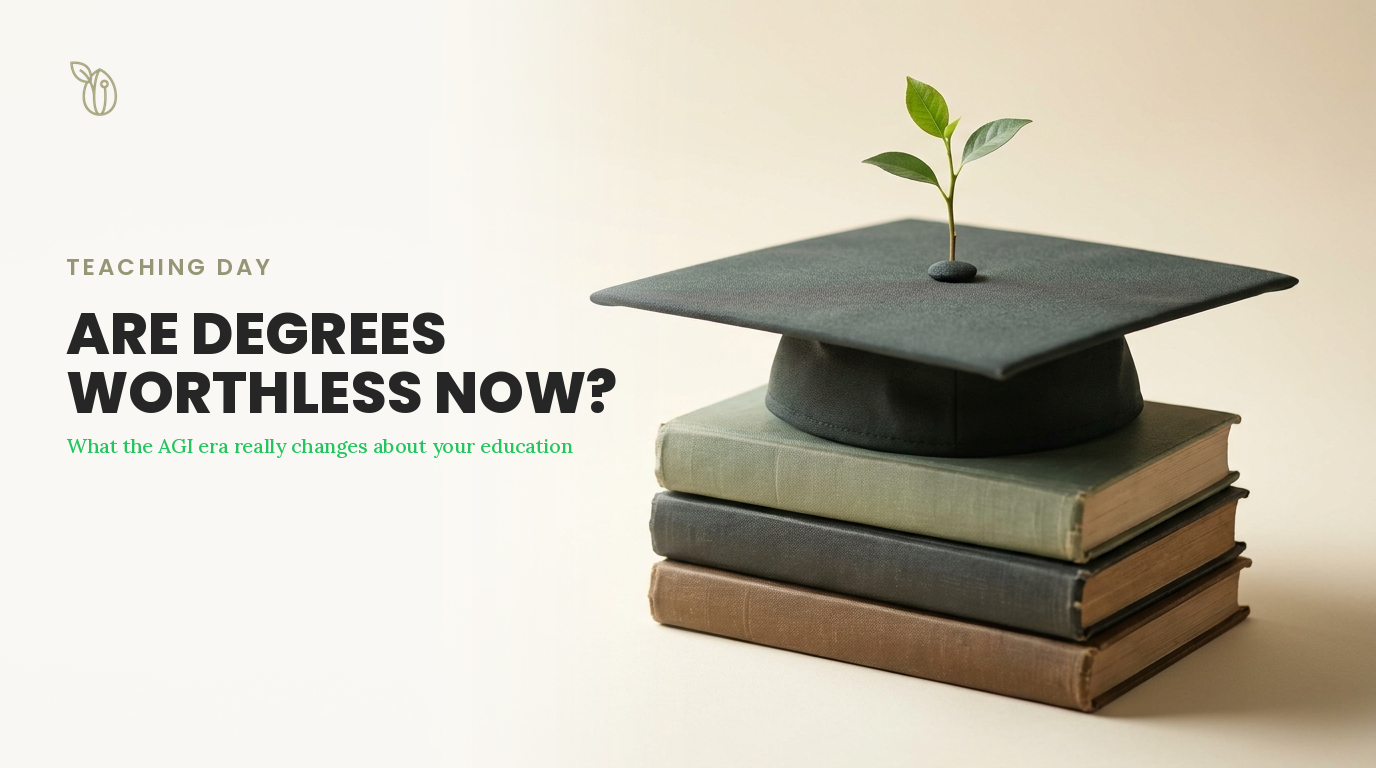
Today's teaching topic is the question I hear most from students and parents right now: as we approach AGI, are degrees becoming worthless?
Here's the short version of what the data says. The college wage premium is real but frozen. The NY Fed still tracks a 30 thousand dollar annual gap between college grads and high school grads, yet Harvard economists found that premium has barely moved since 2000. Meanwhile the World Economic Forum reports AI skills now command a 23 percent wage premium, almost triple the 8 percent for a bachelor's degree alone. And the Dallas Fed found AI is cutting entry level hiring while raising wages for experienced workers in the same fields.
My read: a degree was never the harvest. It was always the seed. The move is not to skip the credential or to hide behind it. It's to stack a visible, verifiable AI skill on top of it and show your work in public. I'm calling it the Degree Stack.
So here's my question for you. If you could stack ONE visible AI skill on top of your existing credentials this month, what would it be, and what's stopping you?
I built a free Degree Stack Audit worksheet to walk you through it. Grab it in the SeedStacking Resources space or the Resources library.
Quick question for the room, because a study out this week put numbers on something I think about a lot.
Researchers followed university faculty through a short, self-paced AI training and measured what changed. The interesting part was not that they used AI more afterward. It was that they got more confident and more skeptical at the same time. They trusted the tool more AND verified it more.
That combination is rare. Most people I meet are stuck on one side. They either avoid AI entirely, or they paste its output in without reading it. The middle, using it boldly while checking it honestly, seems to only come from actually practicing, not from being told the rules.
So here is what I am curious about. When you first started using AI for real work, what was the moment that taught you to trust it less, or more? Was there a specific time it burned you, or a time it genuinely surprised you?
Drop it below. I read every one, and the patterns in these stories are usually better than any study. If you want the backstory, it is in today's post: https://www.harvestkernel.com/faculty-ai-literacy-micro-credential-sdsu-study/
Here is a number worth sitting with: across a normal week, only about a quarter of a teacher's working hours are actually spent teaching. The rest goes to email, grading, forms, and the administrative tide that rises a little every semester.
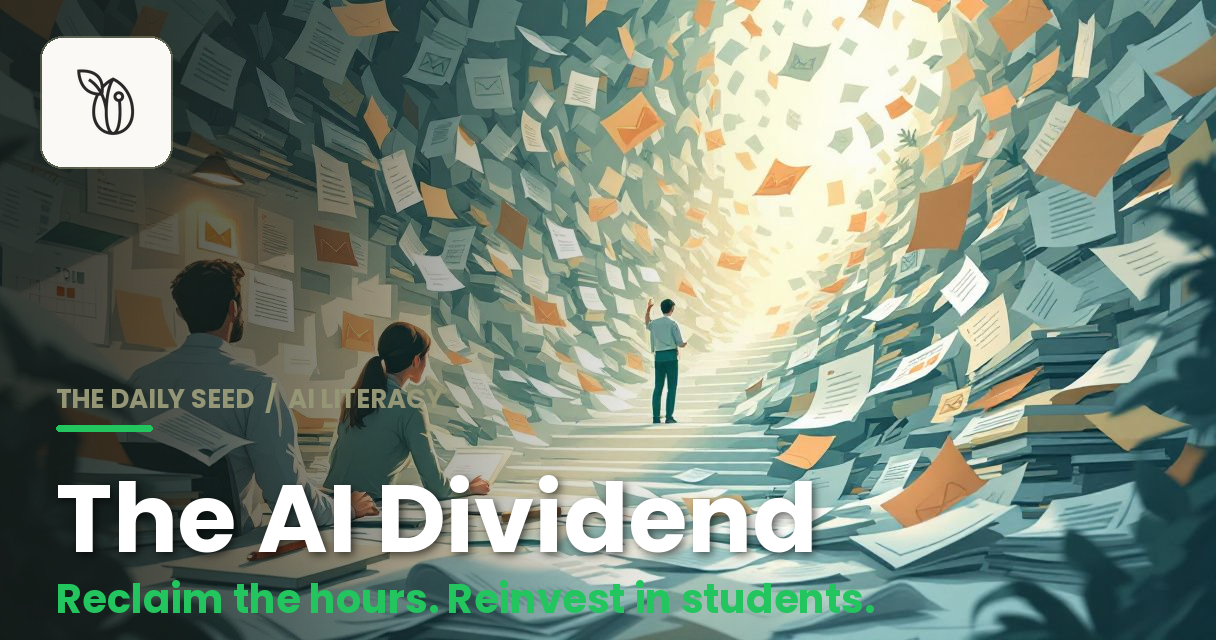
The hopeful part is now measurable. A 2025 Gallup and Walton Family Foundation study found teachers who use AI weekly reclaim 5.9 hours a week, which adds up to six full weeks across a school year. They named it the AI dividend.
But here is the SeedStacking truth: saving the time is not the win. Reinvesting it is. If those six hours just get swallowed by more busywork, nothing changes for the student in front of you.
The dividend reinvestment rule, in three steps:
1. Audit one week. Notice where the hours actually go.
2. Automate the bottom third, the repeatable paperwork, never the human moments.
3. Pre-assign the time to a student before you save it.
So my question for you: if AI handed you back six hours next week, what is the first student-facing thing you would spend them on? Drop it in the comments. I read every one.
The biggest teachers union in the country just asked schools to keep AI out of elementary classrooms. No student facing AI before middle school, no companion chatbots under sixteen, and supervised use after that. Their words: they are not calling for a Chromebook bonfire, they want to get the balance right.
Here is the real question underneath it. AI literacy is developmental. When and how should a learner first meet AI, not simply whether.
Where do you land? Keep the youngest kids AI free while we build literacy as they mature, or does a blanket elementary ban risk widening the gap for schools that cannot staff the human alternative? Educators and parents here, I want to hear your read.
Quick one for today, and I want your honest take.
We keep hearing that AI is going to democratize education. Free tutor in every pocket, available at 2 AM, for any learner anywhere. And the access part is genuinely real. That floor matters.
But here is what I keep running into. Access to a tool has never been the same thing as the ability to use it well.
Give two people the exact same AI. One says "do this for me." The other says "push back on my weakest point, but do not do it for me." Same tool. Two completely different outcomes. A year later they are not in the same place, and it has nothing to do with who could afford what.
So a tool that rewards skill does not automatically close a gap. It can actually widen it. The fix is not more access. It is the literacy to use what we already have. And that is teachable to anyone.
Here is my question for you: the first time you used AI for something that mattered, did you ask it to do the work for you, or to help you do the work better? Be honest. I will go first in the comments.
Today's question, and I genuinely want your answers.
New workforce data shows the people getting ahead aren't just the ones who know the AI tools. They're the ones who pair fluency with judgment, knowing which AI output to trust and when a confident answer is wrong.
So: think of the last time AI gave you an answer that looked right but wasn't. How did you catch it? That moment, that catch, is the judgment skill we're all building. Share one below.
A former Google CEO got booed at a commencement this month the moment he pivoted to AI. He was actually the third speaker booed for praising AI in the same month, across three different campuses.
The headline take is that graduates are scared of AI. I do not buy it. These graduates are deeply fluent in technology. What they rejected was not the tools. It was the pitch: disruption is inevitable, so embrace it, and never mind how you feel about it. Inevitability with no empathy.
Here is the SeedStacking read. Skepticism is a healthy instinct. But skepticism on its own just leaves you anxious on the sidelines. The real answer is skepticism plus skill: enough hands-on fluency that you can check the claims yourself instead of choosing between hype and fear.
I also built you something for this. The AI Hype Detector is a new four-phase worksheet now live in the SeedStacking Resources space. It walks you from spotting the four moves every AI pitch makes all the way to building a one-page checklist you can keep and share. Find it in Resources.
So I am curious: when was the last time an AI claim impressed you, and did it come with an actual demo, or just a slogan? Drop it below. Let us build a running list of hype versus substance.
Your school can have a finished AI policy and an untrained faculty at the same time.
Most schools now have an AI policy. Far fewer have a faculty that can actually use AI well. The data is blunt: around 85 percent of teachers used AI last year, but fewer than half got any training or guidance.
Here is the discussion question. Think about your own school, district, or workplace. What is the honest distance right now between what your AI policy says people should do and what your people can actually do well? And what would the first genuinely useful Seed be for the educators around you?
Today's post goes deeper: Your AI Policy Is Not AI Literacy