The K-Shaped AI Economy Is Here — Which Side Are You On?
Here’s a number that should stop you mid-scroll: workers with AI skills now earn a 56% wage premium over colleagues in the exact same role who lack those skills. That premium was 25% just one year earlier. It doubled in twelve months.1
Same job title. Same company. Same desk. Wildly different paycheck.
That’s the K-shaped AI economy in a single data point. And if you haven’t heard the term yet, you’re about to hear it everywhere — because it describes the single most important economic shift happening right now, and it affects educators, business owners, and every person trying to build a meaningful career in the age of AI.
Feeling the urgency but not sure where to start? You’re not alone. Harvest Kernel was built for exactly this moment.
What the K-Shape Actually Means
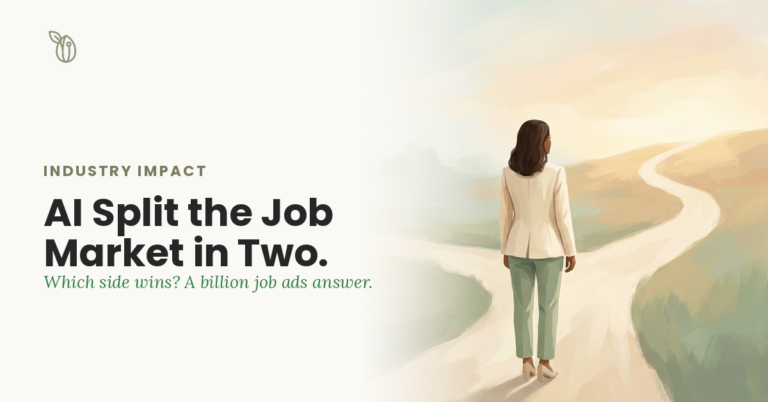
The “K-shaped economy” isn’t new. Economists have used the term since the pandemic to describe a recovery where one group rises while another falls — the two arms of the letter K diverging from the same starting point.2
But in 2026, the K has a new engine: artificial intelligence. The divide is no longer just between wealthy and working-class households. It’s between people and organizations that have integrated AI into how they work, learn, and create value — and those that haven’t.
The data is stark. PwC’s 2025 Global AI Jobs Barometer, built from analysis of nearly a billion job postings across six continents, found that industries most exposed to AI are generating three times the revenue growth per employee compared to industries with the least AI exposure — 27% versus 9%.1 Productivity growth in AI-exposed industries has nearly quadrupled since 2022, while productivity in less-exposed industries actually declined.1
Revenue growth per employee in AI-exposed industries compared to those least exposed to AI. The gap has widened every year since 2022.1
Meanwhile, the broader K-shaped economy continues to squeeze everyday budgets. Consumer prices have risen approximately 25% since 2020, with food prices up 29% over the same period.3 Moody’s Analytics reports that the top 20% of income earners now account for 59% of all consumer spending — a record concentration.4
This isn’t abstract macroeconomics. It’s the reason your grocery bill feels heavier while headlines celebrate GDP growth. Two economies are running simultaneously, and AI is becoming the sorting mechanism.
The Skills Gap Is the Real Divide
Here’s what makes the AI K-shape different from every previous economic split: it’s a skills gap, not just an income gap. And that means it’s something you can actually do something about.
The PwC data reveals that skills requirements in AI-exposed occupations are changing 66% faster than in non-exposed roles — up from 25% the year before.1 At the same time, employer demand for formal degrees is declining, particularly in AI-related jobs. The share of AI-augmented positions requiring a degree fell seven percentage points between 2019 and 2024.1
Read that again. Companies care less about your diploma and more about what you can actually do with AI. That’s a seismic shift — and it’s genuinely good news for anyone willing to learn.
“AI’s rapid advance is not just re-shaping industries, but fundamentally altering the workforce and the skills required. This is not a situation that employers can easily buy their way out of.”
— Peter Brown, Global Workforce Leader, PwC1
The Oxford Economics CEO put an even finer point on the timeline, noting that AI is unlikely to resolve the K-shaped economy anytime soon — and may in fact deepen the divide before any democratization occurs.5
This is exactly why SeedStacking™ exists. Small daily AI wins that compound into real fluency — no computer science degree required. Learn how it works →
Why This Matters for Educators, Business Owners, and Everyone In Between
The K-shaped AI economy doesn’t just affect tech workers. It reshapes every profession and every household.
If You’re an Educator
Your students are walking into a labor market where AI skills carry a 56% wage premium. If they graduate without basic AI literacy, they’re starting their careers on the declining side of the K. That’s not a theoretical risk — that’s the PwC data applied to every graduating class from here forward. Educators who understand AI aren’t just better teachers; they’re career protectors for the next generation.
If You’re a Business Owner
Companies in AI-exposed industries are growing revenue per employee three times faster. If your competitor adopts AI workflows and you don’t, the gap doesn’t stay flat — it compounds every quarter. The solopreneur who uses AI for content creation, customer analysis, and operational efficiency is doing the work of a five-person team. That’s not a productivity hack. That’s a new competitive reality.
If You’re a Lifelong Learner
The K-shape says the window for building AI skills is open but narrowing. The good news? Degree requirements are dropping. What employers want is demonstrated capability — and that’s something you can build in 30 minutes a day. Every tool you learn, every workflow you test, every prompt you refine moves you toward the rising arm of the K.
Wage premium for workers with AI skills compared to the same role without them. Up from 25% just one year earlier. The gap is accelerating.1
Cross to the Rising Side of the K
Harvest Kernel’s Learning Community gives you the structure to build AI literacy without the overwhelm. SeedStacking™ methodology means you start small and grow daily.
🌱 Daily AI education content — practical, not theoretical
🌱 Community of educators and professionals building together
🌱 SeedStacking™ methodology — 30 minutes a day changes everything
🌱 Free account, no credit card required
The 30-Minute Antidote
The K-shaped AI economy sounds intimidating. But here’s what the panic merchants won’t tell you: the door hasn’t closed.
Jobs requiring AI skills grew 7.5% year-over-year even as total job postings fell 11.3%.1 That means the demand for AI-literate workers is increasing while the overall labor market is tightening. If you’re building skills right now, you’re moving against a favorable current.
At Harvest Kernel, we call this SeedStacking™ — small, daily AI investments that compound into genuine fluency. Not a weekend bootcamp. Not a $10,000 certificate. Daily practice with real tools, applied to real work, stacked one day at a time.
🌱 Your SeedStacking™ Action Plan — Start This Week
- Day 1: Pick one AI tool (Claude, ChatGPT, Gemini — doesn’t matter) and use it for a real task you’d normally do manually.
- Day 2-3: Refine that same workflow. Better prompts, better output, faster results.
- Day 4-5: Try a second use case — drafting emails, analyzing data, summarizing research, planning lessons.
- Weekend: Reflect on what worked. Write down the time saved. That’s your first return on investment.
- Week 2: Stack another tool or workflow on top. Repeat. Compound.
The K-shape doesn’t reward brilliance. It rewards consistency. The people pulling ahead aren’t geniuses — they’re practitioners. They’re stacking small wins every day while everyone else reads another article about AI and does nothing.
The Window Is Open. Walk Through It.
The K-shaped AI economy is not a prediction. It’s a measurement. The data exists. The wage premium exists. The productivity gap exists. The question isn’t whether the divide will deepen — it’s which side of that divide you’ll be standing on twelve months from now.
You don’t need to become an AI engineer. You don’t need to quit your job and start a tech company. You need to become someone who can work with AI to multiply your impact, your value, and your options.
That’s AI literacy. And it’s the single most important career skill of 2026.
Start today. Not tomorrow. Not next quarter. Today. Join the Harvest Kernel Learning Community — free, no credit card, no overwhelm. Just one seed at a time.
The K-shape rewards action. Plant your first seed.
References
- PwC. (2025). Fearless Future: 2025 Global AI Jobs Barometer. pwc.com
- U.S. Bank Economics Research Group. (2026). “The K-economy in 2026: Same story, new amplifiers.” usbank.com
- Empower. (2026). “The K-shaped economy: What consumers should know.” Federal data cited: BLS. empower.com
- Axios. (2026). “The rich are powering spending.” Citing Moody’s Analytics data.
- Fortune. (2026). “Oxford Economics: AI is unlikely to help resolve K-shaped economy anytime soon.” fortune.com
All analysis, commentary, and practical recommendations are original work by Harvest Kernel. Citations reference data sources only.
🌱 Ready to Build Real AI Literacy?
The Harvest Kernel Learning Community is where educators, business owners, and lifelong learners build AI fluency together — one small win at a time. SeedStacking™ methodology. Real community. Weekly challenges. Free to join.
Harvest Kernel · Plant Ideas. Cultivate Skills. Harvest Results.
www.harvestkernel.com