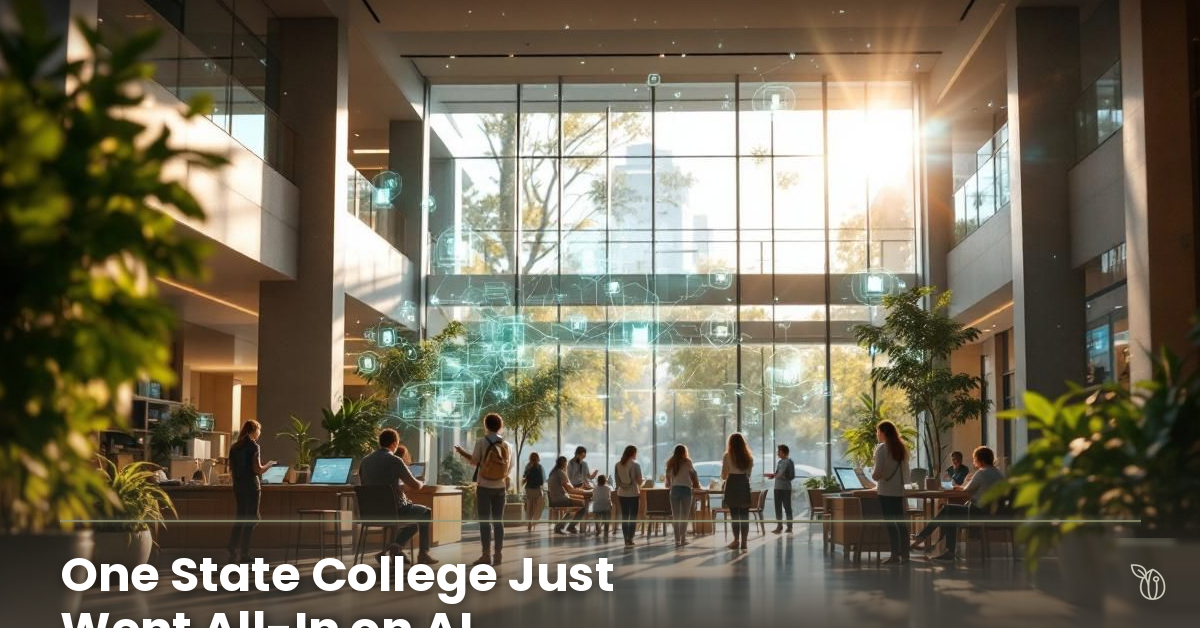
One State College Just Went All-In on AI
The College That Decided Waiting Wasn’t an Option
While most colleges are still debating whether to allow AI in classrooms, one Florida institution just committed $150,000 a year to make it the foundation of everything they do.
Indian River State College — a public, open enrollment institution serving over 24,000 students across Florida’s Treasure Coast — has partnered with Superhuman (formerly Grammarly) to deploy an institution-wide AI strategy. Not a pilot program. Not a single department experiment. A comprehensive, campus-wide infrastructure that embeds AI assistance into the tools students, faculty, and staff already use every day.1
That makes them the first open enrollment state college in the nation to take this step.
Now, you might be thinking: “That sounds expensive and risky for a state college.” But here’s the thing — the real risk is doing nothing. And the data backs that up.
Your students are already using AI. The only question is whether your institution is leading that experience or leaving it to chance.
Feeling like your institution is falling behind on AI? Join the Harvest Kernel Learning Community — where educators build AI fluency together, one day at a time.
What IRSC Actually Did (And Why It Matters)
Most institutions that claim to be “embracing AI” have installed a single tool, run a faculty workshop, or drafted a policy document. Indian River State College did something fundamentally different. They built an ecosystem.
The partnership leverages Superhuman Go — a platform that creates custom AI agents designed for specific academic and administrative workflows. These agents embed directly into the tools people already use: Canvas, Google Docs, email systems, and administrative platforms.1 No new software to learn. No separate login. AI shows up where the work already happens.
This is the critical distinction most institutions miss. Adding an AI tool is not the same as building AI into your operations. One is a feature. The other is a strategy.
Generative AI is rapidly transforming education from a literacy-based world to one built around dynamic intelligence. AI is becoming the infrastructure for knowledge work.
— Dr. Michael Hageloh, Executive Director of Strategic Initiatives, IRSC
The partnership covers three connected pillars: enhancing student learning, streamlining faculty workflows, and modernizing administrative operations. That’s not a department initiative — that’s an institutional commitment that touches every role on campus.
But the decision runs deeper than technology deployment. IRSC will join Superhuman’s Customer Advisory Board, directly shaping the future of AI tools for education. They plan to co-publish research findings, positioning themselves as a national thought leader in AI integration for open enrollment institutions.1
They’re not just adopting AI. They’re helping define how it works in higher education.
The Gap That Should Worry Every Educator
Here’s where the story gets uncomfortable. Students have already made their decision about AI — overwhelmingly. Institutions haven’t.
And it’s not just K-12. In higher education, while 61% of faculty report having used AI in teaching, 88% of those use it only minimally.2 That means the vast majority of educators who claim to use AI are barely scratching the surface.
Meanwhile, 88% of students use generative AI specifically for assessments — up from 53% in just one year.3 Students aren’t waiting for permission. They’re not waiting for policy. They’re building their own AI workflows, and they’re doing it without institutional guidance.
This is the gap that IRSC decided to close. Not with a memo, but with infrastructure.
Think about what happens when 92% of your students are using a technology that 85% of your faculty aren’t prepared to address. That’s not a gap — it’s a canyon. And every semester you wait, it gets wider.
This is exactly why SeedStacking™ works. Instead of overwhelming transformation, you build AI fluency through small daily wins that compound. Start your first stack today →
Why Open Enrollment Makes This Story Bigger
If this were Stanford or MIT, you’d nod and keep scrolling. Elite institutions have the budgets, the research teams, and the industry partnerships to experiment with anything. But Indian River State College serves a fundamentally different population.
Open enrollment means every student who applies gets in. That includes first-generation college students, career changers, working parents, and students who might not have had access to AI tools before arriving on campus. These are the students who stand to benefit the most from AI literacy — and the ones most likely to be left behind without it.
The AI education market reached $5.57 billion in 2024 and is growing at nearly 40% annually.4 But that investment is disproportionately flowing to institutions that already have resources. The risk is that AI becomes another amplifier of existing educational inequality — where students at well-funded schools learn to leverage AI while everyone else learns to fear it.
IRSC’s $150,000 annual investment challenges that trajectory.5 It says that open access institutions — the ones serving the broadest, most diverse student populations — can and should lead on AI adoption. Not follow. Lead.
🌱 The Seed
The mistake isn’t investing in AI at a state college. The mistake is believing state college students can afford to wait while private universities figure it out first. AI literacy isn’t a luxury — it’s the new baseline.
What SeedStacking™ at Scale Actually Looks Like
At Harvest Kernel, we teach the SeedStacking™ methodology — the idea that genuine AI fluency comes from small, consistent daily interactions that compound over time. What IRSC has done is essentially SeedStacking™ at institutional scale.
Think about it. They didn’t ask every faculty member to become an AI expert overnight. They embedded AI assistance into the tools people already use. A student writing a paper in Google Docs gets contextual AI support. A professor building a Canvas assignment gets workflow assistance. An administrator processing enrollment data gets intelligent automation. Each of those is a small win. A seed planted.
The genius is that nobody has to change their entire workflow. The AI meets them where they are. Over weeks and months, those small interactions build into genuine fluency — not because anyone sat through a training seminar, but because the technology became part of their daily rhythm.
That’s SeedStacking™. And IRSC just built it into their operating system.
Contrast this with the approach most institutions take: a mandatory two-hour workshop, a policy document nobody reads, and a vague encouragement to “explore AI tools.” Those aren’t seeds. They’re scattered dust. Nothing compounds because nothing is consistent.
Build Your Own AI Fluency — One Day at a Time
You don’t need a $150,000 institutional partnership to start building AI literacy. The Harvest Kernel Learning Community gives you the methodology, the daily practice, and the community of educators who are doing the same thing. The article gives you the what. The community gives you the how.
The Three Lessons Every Institution Should Take from IRSC
You don’t have to replicate IRSC’s exact partnership. But you can learn from the principles behind their decision. Here’s what stands out.
First: Embed, don’t add. IRSC didn’t introduce a new platform and ask people to learn it. They embedded AI into the platforms people already use. If your AI strategy requires a new login, you’ve already lost most of your faculty. The best technology is the kind people use without thinking about it.
Second: Cover all three levels. Students, faculty, and operations. Most institutions focus on one — usually student-facing tools. IRSC recognized that AI fluency has to live at every level of the institution. When faculty and administrators use AI daily, they model the behavior they want to see in students. That’s not a training strategy. It’s a culture shift.
Third: Commit publicly and invest real money. A $150,000 annual commitment sends a message that this isn’t a pilot. It’s a priority. Advisory board participation and research co-publishing create accountability. When you tell the world what you’re doing, you can’t quietly walk it back.
Most institutions are still in the “let’s wait and see” phase. IRSC is in the “let’s build and lead” phase. The gap between those two positions will only grow.
Ready to stop waiting and start building? The Harvest Kernel community is full of educators who made the same decision. Join the conversation today →
What Comes Next
IRSC’s partnership took effect immediately when it was announced in February 2026. The early data — from both student outcomes and operational efficiency — will be worth watching closely. The co-published research they’ve committed to producing could become a blueprint for other open enrollment institutions.
But the bigger story isn’t about one college in Florida. It’s about what happens when an institution decides that AI literacy is too important to delegate to individual faculty members figuring it out on their own. When the infrastructure does the heavy lifting, every interaction becomes a learning moment. Every workflow becomes a practice opportunity. Every day becomes a chance to build fluency.
That’s not just an AI strategy. That’s a commitment to the future of education.
The question isn’t whether your institution will eventually adopt AI at this level. The question is how many semesters of student preparation you’re willing to lose while you wait.
Sources
- Indian River State College Press Release — IRSC and Superhuman Partnership Announcement (February 3, 2026)
- Campbell Academic Technology Services — AI in Higher Education: A Meta Summary of Recent Surveys (2025)
- Anara — AI in Higher Education Statistics: The Complete 2025 Report
- AI Statistics — AI in Education Statistics 2026: Growth, Adoption & Impact
- WFLX — Indian River State College Is Embracing AI Technology in Classrooms (March 2, 2026)
Plant Your First Seed Today
Join the Harvest Kernel Learning Community — where educators, professionals, and lifelong learners build genuine AI fluency through the SeedStacking™ methodology. Free account. No credit card. Real community.