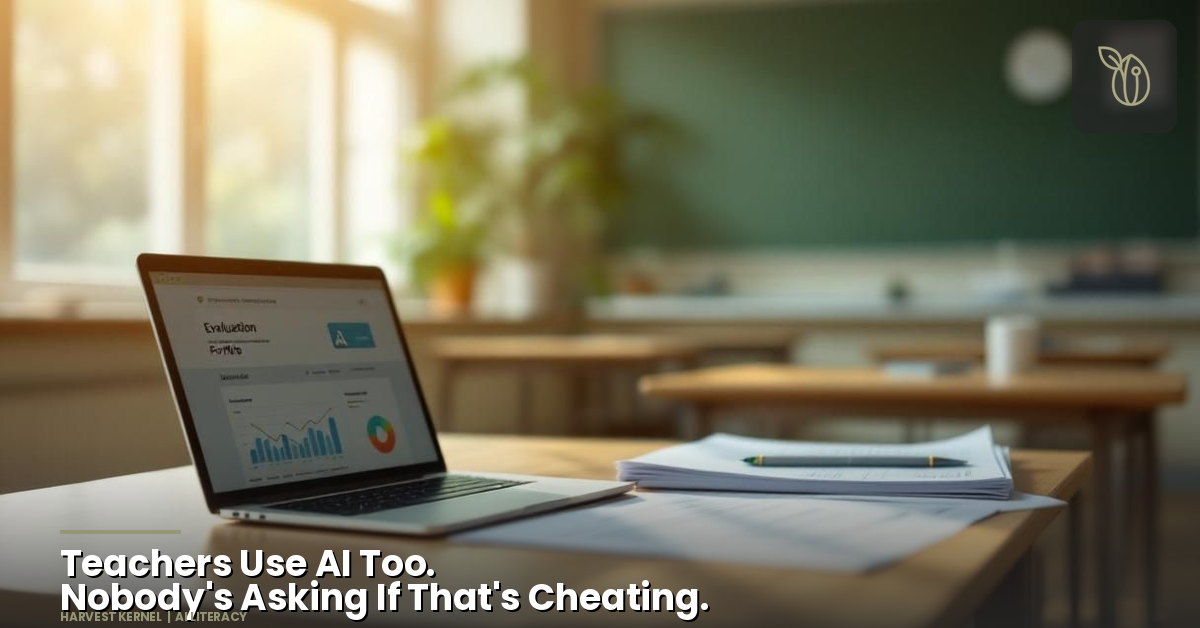
Teachers Use AI Too. Nobody’s Asking If That’s Cheating.
For three years, education has wrestled with one question: should students be allowed to use AI on their assignments? Schools wrote policies. Districts drew lines. Entire conferences were built around the word “integrity” as it applied to a 16-year-old’s essay.
During that time, almost nobody asked the same question about the people writing those policies.
The Debate Nobody Started
A new Education Week investigation reveals a gap that should concern every educator: the AI integrity conversation has focused almost exclusively on student work while ignoring the professional evaluation systems that determine whether teachers get licensed, certified, and promoted. edTPA, the national portfolio-based assessment used in a majority of U.S. states for initial teacher licensure, already encourages AI use for lesson planning and connecting instruction to state goals. Yet the system relies on originality-detection software to catch improper submissions, software that has significant error rates even for student work and virtually no validation for teacher professional writing.
If you are thinking, “Wait, we spent three years building student AI policies and zero time on teacher portfolio AI policies?” that is exactly the point. The asymmetry reveals something uncomfortable about how education treats AI literacy: as a student management problem, not a professional competency.
What Is Actually Being Evaluated?
The edTPA requires aspiring teachers to build portfolios that demonstrate lesson planning, student engagement, and reflective practice. Candidates submit video recordings, lesson artifacts, and written commentary explaining their instructional decisions. National Board Certification takes this further, requiring three portfolio entries across 25 certificate areas, each demanding evidence of accomplished practice over time.
AI tools can help a teacher analyze student data patterns, connect their instructional strategies to district goals, and draft the reflective commentary that ties everything together. The question is whether that help undermines the assessment or enhances it, and the answer depends entirely on what you think the portfolio is measuring.
Portfolio systems need to develop assessments capable of evaluating the process of teacher work with AI, not just the products.
Alex Pinedo, aiEDU
If the portfolio measures a teacher’s ability to reflect on their practice, AI can genuinely deepen that reflection by surfacing patterns the teacher might have missed. If it measures writing quality, AI makes the entire exercise meaningless. The problem is that most portfolio systems were designed before this distinction mattered, and they have not caught up.
Detection Is Not a Strategy
Pearson, which administers edTPA, warns that portfolio reviewers use originality-detection software. But AI detection tools still produce unacceptably high error rates for student submissions, and there is virtually no research validating their accuracy on professional teacher writing. An experienced educator writing about their own classroom practice produces text that looks substantively different from a first-year college student writing an essay. The detection models were not trained on that distinction.
Like what you’re reading? Get insights like this delivered daily.
The deeper issue is that detection answers the wrong question. “Did this teacher use AI?” tells you nothing useful. “How did this teacher use AI, and what does that reveal about their professional judgment?” tells you everything. The shift from product verification to process evaluation is the same shift the entire education system needs to make with students. Teachers just happen to be the ones who should model it first.
This connects directly to something we have seen playing out across institutions. When ASU built an AI that repackages professor lectures without faculty input, it raised the same fundamental question: who controls how AI intersects with professional expertise? For teachers building evaluation portfolios, the stakes are personal. Their careers, certifications, and professional identities are on the line.
What edTPA Essentials Could Get Right
There is a rare opportunity sitting in front of the profession. edTPA Essentials, a streamlined two-task redesign, launches in August 2026. It simplifies evidence requirements and rethinks how teaching performance is assessed. If the redesign builds AI-literate evaluation criteria from the ground up, rather than bolting detection software onto an existing framework, it could set the standard for every professional assessment system in education.
That means evaluating teachers not on whether they avoided AI, but on whether they can articulate exactly what AI contributed to their work and what remained distinctly human. A teacher who uses AI to surface student data patterns, identifies a trend the algorithm missed, adjusts their instruction based on that combined insight, and documents the entire process is demonstrating a higher order of professional competence than a teacher who builds the same portfolio by hand.
When more than two-thirds of teachers already use AI professionally, pretending it does not exist in evaluation systems is not protecting integrity. It is ignoring reality. The profession that is supposed to teach AI literacy cannot exempt itself from practicing it.
Process Over Product: The Only Answer That Works
The SeedStacking Principle
AI literacy is not just for students. The teacher who can articulate exactly how and why they used AI in their portfolio is demonstrating a higher order of professional competence than the teacher who either avoids AI entirely or uses it uncritically. Process over product. Literacy over avoidance. Intentionality over prohibition.
The solution for teacher portfolios is the same solution that works for student assignments: stop asking “Was AI used?” and start asking “How was AI used, and what did the human contribute?” That requires evaluation rubrics that reward transparency, process documentation that captures the human-AI collaboration, and assessors trained to recognize the difference between AI-assisted reflection and AI-generated filler.
This is not theoretical. It is the practical foundation of what SeedStacking teaches: start with small, intentional interactions. Build understanding of what the tool can and cannot do. Stack those daily practices until they become genuine fluency. A teacher who follows that process will produce a portfolio that no detection software needs to flag, because the human thinking will be unmistakably present on every page.
I built a companion resource for this. The AI Portfolio Documentation Worksheet gives you a structured template to document your AI use across any professional evaluation. It is free inside the Harvest Kernel Learning Community.
Ready to go beyond reading and start building AI fluency?
Join the free Harvest Kernel community for practical guidance, fresh ideas, and tools that help you make AI useful in real life.
Sources
Sparks, S. D. (2026, May 4). AI Can Help Teachers Craft Their Assessment Portfolios. Is That Cheating? Education Week.
RAND Corporation. (2026, January). K-12 Teacher AI Use Survey. 4,200 U.S. educators surveyed.
Pearson Evaluation Systems & Stanford SCALE. (2023). edTPA AI Use Statement and FAQ.
edTPA.com. (2026). edTPA Essentials announcement, launching August 2026.