Agentic AI Without the Hype: What It Actually Does and How to Stay in the Driver’s Seat
You cannot get through a Tuesday right now without someone saying “agentic.” It is on every keynote slide and every vendor email. What almost nobody does is stop and say, in plain words, what it means and why you should care. MIT just ran a Q and A that did something better. It asked not only what agentic AI is, but what we actually want it to be. That second question is the whole ballgame, and it is the one that decides whether this technology works for you or around you.
The plain answer: from tools that answer to tools that act
Last year’s AI answered questions. You asked, it replied, you took it from there. An agent is different in one specific way. You hand it a goal, and it works the steps. It makes a plan, reaches for tools, checks its own progress, and keeps going until the goal is met or it hits a wall it cannot climb. The chatbot is a smart intern who waits for the next question. The agent is the one who reads the goal off the whiteboard and starts working the list.
Picture the difference with something ordinary. Ask a chatbot to help plan a trip and it gives you a tidy list of suggestions. Give an agent the same trip as a goal and it can check the calendar, compare the flights, hold a hotel, and drop the itinerary on your desk. Same starting sentence. Very different amount of rope. That rope is the thing worth understanding, because rope is useful and rope is also how you trip. The educator who grasps this stops asking “will AI replace me” and starts asking a sharper question: “which parts of my week am I ready to hand off, and which parts are mine to keep.” That is not a fearful question. It is a foreman’s question, and it puts you back in charge of the answer.
Autonomy is a dial, not a switch
Here is where the MIT framing earns its keep. The interesting question is not whether a system is “an agent.” It is how much autonomy you want it to have, and where. Autonomy is a dial you can turn, not a light switch you flip once and forget. A low setting means the AI drafts and you approve every send. A high setting means it books, files, and replies while you sleep. Neither is right or wrong on its own. The setting depends on the stakes, and choosing the setting on purpose is the skill almost nobody is teaching.
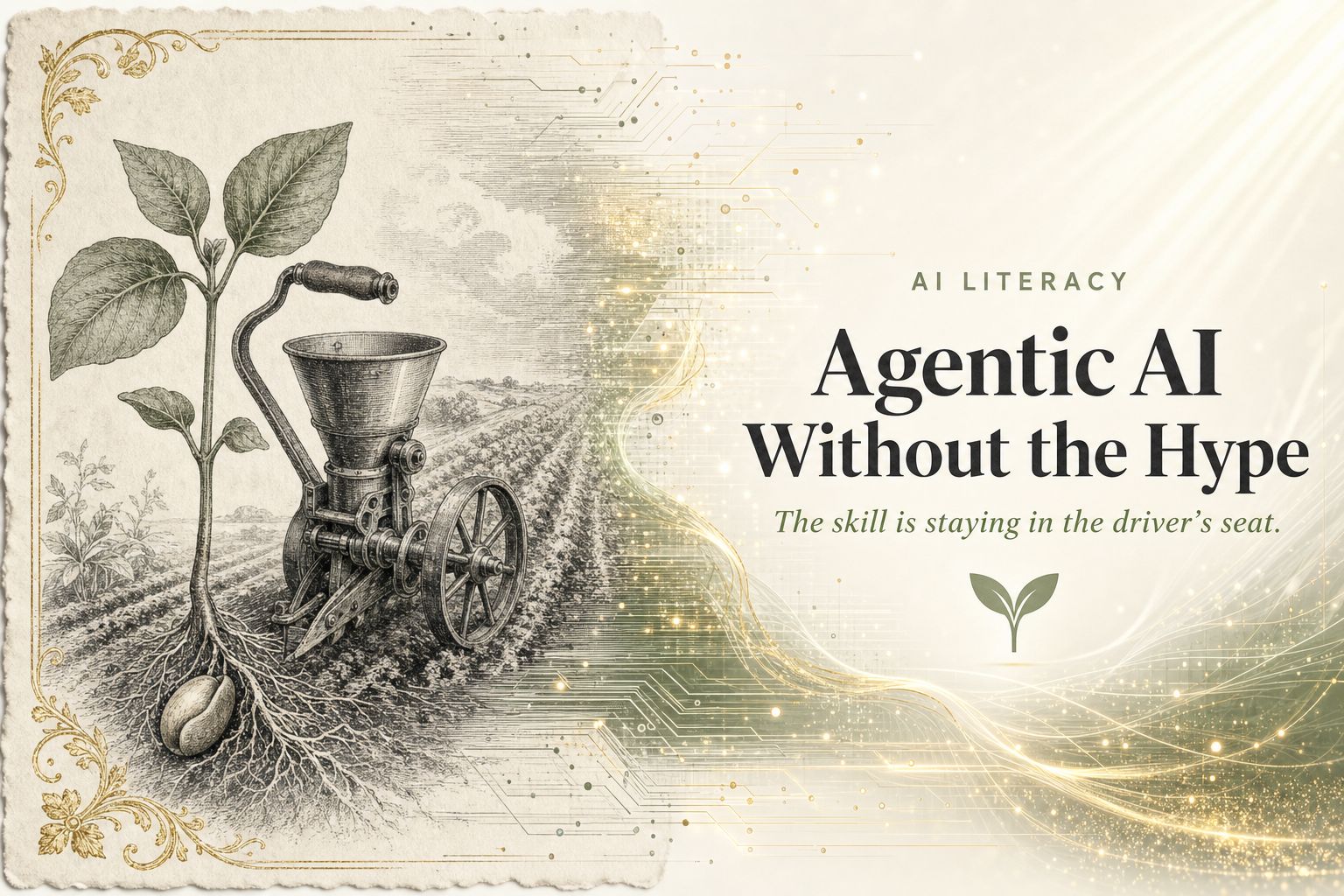
Think of it the way a good farmer thinks about a new piece of equipment. You do not hand the keys to the biggest machine on the lot to someone who has never driven it, and you do not run it flat out through a field you have not walked. You start slow, in a corner, where a mistake is cheap. Then you turn the dial up as trust is earned. The people who get burned by agentic AI are not the ones who used it. They are the ones who ran it wide open on day one and were not standing anywhere near the wheel.
This is exactly what SeedStacking is built for.
Turning a slippery idea like autonomy into a habit you can actually run on Monday morning. That is the whole method.
See the SeedStacking methodThe literacy skill: staying in the driver’s seat
Agentic AI does not ask you to become a programmer. It asks you to become a better boss. The literacy skill here is delegation done well, and delegation done well has always come down to three habits. They do not change just because the worker is made of software.
1. Define the goal and the guardrails in the same breath
A vague goal is how an agent wanders off. “Clean up my inbox” is an invitation to delete something you needed. “Archive every newsletter older than thirty days and leave everything else alone” is a goal with a fence around it. Say what you want and say what it must never touch. The fence is not a limit on the AI. It is the thing that lets you turn the dial up without holding your breath.
2. Keep a human checkpoint on anything consequential
Let the agent do the legwork. Keep the last click on anything that spends money, sends a message under your name, or cannot be undone. That is not distrust. It is the same reason a pilot keeps a hand near the controls even when the autopilot is flying. The autopilot is better at holding altitude. The pilot is better at knowing when the plan itself is wrong.
3. Verify the output against the real world
An agent that reports it finished a task and an agent that actually finished the task are not always the same agent. Confident and correct are different things, for software and for people. Spot check the result. Open the calendar and confirm the meeting is really there. Read the draft before it flies. The habit of checking the work is not a lack of faith in the tool. It is the difference between someone who delegates and someone who abdicates.
Run it through SeedStacking
Reading about a skill and owning a skill are different fields. Here is how you plant this one instead of just admiring it.
- Seed. Name one task you already do on a keyboard that eats an hour a week. Just one. Do not reach for the hardest thing you own. Reach for the boring, repeatable thing.
- Sprout. Write the goal for that task in one sentence, and write the guardrail in the next. What should it do, and what must it never do.
- Grow. Add one verification checkpoint before anything goes live. A place where you lay eyes on the result and give the nod.
- Harvest. Keep the judgment, hand off the legwork. Bank the hour you got back and point it at the work only a human can do.
The Seed
The goal was never to use agents. Plenty of people will use them badly and wonder why they feel less in control of their own week. The goal is to stay the person who decides. Let the software do the walking, the sorting, the drafting, the fetching. You keep the judgment, the taste, and the last click. MIT asked what we want agentic AI to be. Here is a clean answer you can carry: a very capable set of hands, working for a mind that stays firmly its own. Set the dial on purpose, keep your seat, and the hype stops mattering, because you are the one steering.
Learn the skill, not just the headline.
The article gives you the what. The community gives you the how. Join educators and professionals building real AI literacy one habit at a time. It is free.
Join the free community
Dean Le Blanc
Founder of Harvest Kernel. Dean teaches educators, professionals, and lifelong learners how to turn AI from a buzzword into a practical, repeatable skill using the SeedStacking method. Straight talk, no hype, no jargon.
Book a working session with Dean