AI Raised the Price of Not Knowing Things
Manu Kapur runs learning sciences at ETH Zurich, and this week in Times Higher Education he said the thing half the industry has spent three years hoping was false: the better AI gets, the more it costs you to not know things.
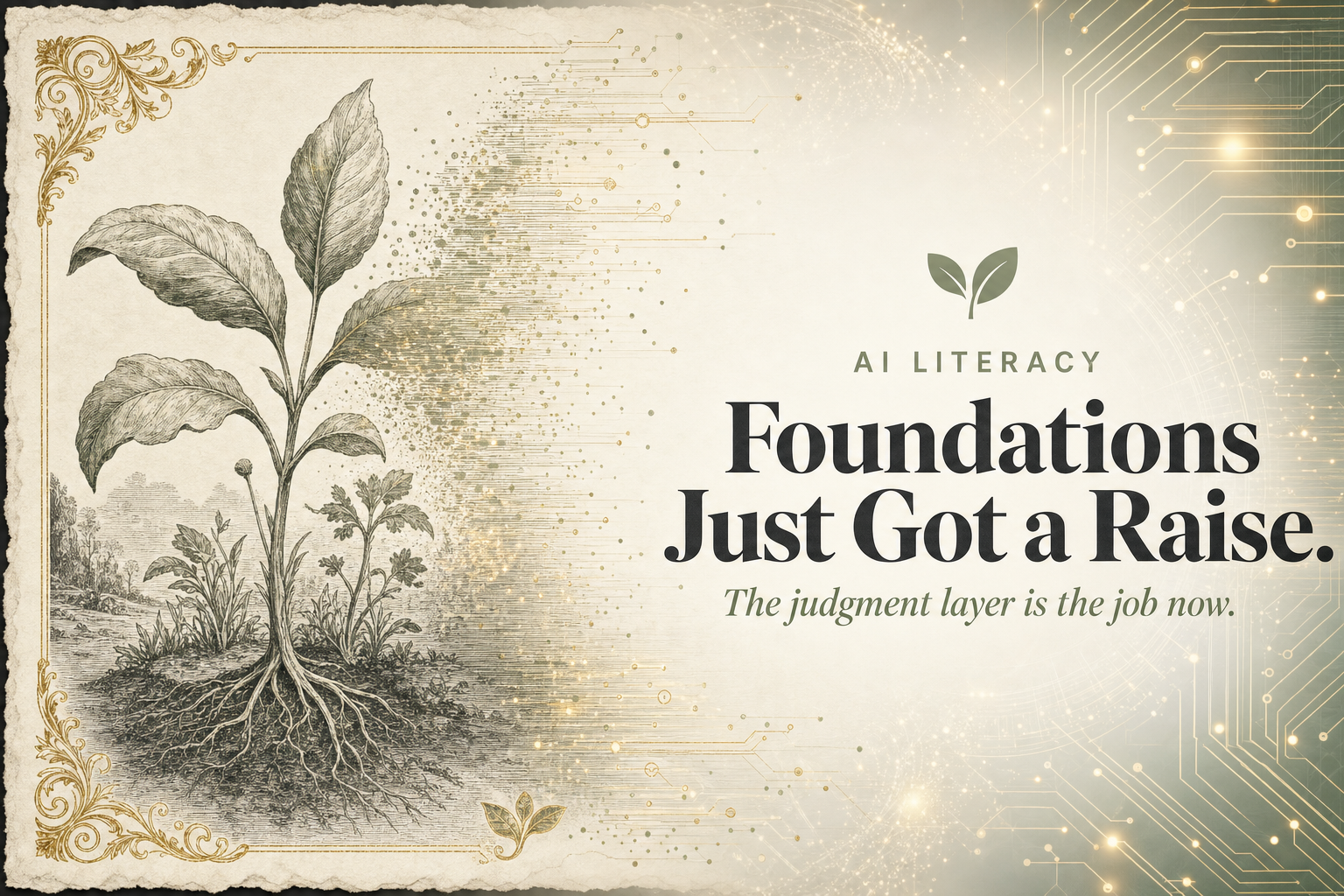
The comfortable story ran the other way. Why memorize anatomy when the model has it. Why learn statistics when the model runs them. Kapur’s answer is blunt: because the student who wins with AI is the one who can get an answer out of it and then judge whether the answer is any good. The first half of that sentence is free now. The whole price moved to the second half.
Fifty doctors called the bluff
The evidence Kapur leans on deserves a closer look than he had column space for. In a randomized trial published in JAMA Network Open, fifty physicians worked through diagnostic cases. Half got GPT-4 on top of their usual references. Half did not.
76%
Diagnostic reasoning score, physicians with the AI
74%
Physicians without it
92%
The model working alone
Sit with that middle gap. Handing a physician the tool moved the needle two points, noise territory. The tool alone beat both groups. The bottleneck was never access to the model. It was that the humans holding it did not have a reliable way to tell its good reasoning from its confident nonsense, so they overrode it in both directions, keeping their own wrong answers and discarding its right ones.
Outside medicine the receipts pile up the same way. Courts keep sanctioning lawyers for filing briefs stuffed with citations that do not exist. Those attorneys had the best legal AI money can buy. What they lacked was cheaper: the working knowledge of case law that makes a fake citation look fake.
The short version
AI produces plausible answers faster than anyone can check them. Your foundations are the checking equipment now, and people without them are holding output they cannot evaluate.
Why shallow just got expensive
Before AI, producing a wrong answer took effort, and the effort left fingerprints. A weak essay read weak. A bad analysis looked bad from across the room. Now the wrong answer arrives wearing the same polish as the right one, in perfect prose, with invented sources formatted beautifully.
Picture the Tuesday afternoon version of this in your own work. The model hands you a summary of a report you have not read, with a statistic you did not check, and the meeting starts in eight minutes. Whether you catch the invented number depends on what you already know about that domain. The deadline does not care, and the model will not warn you.
Kapur points at a second cost, quieter and worse. Research on passive AI use keeps finding the same trade: immediate productivity up, cognitive engagement down. Every answer you accept without the knowledge to question it is a rep you skipped. Skip enough reps and you have not saved time on thinking. You have retired from it, without noticing, while your output stayed impressive.
SeedStacking exists for exactly this trade.
Four phases for building real capability with AI instead of renting the appearance of it. Free to join, and the community is where people compare what actually held up.
The two subjects that got a raise
So which foundations? Kapur names two, and calls them the core grammar of the AI era. Neither is a coding language.
Mathematics, but not for the arithmetic
His best line: AI systems speak in the grammar of certainty while operating on the machinery of probability. The model never says “probably.” It says the answer, at full confidence, every time, because that is what it was built to do. A person with probabilistic instincts hears a weather forecast and treats it accordingly. A person without them hears a verdict. Same output, two completely different levels of risk.
Philosophy, but not for the trivia
What counts as knowing something? What makes an argument valid instead of just fluent? When the model drafts the policy, who bears the risk when it fails? These stopped being seminar questions the day AI output started shipping straight into contracts, diagnoses, and lesson plans. The Economist and WIRED have both reported tech companies hiring philosophers, and it is not for decoration. Fluent nonsense is a philosophy problem, and they have a nonsense supply like never before.
The Core Grammar Drill
You do not need a math degree or a philosophy seminar to start collecting the raise. You need reps against real output. Four rungs, one per SeedStacking phase, about 80 minutes total.
Seed: pull one claim, 10 minutes
Take something AI handed you this week that you accepted and used. A number, a citation, a recommendation. Write down exactly what would have to be true for it to be right. Most people discover they never asked.
Sprout: find the probability under the certainty, 15 minutes
Ask the model how confident it should be in that claim and what would change its answer. Watch the verdict dissolve back into a forecast. That dissolving feeling is the math foundation doing its job.
Grow: build the case against, 25 minutes
Argue the claim is wrong, seriously, using the model as a sparring partner rather than an oracle. If you cannot construct a single decent objection, you do not understand the claim well enough to have accepted it.
Harvest: verify against the source, 30 minutes
Chase the claim to a primary source and log the verdict: held, partly held, or fabricated. Keep the log. Ten entries in, you will know your personal miss rate with AI, which is a number almost nobody using these tools every day can tell you.
What to do this week
Run the drill once on one claim. If you teach, run it in front of students on a claim from your own discipline and let them watch you catch or clear the model in real time. That single demonstration teaches more AI literacy than a semester of policy slides.
The fifty physicians were not careless people. They were experts holding a tool nobody had trained them to argue with. Two points of improvement from the most powerful technology of the decade. The foundations are where the other sixteen points live.
The article gives you the argument. The community gives you the reps.
Harvest Kernel is free to join. Bring one claim AI handed you this week and we will run the drill on it together.