Cal State Faculty Want AI on the Paperwork So They Can Rebuild Assessment
The most useful job for AI in your teaching this year may be the work that is not teaching at all. That is not a vendor slogan. It is, almost word for word, what Cal State faculty just asked their university system to do.
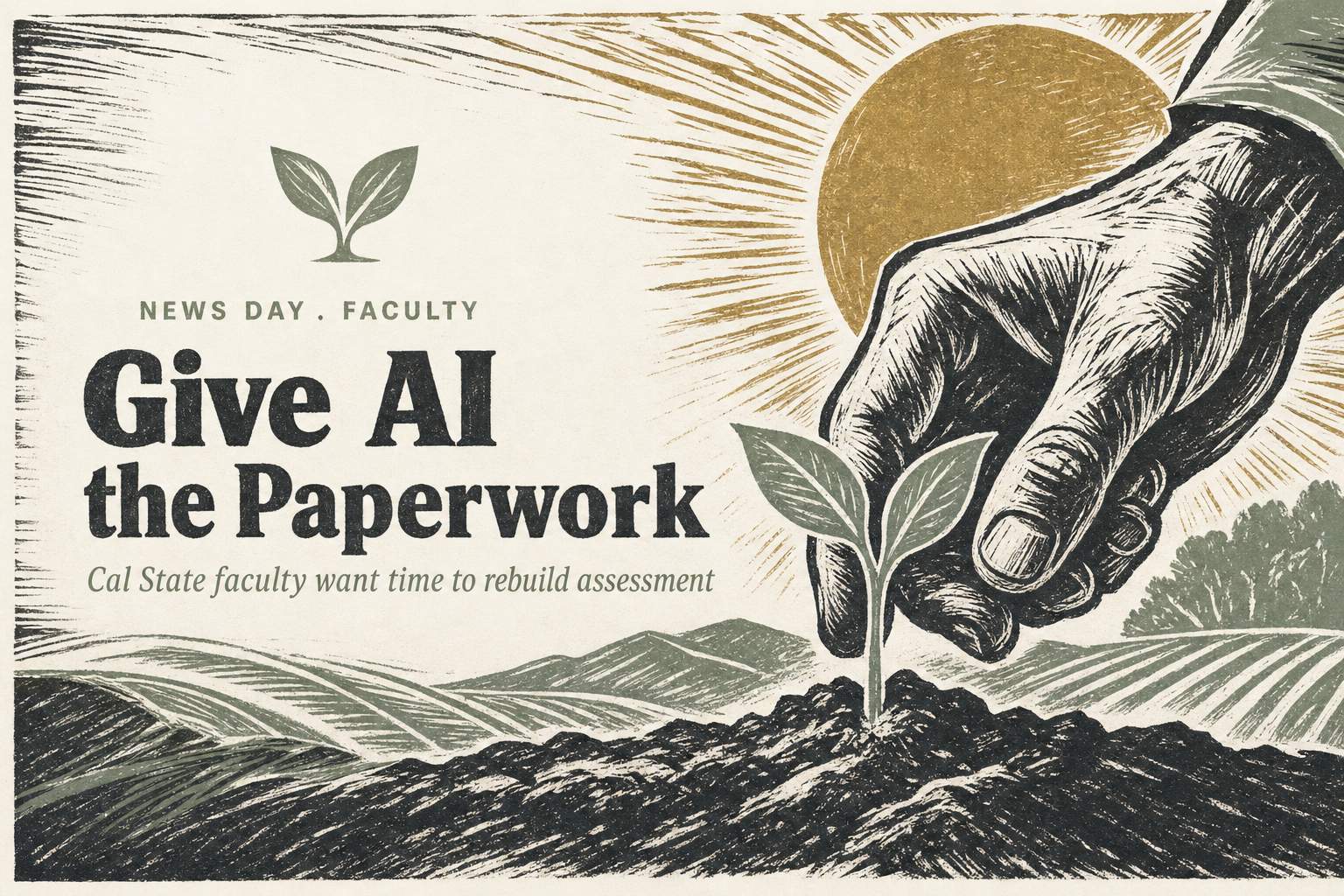
On November 5, the Academic Senate of the CSU approved a resolution titled Reorientation of Faculty Engagement With Generative A.I. It asks the system and its campuses to refocus their efforts to encourage AI in teaching and learning on something smaller and less glamorous: using generative AI “to simplify administrative processes and to facilitate the accomplishment of routine faculty tasks.”
That would be a modest request almost anywhere else. It lands differently at Cal State. In February 2025 the system announced an initiative to become the “Nation’s First and Largest AI-Empowered University System,” including a deal with OpenAI to give ChatGPT Edu to its students, faculty and staff. The senate’s 53 elected faculty members are, as The Sacramento Bee put it, the official voice of the system’s roughly 28,000 faculty. They did not say no to AI. They said not there, not first, and they told the system why.
What Cal State faculty actually asked for
The resolution has two working clauses. The first points AI at administration and routine faculty work. The second asks the Chancellor’s Office to support faculty “in developing and learning new approaches to teaching students and assessing their learning in an AI-enabled environment.”
Read those two together and the shape is clear. One clause takes work off the faculty desk. The other tells the system what the freed time is for.
It is also narrower than the headlines make it sound. The rationale says plainly that the reorientation “does not preclude individual faculty from judiciously experimenting with GenAI in their own curricula.” Nobody is banning anything. The senate is arguing about where an institution should spend its push, its training and its money. And as the Bee notes, the senate recommends policy. Its resolutions carry no executive power on their own.
The argument is about measurement, not machines
The reasoning is the part worth reading twice. The senate does not argue that AI is bad for students. It argues that nobody can yet tell.
“Although GenAI poses a variety of challenges and opportunities, by far the greatest challenges are in assessment and assurance of learning,” the rationale says. “Because GenAI tools easily generate long-form responses to questions, faculty are struggling to carry out meaningful assessment.”
Then it names the risk in a sentence most of us have felt and few have written down: “There is thus a substantial risk that we are embarking, blindfolded, on one of the most consequential social experiments in years.”
Blindfolded is the right word. If a student can hand in a polished essay without having done the thinking, the essay stops telling you whether the thinking happened. The senate borrows a rule from medicine, primum non nocere, first, do no harm, and applies it to the classroom: “Until we are confident that we have solved the assessment problem, indiscriminate deployment of GenAI in the classroom may do more harm than good.”
The senate also takes aim at how the system is measuring itself. CSU is surveying AI use, the rationale says, but “the data are insufficiently revealing of AI’s impact on student learning.” Its question is the one every department should be asking: “Are students using it to get quick answers, or are they being guided by faculty to use it to augment their understanding?” A usage count cannot answer that. Only a study of learning can, which is why the resolution asks for a systemwide one.
If this sounds familiar, it should. On Friday we covered AI Assessment: England’s Regulator Says Replace What AI Can Pass. A national regulator in England and a faculty senate in California landed on the same problem in the same month. The grade is only as good as the evidence behind it.
Want to run this on your own week first? The Paperwork Swap is a free working session. List the routine work from your last week, sort what needs your judgment from what does not, and name the one assessment you would rebuild with the time you get back. You leave with a one page swap sheet. Start The Paperwork Swap.
Why the paperwork comes first
Here is the move that makes this resolution more than a complaint. It connects two problems most faculty treat as separate: too much administrative work, and assessment that no longer measures what it claims to.
“Faculty need time and resources to design robust approaches to assessment in a world with ubiquitous AI,” the rationale says. “Redesigning assessment is a significant undertaking. Relieving faculty of administrative burden is a necessary first step in that work.”
That is a sequence, not a slogan. Redesigning one major assignment so it shows you real learning is real work: rethinking the prompt, adding a checkpoint, building a short conversation into the grade, rewriting the rubric. Those hours have to come from somewhere. The senate’s answer is to take them from the routine work that eats a faculty week and has nothing to do with judgment. Professors gave the Bee two examples: responding to emails, and applying a grade curve to student scores.
Here is the twist. Faculty time was in the original pitch. When OpenAI announced the Cal State deal, it said faculty could use ChatGPT Edu “to streamline administrative tasks, freeing up more time for teaching and research.” The senate is asking the system to move that sentence to the front of the line, and to say out loud what the freed time is for.
There is a quieter point in here too. The people closest to the work are asking to decide where the technology goes. When we wrote ASU Built an AI That Repackages Professors. Nobody Asked Them., the problem was a system deciding for faculty. At Cal State, the faculty are deciding for the system, or at least asking to.
Where Harvest Kernel lands
We build AI tools for faculty, so you should know where we stand. We think Cal State faculty have the order right.
The line on our Faculty Toolkit page is that the busywork was never the teaching. It just came bundled with the job. The reply to the long email that turns out to ask one question. The announcement you rewrite every term. The same feedback sentence, typed again. None of that is where a student learns from you. All of it is where your week goes.
The other half matters as much. A drafting tool that sends things without you is not saving your judgment, it is replacing it. Our rule is review first: nothing reaches a student until you approve it. That is the same line the senate is drawing, from the other side. Let the tool draft the routine work. Keep the decisions that tell you what a student actually knows.
Run the swap on your own week
You do not need a systemwide study to do what Cal State faculty are asking for. You need one honest look at last week.
- List the routine work. Write down every non teaching task from your last full week: emails, announcements, reminders, forms, reformatting, the same comment typed again. Next to each, write the minutes it took, by your own estimate.
- Sort it with one test. Ask of each task: if a draft appeared in front of me and I reviewed it, would anything a student needs from me be lost? If not, it is routine. If yes, it needs your judgment from the first word.
- Name the assessment. Pick the one graded assignment in your course that AI could now complete without the student learning what it is meant to show.
- Write what you need to see. In one sentence, write what a student would have to do in front of you, or in a way you can follow, for that grade to mean something again.
- Move one routine task. Choose one task from your routine list and stop drafting it from a blank page. Review a draft instead.
- Spend the time on purpose. Put the minutes you got back on your calendar, by name, as time to redesign that one assessment.
This method is a judgment call built from one resolution and its reasoning, not a tested intervention. It will not fix your assessments by Friday. It does make the trade the senate is describing visible in your own week, which is where it either happens or does not.
Where this goes next
Sorting one week by hand is the right way to see it. Doing the routine part of it every week by hand is how the redesign never gets its hours.
If student email sits near the top of your routine list, the Student Email Decoder in the Harvest Kernel Faculty Toolkit figures out what the email is really asking and drafts the reply, grounded in your Course Record and in your voice. Review first, always. See the Student Email Decoder. Every individual plan starts with a 14 day free trial.
If you would rather compare swap sheets with other faculty first, the free Harvest Kernel community is open.
Give the machine the paperwork. Keep the part where you find out what your students know.
Sources
- Academic Senate of the California State University, “Reorientation of Faculty Engagement With Generative A.I.” (AS-3813-26/AA/FA), approved November 5, 2026, calstate.edu (PDF)
- Tarini Mehta, “Professors urge CSU system to use AI for admin work instead of instruction,” The Sacramento Bee, November 13, 2026, sacbee.com
- California State University, “CSU Announces Landmark Initiative to Become Nation’s First and Largest AI-Empowered University System,” February 4, 2025, calstate.edu
- OpenAI, “OpenAI and the California State University system bring AI to 500,000 students and faculty,” openai.com
- Academic Senate of the California State University, “About the Senate,” calstate.edu