AI in the Classroom: What 67 Georgia Tech Experiments Found, and How to Run Your Own
Georgia Tech just published 278 pages of faculty AI experiments from real courses. Its most useful idea is not a finding. It is a four part format any instructor can use to document their own, so next term’s syllabus stops being a guess.
The Georgia Tech Academic AI Playbook, 2026 edition, came out on November 17. It gathers 67 articles from faculty, staff and researchers across every college at the institute, along with its library, its Center for Teaching and Learning and several other units. The playbook’s own site says the effort began in January 2026 at the suggestion of Provost Raheem Beyah, and that a first call for nominations drew 139 submissions before a second call added 38 more proposals. The editors are David Joyner, interim vice provost for AI in Education, and Nimisha Roy, director of online undergraduate initiatives in the College of Computing.
“A lot of the conversation around AI in teaching has stayed at a pretty abstract level,” Joyner said in the university’s announcement, “but our faculty have turned hundreds of classes into micro-laboratories to explore how these technologies can support teaching and learning.” The whole volume is free to read under a Creative Commons license, and the playbook says plainly that nobody is expected to read all of it.
Every article in the AI playbook is a play
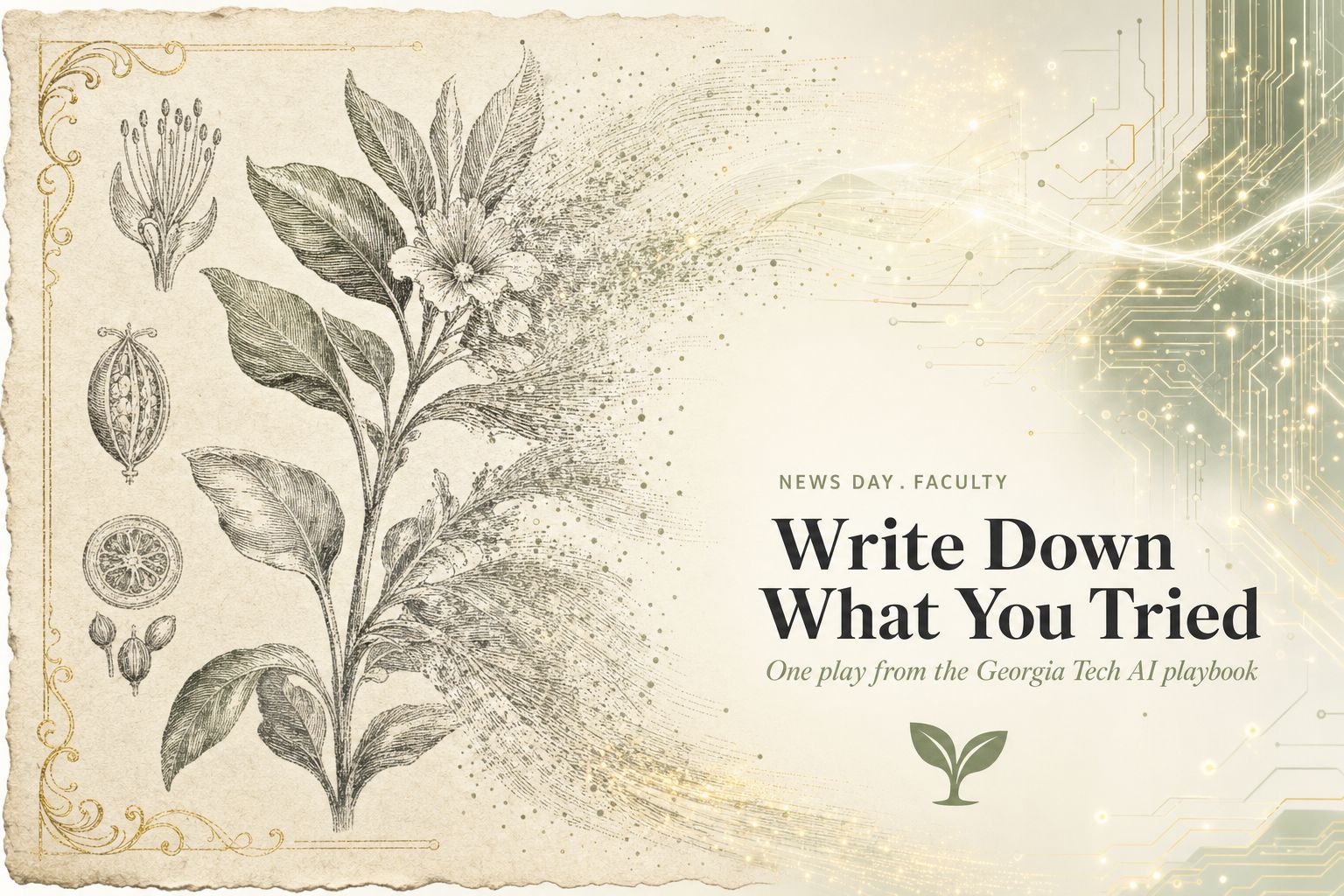
Here is the part worth stealing. Each of the 67 articles is written as a “play”: one specific initiative carried out in one real course, documenting the prior context, the actions the instructor took, the results, and the lessons learned. Context, actions, results, lessons. That is the whole format.
It sounds too simple to matter. It is not. The announcement describes the collection as documenting what instructors are already doing, “rather than offering another set of broad predictions about how AI could reshape education.” Most of what reaches faculty about AI is prediction, vendor promise or alarm. A play is none of those. It is a record of what happened in one room, written by the person who was in it.
The plays cover a wide spread. Some faculty built AI tutors grounded in their own course materials. Some made students critique AI output. Some redesigned assessments in response to AI, including one course that replaced exams with “Write Your Own Problem” assignments. Some simply set a policy and studied what happened. The playbook sorts them into three groups: using AI, teaching AI and reacting to AI. Reacting counts. A ban you set and watched is a play too.
“There isn’t one right way to respond to AI in the classroom,” Beyah said. “A computer science course, an engineering lab, and a writing-intensive course may require very different approaches.”
Five of the 20 lessons to read first
The volume closes with 20 lessons synthesized across all 67 plays, on pages 265 to 278. The announcement notes that AI helped produce that synthesis. Five of them deserve a place on your desk before you touch next term’s syllabus.
Lesson 7, establish the standard before introducing the tool. Students “cannot recognize what an AI system has flattened, omitted, or quietly gotten wrong unless they already know what good work looks like,” so the playbook says to put unaided work first.
Lesson 11, assess the process, not the artifact. When artifacts are cheap to generate, the lesson says, “relocate the evidence of learning to the process.”
Want to write your own play before break? The Term Play is a free working session. Pick one thing you changed about AI in a course this term, even a single syllabus line or a ban. You leave holding a one page play in Georgia Tech’s four parts, an honest check on your evidence, and the exact line that goes into next term’s syllabus. By hand, no account required. Start The Term Play.
Lesson 12, do not build on a capability gap. “Assignments, rubrics, and policies premised on what AI currently cannot do expire within a model generation or two; build on disciplinary necessity instead.” This site made a related argument in If AI Can Pass Your Assignment, the Assignment Is Broken. The playbook adds the warning that a fix built on what AI cannot do today has a shelf life.
Lesson 14, make the policy explicit, specific, and reasoned. “Blanket bans and blanket permissions both fail; assignment-level specificity paired with an articulated rationale removes integrity anxiety and builds trust, and students can help write the policy.” If you want a worked example of reasoned classroom rules, A Harvard Professor Just Wrote the AI Rules Every Classroom Needs walks through one.
Lesson 19, bring in the skeptics and the non experts early. Guidance built only from enthusiasts “reads as advocacy to the colleagues who most need to find it credible.” The playbook’s advice is blunt: name a skeptic in advance.
The experiment you ran this term is already fading
If you changed anything about AI in a course this fall, you ran an experiment. Maybe you added a disclosure line. Maybe you moved one essay into class. Maybe you let students use a chatbot on one assignment and graded their critique of it. Maybe you banned it outright and watched what happened.
Now picture January. You open last spring’s syllabus file, or this fall’s, and copy it forward. What you saw in week six, the assignment that worked better than expected, the policy line two students misread, the thing you swore you would fix: none of it is written anywhere. Next term’s version is a guess built on a memory.
That is the gap the playbook closes for 67 courses at one institution. The format closes it for yours. Georgia Tech’s editors describe the articles as “public contributions to the record for citation and reference.” Your play does not need to be public. It needs to exist before you forget the results.
How to write your own play before break
- Name the experiment in one line. One change, one course. “Moved the first essay into class.” “Allowed AI on the lab report and graded the critique.” “Banned AI and explained why on day one.”
- Write the context. What was the course like before, and what problem were you trying to solve? Two or three sentences.
- Write the actions. What exactly did you do, and what exactly were students told? Paste the syllabus line or the assignment wording if you have it.
- Write the results. What did you see? Grades, the quality of the work, what students said, what went wrong.
- Check your evidence. For each result, ask what backs it: graded work, written student comments, your own notes from the week, or memory alone. Memory is not nothing, but mark it as memory.
- Write the lesson in one sentence. Then check it against the playbook’s 20 lessons. Does your play confirm one of them, or push back on it?
- Decide keep, change or cut, and write the line. Write the exact sentence that goes into next term’s syllabus or assignment, and when you will put it there.
Fifteen honest minutes on one course is enough to start. The format comes from Georgia Tech’s playbook. Using it for a single instructor’s end of term record is a judgment call, not a tested method, and the playbook itself says there is no one right way to respond to AI.
Where this goes next
One play is one course. Then the rest of your courses come up for next term, each with a syllabus that will be copied forward unless something stops it. Carrying every lesson into every syllabus by hand is a different job.
The Course Refresh Assistant in the Harvest Kernel Faculty Toolkit takes an old syllabus and turns it into a live Course Record in minutes, so every tool in the toolkit drafts from what your course actually is now. Review first, always: nothing goes anywhere until you have read it. See the Course Refresh Assistant. Every individual plan starts with a 14 day free trial, and you can cancel in one click.
If you would rather compare plays with other faculty first, the free Harvest Kernel community is open.
Write your first play by hand anyway. Your syllabus gets copied forward in January. Write down what this term’s AI experiment taught you before it does.
Sources
- Brittany Aiello, “Georgia Tech Tests AI in the Classroom and Shares What Works,” Georgia Tech News Center, November 17, 2026. news.gatech.edu
- David A. Joyner and Nimisha Roy, editors, Georgia Tech Academic AI Playbook, 2026 edition, Georgia Institute of Technology. sites.gatech.edu, permanent link hdl.handle.net/1853/81982
- “Lessons Learned,” Georgia Tech Academic AI Playbook, 2026 edition, pages 265 to 278. PDF