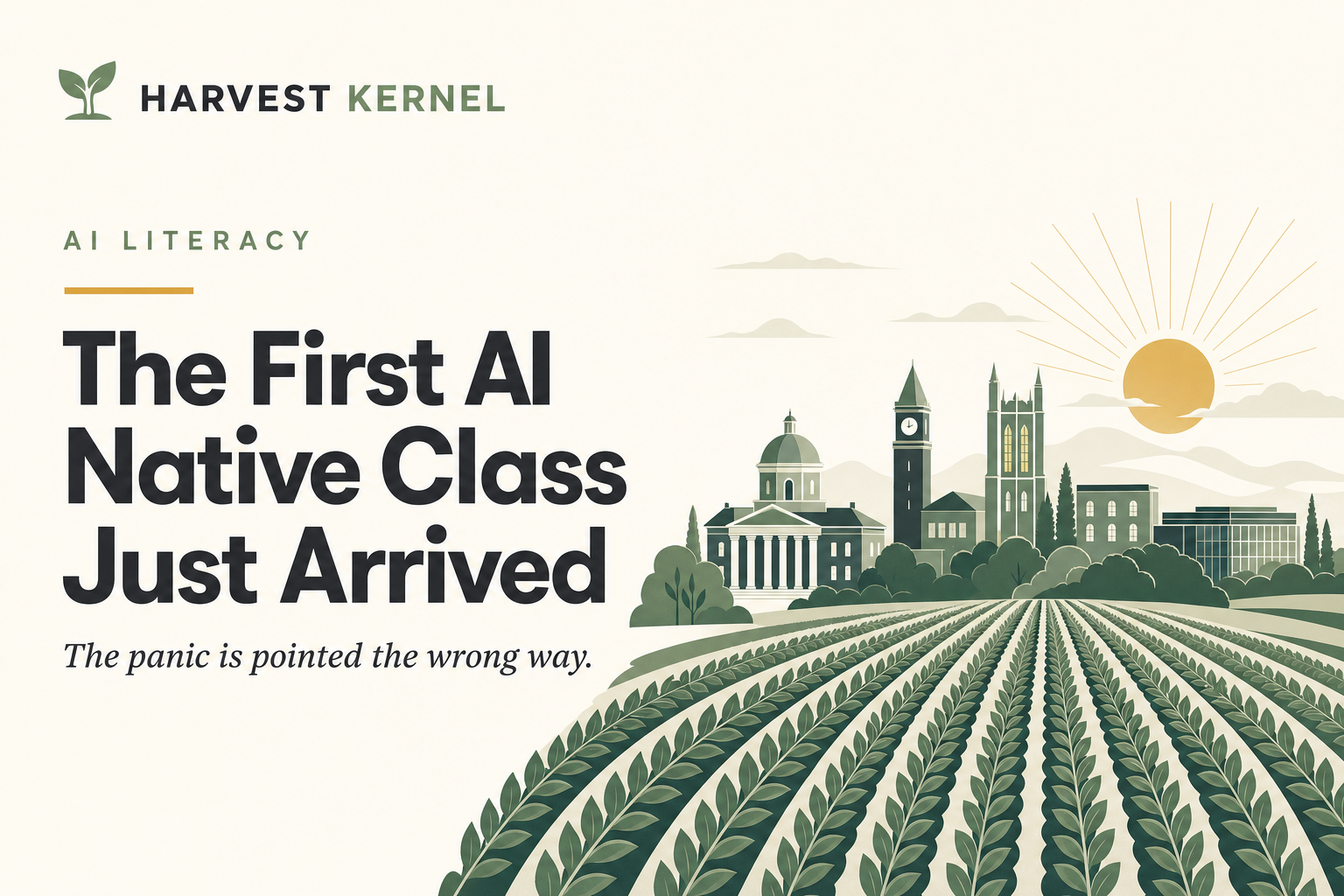
The First AI Native Class Just Arrived. The Panic Is Pointed the Wrong Way.
This fall, a freshman class walks onto campus that has never written a paper, studied for an exam, or looked up a fact without an AI within reach. Commentators have a name for them already. The first AI native class. The reflex, in a lot of faculty lounges right now, is to ask how to keep this group honest. That is the wrong first question, and asking it first is how an institution wastes a year it does not have.
The sharper framing came from Dr. James Norrie, a professor of law and cybersecurity and the founding dean of the Graham School of Business at York College of Pennsylvania, writing in University Business at the end of July. Norrie’s point is not that these students arrived with worse character. It is that they never had the argument the rest of us are still having. They did not decide AI belonged in their education. They assumed it, the way you assume the lights will come on. The questions they bring are how, when, and why. Never whether.
They already settled the question we are still debating
The faculty meeting about whether to permit AI is a conversation the incoming class finished in high school. That is the gap that actually matters this fall. On one side, an institution still deciding. On the other, a student who decided years ago and cannot imagine why it is a question. Close that gap the wrong way, with a ban nobody can enforce, and you spend the semester policing a decision the students made before they packed the car.
Norrie packages the alternative as three letters. Abundance, Belief, Choice. The ABCs. It is worth walking through each one, because every letter names a cost the university used to charge for and no longer can.
Fall 2026
First AI native cohort on campus
How, when, why
The questions they bring, not whether
Trust
The resource that just went scarce
Three letters
Norrie’s frame: Abundance, Belief, Choice
A is for Abundance
For most of the university’s history, its core service was access to knowledge that was genuinely hard to get. You came to the building because the books, the expert, and the explanation lived there and almost nowhere else. That scarcity is gone. A student can now summon a competent explanation of nearly anything in the time it takes to open a laptop.
If your course still competes on delivering information, you are selling ice to people who just bought a freezer. The value moves to what a person does with abundance. Which of five fluent answers is the wrong one. Which source is dressed up to look more certain than it earned. Abundance does not lower the bar. It slides the bar off recall and onto judgment, and judgment is harder to teach and harder to fake.
The short version
The first AI native class did not arrive with a cheating problem. It arrived having already decided AI belongs in learning. The job now is not to police that decision. It is to teach the judgment that makes the decision pay off instead of backfire.
B is for Belief
When answers are everywhere, trust becomes the scarce good. An AI will hand a student a fluent, confident, well organized answer, and some fraction of the time that answer is simply wrong. The machine never once sounds unsure. It is wrong in the same calm voice it uses when it is right.
So the skill that matters is the reflex to withhold belief until something earns it. Norrie names belief as the scarce resource, and he is right. The student who trusts every fluent answer is more exposed than a student who had no answer at all, because the second one at least knew to go looking. Teaching belief means teaching a young adult to interrogate the thing in the room that sounds smartest. That is not cynicism. It is the oldest habit of an educated mind, and it just became the whole game.
You do not teach judgment with a lecture about judgment.
Harvest Kernel is where educators and professionals build AI fluency one real task at a time, in the open, with people who will argue the useful way. Free to join.
C is for Choice
This class expects to choose whether and how to bring AI to any given task. That expectation is not going away, and pretending it will is how you lose the room by week two. Education’s job shifts from handing students the one approved method to helping them decide well under uncertainty. Which task deserves the tool. Which task deserves an unaided human head. How you tell the two apart before the deadline rather than after.
Choice is a curriculum now, not a footnote at the bottom of the syllabus. A graduate who cannot decide when to reach for the tool and when to leave it alone is not AI literate. They are AI dependent, and the market has already learned to tell the difference.
Where the ABCs need a harder edge
Give Norrie the frame. It is a good one, and it beats the panic it is competing with. But a frame is not a lesson plan, and this is exactly where most administrators will stall out. Abundance, belief, and choice fit on one slide, and you can present that slide in August and have changed nothing by October. Three letters describe the destination. They do not tell a Tuesday afternoon instructor what to do with a stack of assignments due Friday.
That distance, between a true idea and an actual Tuesday, is the whole reason Harvest Kernel exists. So here are the ABCs turned into something you can run before the first class meets, on one assignment, in under two hours.
The week one move
Four steps. You are fixing one assignment, not your whole course. A farmer who tries to replant the entire field in a weekend plants nothing. He picks one row.
1. Pick the assignment you already grade most weeks. The recurring one, the boring one, the one that eats your Sundays. Not the exciting capstone. The workhorse. Fifteen minutes.
2. Name what it is supposed to prove. Not what it covers, what it proves the student can now do. Write one sentence. If an AI can already do that thing start to finish, the assignment is measuring the wrong skill, and you just found your real problem in August instead of after midterms. Twenty minutes.
3. Set the AI value out loud, before day one. Prohibited, assistive, or required, plus the reason in one sentence tied to what the task proves. Students can smell a rule with no reason behind it, and they will treat it exactly like one. Thirty minutes.
4. Run it once yourself with AI in the loop. Then write the single verification question you want every student to ask of the output. That question is the belief skill made concrete, and you hand it to them on the first day rather than hoping they invent it. Forty minutes.
Under two hours, and you walk into week one holding a defensible position on one real assignment instead of a policy paragraph you will spend fifteen weeks enforcing and no student will read. The AI native class is not the risk in this story. Arriving to meet them with last year’s syllabus is.
The class already arrived. Meet them with a plan.
Harvest Kernel is free to join. Bring the one assignment you dread grading and the room will help you turn it into a week one plan.