|
THE FRIDAY HARVEST
One email a week for people who teach. Issue 001 . August 13, 2026
|
 |
 |
Dean Le Blanc
College faculty member. Still grades every week.
|
|
|
|
|
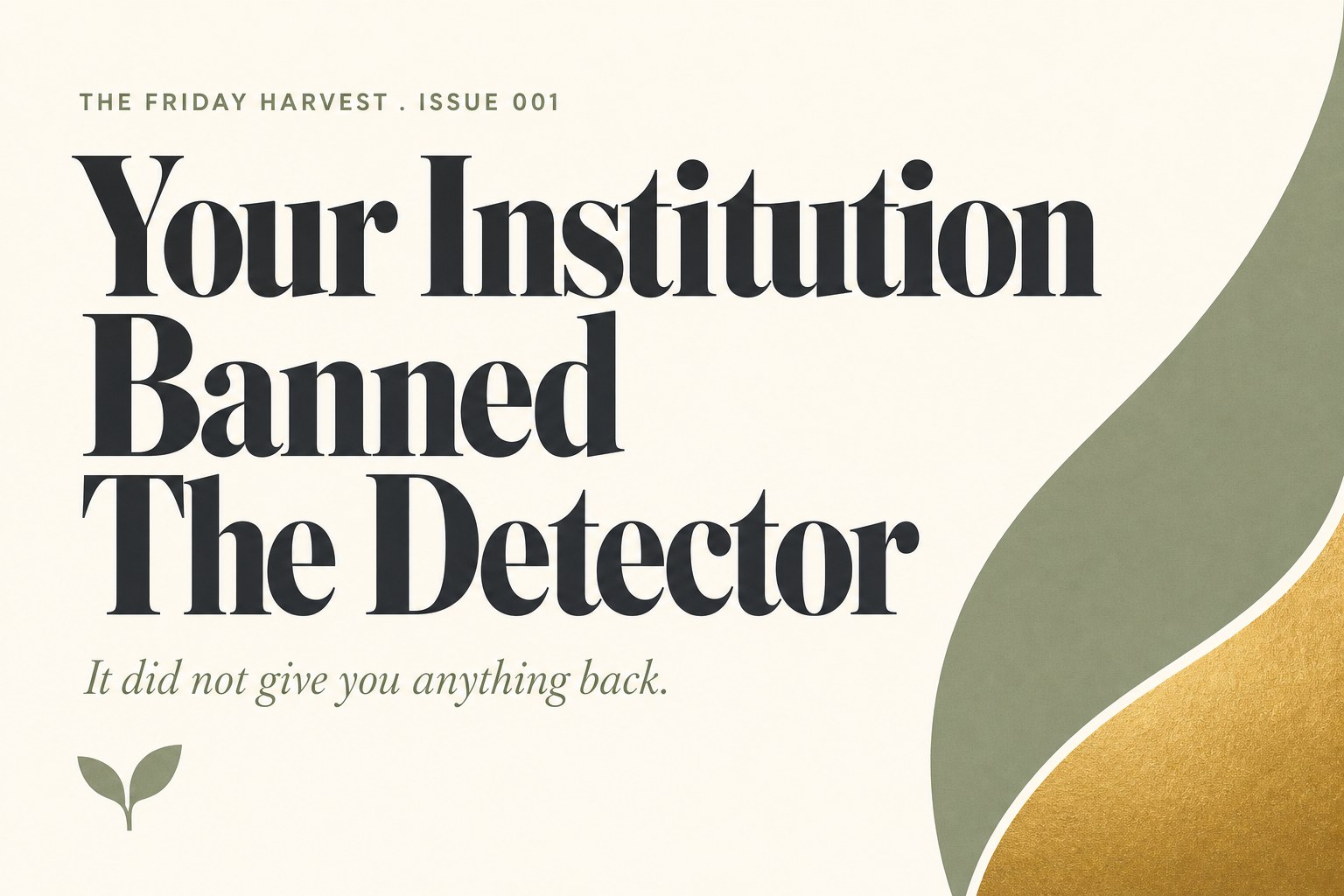
Your institution is taking away the AI detector. It is not giving you anything back.
|
|
Inside Higher Ed reported on August 5 that a long list of institutions now prohibit or discourage AI detection tools. Yale, Vanderbilt, Johns Hopkins, Indiana, Northwestern, Georgetown, NYU, Brown, UC San Diego, UCF, Ole Miss, Waterloo. The recommended replacements are oral exams, blue books, process visible assignments, and required disclosure.
|
|
Read that list of replacements again, because it is the whole story. Every one of them is more work for the instructor, and every one has to be designed before the assignment goes out, which for most of you is now.
|
|
The bans are correct. Detection scores are probabilistic, they fall apart under challenge, and defending one in a room with a dean is a bad afternoon. The policy is right.
|
|
What is not right is the accounting. The institution retired a tool that cost it a licence fee and replaced it with a redesign that costs you a weekend, and nobody wrote that trade down. If your department is celebrating this month without cutting something else from your plate, a cost just moved off a budget line and onto your Sunday.
|
|
The move that works is not a better detector. It is making the process visible enough that the final artifact stops being your only evidence. That is a design problem, and it is far cheaper to solve in week two than in week ten.
|
|
Inside Higher Ed, August 5, 2026
|
|
|
|
Gemini in Google Classroom can now read your assignment. Live on the web Monday, mobile August 17. Students pick a class and assignment, and Gemini pulls in that course’s posted materials. There is a “Learn with Gemini” prompt one hover from the assignment. It also dropped its 18 and over limit. Included in Workspace for Education Fundamentals, the free tier, so if your campus runs Google this is already true. Your syllabus language about outside assistance was written for a world where the assistant had not read your handout.
|
|
Google, August 4, 2026
|
|
California is voting on whether your instructor of record has to be a person. SB 928 would require CSU faculty and instructors of record to be human beings. It passed the Senate 37 to 0 in April and cleared Assembly Higher Education in June. Companion bill AB 2392 would require CSU and the community colleges to build procurement standards and training for generative AI. Both reached the suspense file this month. This is the first serious legal test of whether “instructor of record” is protected from automation, and the answer will not stay in California.
|
|
Bill tracker, latest action August 3, 2026
|
|
111,000 fewer international students, and enrollment no longer protects a line. NAFSA and JB International project enrollment falling from 1,168,602 to between 1,056,884 and 1,104,912, up to $3.4 billion in lost revenue and up to 39,000 fewer jobs. Illinois Tech cut roughly 160 faculty and staff on July 31, weeks before an August 17 start. And at Minnesota State Mankato a $22 million shortfall produced 17 layoffs, 15 eliminated vacancies and 21 cut graduate assistantships, at an institution sitting near record enrollment of about 18,700, with notifications landing after the term starts. Growing your headcount is no longer the thing that keeps your department whole.
|
|
NAFSA and JBI, August 12 . Higher Ed Dive, August 7
|
|
A four label AI policy you can copy this week. Midwestern State adopted four categories rather than a yes or no: AI Prohibited, AI Critical, AI Limited, AI Exploratory, set per course by the instructor. Whatever you think of the labels, the structural move is right. A binary policy forces you to defend a line you did not want to draw. Four levels let you say this assignment is Prohibited and that one is Exploratory, and have it read as pedagogy rather than as a trust judgment.
|
|
News Channel 6, August 11, 2026
|
|
|
|
ChatGPT for Academic Researchers. Free, real, and now a lottery.
|
|
Deep research, higher usage limits, larger context windows, connectors into literature databases. Free, including frontier model access.
|
|
Whether you can actually get it is the part other newsletters skip. As of August 10, new applicants join a waitlist. Over 13,000 first wave applications are under review, representing up to 65,000 seats, and a lottery decides the initial 10,000.
|
|
Apply anyway, and coordinate before you do: each approved researcher can invite up to four collaborators from their institution. One approval in your department is five seats.
|
|
OpenAI, updated August 10, 2026
|
|
And one to skip. Claude for Teachers is free and is circulating in faculty channels right now. Higher education faculty are not eligible. Anthropic’s own documentation says it is for K through 12, and lists the eligible roles. If you saw it forwarded this week and made a note, take the note off your list.
|
|
Anthropic documentation
|
|
Same caution on OpenAI’s College Educator plugin from August 4. Genuinely built for the instructor’s workflow, which is new. It also requires institutional ChatGPT Edu, with no individual path. The useful action is not signing up. It is asking whether your institution has Edu.
|
|
|
|
The AI number that should worry a dean is not about students.
|
|
Research by Geoffrey Sanzenbacher, published by the Center for Retirement Research at Boston College in June, found that among postsecondary educators aged 55 and over, annual job departures rose from about 11 percent before ChatGPT to 16 percent after, which the researcher called a much bigger than expected increase.
|
|
The Chronicle put faces on it on August 4. Michael Hoberman at Fitchburg State, twenty five years in, said AI was “definitely the straw that broke the camel’s back” and that it has “taken a lot of the joy and excitement of teaching out of it.”
|
|
Put that beside The One Thing above and the shape changes. The sector is spending its AI attention budget on student behavior. The measurable damage in the labor data is senior faculty leaving early, and those are exactly the people absorbing the extra labor every detector ban creates. That is a mentoring problem, a curriculum continuity problem and an accreditation problem, and no assessment redesign touches any of it.
|
|
Worth reading against it: Anthony Picciano at CUNY, fifty plus years teaching, argued the opposite on August 11. Require AI use, require documentation of it, spend class time on how students applied it. I think he is right that the exhaustion comes from policing rather than from the technology.
|
|
CRR Issue Brief 26-13, June 2026 . The Chronicle, August 4, 2026
|
|
|
|
|
|
|
|
Fifteen minutes. Pick your most AI exposed assignment and add one process artifact.
|
|
Not a detector. Not a policy paragraph. One small piece of visible process, turned in alongside the final work. Any of these take a student under ten minutes and take you under two to review:
|
- The two sentence version of their argument, submitted three days before the draft
- A photo of the handwritten outline or the whiteboard
- Three sources with one line each on why that source and not another
- A short note naming what they used AI for, and what they decided against
|
|
Pick one. Add it to one assignment, not the whole course.
|
|
This stops the final artifact from being your only evidence. The question shifts from “did a machine write this” to “can this student account for their own thinking,” and the second one is a question you are qualified to judge and can defend in front of anyone.
|
|
If it works there you will want it everywhere, and every rubric it touches needs its criteria rewritten to match. That is the part that eats the weekend, and it is what the Rubric Builder exists to do. Do the first one by hand though. You will write a better rubric for having done it once yourself.
|
|
|
|
If one person in your department is rewriting a syllabus policy this week because the detector went away, send them this.
|
|
That is the whole ask.
|
|
CORRECTION, ADDED AUGUST 15, 2026
|
|
|
This issue was written on Thursday August 13 and sent on Saturday August 15. The version that reached inboxes carried the wrong date, said it was arriving a day early when it was a day late, and listed Friday’s post as still to come when it had already published. The cause was a clock the pipeline trusted instead of reading the date from the server.
|
|
Nothing factual changed. Every source, figure and link in this issue is unaltered and still stands. What changed on this page is the date line, the opening sentence, and the Friday entry in the recap, which now carries the post that actually ran.
|
|
Every issue keeps its corrections in the open like this. Nothing here gets quietly edited after the fact.
|
|
The Friday Harvest is written by Dean Le Blanc, a college faculty member who still grades every week, and published by Harvest Kernel.
|
|
Somebody forward this to you? Get it yourself. One email a week, no account needed.
|
|
Join the free community . Unsubscribe
|
|
|
|
|
