Samsung banned generative AI in 2023 after an engineer leaked source code into ChatGPT. This week it handed ChatGPT and Codex to every employee in Korea and its entire global Device division. One of the biggest AI rollouts ever.
But the headline number is not the story. Before a single login went out, Samsung ran a two month bake off and gated access behind required training. Translation: the company knows the tool is now the floor, not the ceiling. Fluency is the climb.
I unpacked what this means for the rest of us, the ones who are about to be handed the same tools at work or school, and the simple way to build fluency before someone hands you access.
New on the blog. A fresh Pew survey found 63% of Americans think AI is moving too fast, even as half of us now use chatbots regularly. The fix is not a slower world. It is a steadier you. Here is the case for building fluency through small, compounding wins.
Read it: https://www.harvestkernel.com/most-americans-say-ai-moves-too-fast-fluency/
New on the blog. A model can ace a benchmark and still fumble your real work, and OpenAI just showed that models are getting good at recognizing when they are being tested. Here is why evaluation literacy, asking how an AI was checked before you trust it, is the skill that matters most right now.
Read it here: https://www.harvestkernel.com/ai-evaluation-literacy-deployment-simulation/
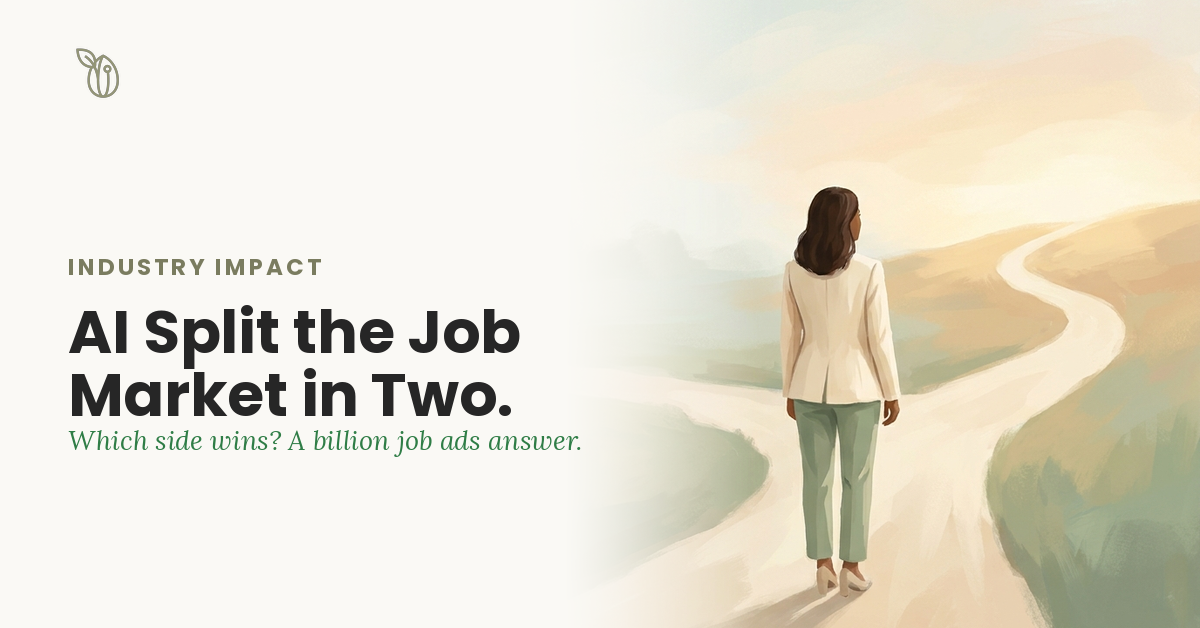
PwC just did something the AI jobs debate badly needed. They stopped guessing and counted. More than one billion real job ads across 27 countries, released this morning.
The finding lands like a fork in the road. AI is not deleting the job market, it is splitting it into two tracks. On one side, roles where AI handles the routine and a human carries the judgment are hiring faster and paying more. On the other, roles where AI just made the task easy for anyone are getting crowded and cheap.
I am calling the thing the market now pays extra for the Judgment Premium. Not knowing the tool, everyone has that. Knowing when the tool is confidently wrong, that is the scarce skill.
The difference between the two tracks is not talent or a fancy degree. It is a daily habit of checking AI instead of just shipping whatever it produces.
What is one task where you have actually caught AI being wrong lately, and how did you spot it?
Full breakdown in today's post: AI Split the Job Market in Two → https://www.harvestkernel.com/ai-job-market-two-track-pwc-barometer/
<img src='https://www.harvestkernel.com/wp-content/uploads/2026/06/ai-wont-replace-great-teachers.png' alt='AI Won\'t Replace Great Teachers - Harvest Kernel' style='width:100%;border-radius:8px;margin-bottom:16px;' />A language tutoring company just raised 150 million dollars and spent it making their human teachers better, not replacing them. That one choice says more about where AI in education is heading than any product launch this year.
Here is what stopped me: Preply reports that 97 percent of their learners say human interaction is the part they value most. So they aimed the AI at the busywork (lesson recaps, practice drills, progress tracking) and left the actual teaching to people. That division of labor is the whole game.
I pulled one skill out of the story and named it the Augmentation Test. Before you let AI touch a task, ask whether it replaces your judgment or frees you to use more of it. Lean in when it frees you. Stop when it quietly takes over the thinking.
Have you found a task where AI clearly made you better at the human part of your work, instead of just doing it for you? I want the specific example, because that line lands in a different place for everyone.
Dive deeper in today's post: AI Won't Replace Great Teachers. It Makes Them Greater. → https://www.harvestkernel.com/ai-wont-replace-great-teachers/
New on the blog: a fresh MIT Media Lab study found that people who leaned on AI to verify facts got worse at spotting misinformation once the AI was gone. It is called the AI dependency paradox, and it is the strongest case yet for using AI to build judgment instead of replacing it.
Read it here: https://www.harvestkernel.com/ai-dependency-paradox-use-ai-to-build-judgment/
New on the blog. Real creators are now being asked to prove they are human, and the AI fakes have gotten good enough that detectors are losing the arms race. The durable answer is not a better detector. It is discernment, built as a small daily habit.
Read it here: When You Can't Tell What's Real: Why Discernment Is Now Your Most Valuable AI Skill
What is one piece of content you saw this week that made you pause and wonder if a human actually made it?
OpenAI just rolled out Dreaming, a memory system that quietly builds a running model of who you are across every conversation. It is rolling out to Plus and Pro users now and Free accounts in the coming weeks, which means persistent AI memory is about to be the default experience for everyone.
Today's post breaks down what shipped, why it changes the relationship between you and your AI, and the simple habit we call Memory Hygiene: review, prune, direct, repeat.
Read the full post: https://www.harvestkernel.com/chatgpt-dreaming-memory-upgrade-memory-hygiene/
New on the blog. A peer-reviewed study just followed faculty through a self-paced AI micro-credential, and the result is the cleanest proof of SeedStacking I have seen. They came out more confident AND more careful at the same time.

The takeaway is simple. AI literacy is not a policy you hand down. It is a skill you build in reps. Read the full piece, including a four-rep loop you can run on yourself this week: https://www.harvestkernel.com/faculty-ai-literacy-micro-credential-sdsu-study/
New on the blog. The largest US teachers union just asked schools to keep AI out of elementary classrooms. No student facing AI in elementary, no companion chatbots under sixteen, supervised use for older students. They are not anti AI. They are asking a sequencing question, and read through the SeedStacking lens it maps almost perfectly: protect the Seed stage, supervise the Sprout stage, build judgment by graduation.