The Two-Track Workforce: Why AI Skills Alone Won’t Save Your Career
There is a single number in this week’s workforce news that deserves more attention than every layoff headline combined. It comes from Randstad, the largest staffing company in the world, which means it is not a small or cherry-picked sample. The finding: workers who hold a verified AI certification are being promoted more than three times faster than their peers, and entry-level workers with AI skills are earning roughly 25 percent more than the colleagues sitting next to them.
Same role. Same starting line. A measurable pay gap, decided largely by one factor. That is not a prediction about the future. That is data describing right now.
The headlines are telling you half the story
If you have read the news this month, you have seen the fear. Major technology companies announcing workforce cuts. Forecasts of AI-driven job losses. That anxiety is not imaginary, and pretending otherwise would be dishonest. But fear, on its own, is not a plan. And it is only half the picture.
Because while one part of the workforce is contracting, another part is wide open. The same Randstad research found that senior AI roles carry vacancy rates above 25 percent in certain markets. Employers cannot find the people they need. The shortage is not talent in general. It is a specific kind of capable professional who can integrate, govern, and scale these systems.
The real story
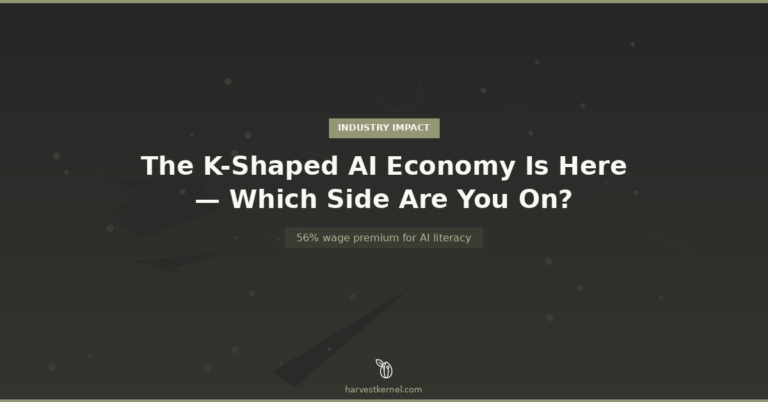
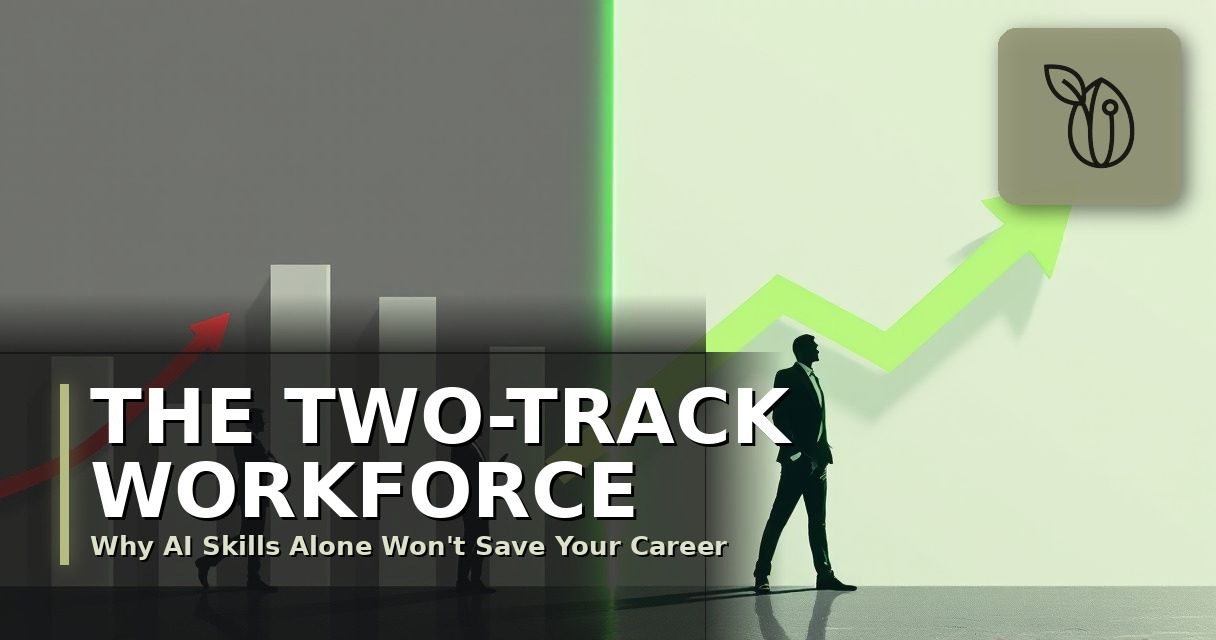
AI is not simply destroying work. It is splitting the workforce into two tracks. One track is shrinking. The other is paying more and promoting faster. The gap between them widens every month, and which track you land on is increasingly a choice, not a circumstance.
Want to know which track you are actually on? We built a two-page self-assessment that scores you across AI fluency and AI judgment, then names your next concrete step.
What actually gets you on the right track
Here is where most people get the answer half right. The obvious conclusion is “learn the tools.” Get fluent with the AI platforms, earn the certification, and you are set. Fluency matters, and the certification data backs that up. But it is not the whole answer, and the same Randstad report contains the proof.
In that same study, demand for emotional intelligence rose 173 percent. Demand for creativity rose 168 percent. Problem solving, critical thinking, and ethical judgment all climbed. Sit with what that means. The technology became more powerful, and the distinctly human skills became more valuable, not less. Randstad’s own framing is that advancement is now driven by AI fluency, adaptability, and uniquely human capabilities, rather than tenure alone.
This pattern is showing up everywhere. Recent reporting from The Wall Street Journal on the first wave of “AI-native” graduates found the same split: employers are cutting some entry-level roles while fast-tracking graduates who can genuinely work with AI. One detail from that reporting stuck with us. A university professor stopped policing whether students used AI and instead asked them to submit their full chat logs, so she could grade how they thought, not just what they produced. She was grading judgment.
Like what you’re reading? This is the kind of practical AI literacy we work through together every day.
Fluency, then judgment: the SeedStacking path
The winning track is not AI fluency alone. It is AI fluency plus human judgment. The tool, and the wisdom to direct the tool. That combination is the entire premise of SeedStacking, and it is built in a deliberate order.
The Seed and Sprout phases build your fluency. You get comfortable. You learn what these tools can actually do, and what they cannot. That is the foundation. But a foundation is not a finished house. The Grow and Harvest phases build the judgment layer: knowing which AI output to trust, recognizing when a confident answer is quietly wrong, and applying the tool to a real problem in a way you would stake your name on.
A professional who can do both is not competing with AI. They are directing it. And the Randstad data says that person gets promoted three times faster.
The instruction is the other number
The fear in the headlines is real, but it is not the instruction. The instruction is the other number. Twenty-five percent more pay. Three times faster to promotion. That is the measurable reward for landing on the right track, and the track is open right now.
You do not need to be a new graduate to start. You do not need a computer science degree. You need to build fluency, and then build judgment, deliberately, in that order. That is a learnable path, and in a year defined by workforce anxiety, it is the most reliable investment you can make in yourself.
Ready to go beyond reading and start building AI fluency?
Join the free Harvest Kernel community, where educators and professionals build the fluency-plus-judgment combination employers are paying for.
Plant Ideas. Cultivate Skills. Harvest Results.