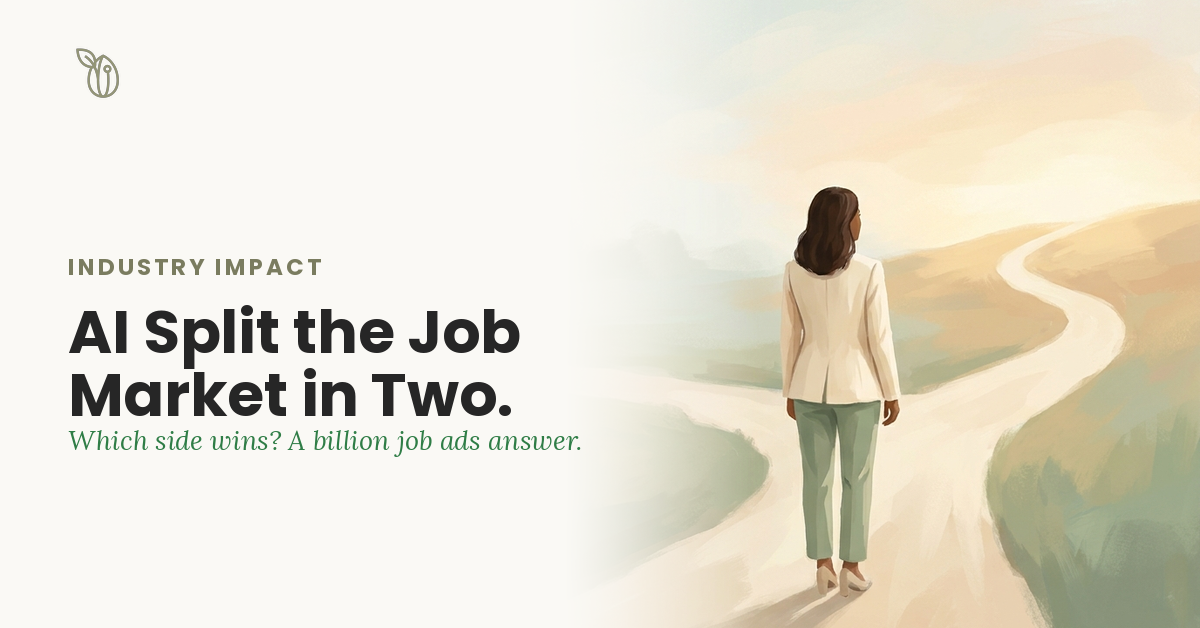
AI Split the Job Market in Two. Which Side Wins?
For three years the argument about AI and your job has been a shouting match. One camp promised a productivity paradise. The other promised a jobs apocalypse. Both sides waved studies. Neither side could prove much, because nobody had counted the actual jobs at scale.
Today that changed. PwC released its 2026 Global AI Jobs Barometer, built on more than one billion real job advertisements across 27 countries. That is not a survey of opinions. That is the labor market showing its hand. And the answer it gives is neither paradise nor apocalypse. It is a fork.
The market did not shrink. It split
The headline finding is simple enough to change how you plan your next five years. AI is sorting work into two tracks, and the two tracks are moving in opposite directions.
On one track sit what PwC calls professionalised roles. These are jobs where AI swallows the routine and frees a human to do the judgment heavy part. Think of a radiologist who reads more scans because the model flags the obvious cases, or a recruiter who interviews more candidates because the sourcing is automated. On the other track sit democratised roles, where AI makes the task itself easy enough that almost anyone can do it. The first track is hiring faster and paying more. The second is not.
Sit with that gap for a second. Same economy, same technology, two completely different outcomes depending on which side of the line your work falls. The roles where AI raises the ceiling on what a skilled human can do are seeing roughly double the growth in openings. The roles where AI lowers the floor on who can do the work are getting crowded and cheap.
Feeling behind on all of this? You are not. You are early. Start here, free.
Meet the Judgment Premium
Here is the pattern underneath the data, and it deserves a name. Call it the Judgment Premium. The market is now paying extra for exactly the things a model cannot hand you: knowing which answer to trust, deciding what matters, owning the call when it is wrong. AI made raw output nearly free. So the value moved to the one scarce thing left, which is good judgment about that output.
Now, you might be thinking this is just another way of saying learn to use the tools. It is not, and the distinction is the whole game. Tool familiarity is table stakes. Everyone on both tracks can prompt a chatbot by now. What separates the professionalised track is the layer on top: the human who can look at a confident, fluent, completely wrong AI answer and catch it. We wrote about this gap before the data confirmed it, in the two track workforce. PwC just put a billion job ads behind the argument.
AI made the answer free. The market now pays for knowing which answer to trust.
The Judgment Premium
The slow track trap nobody warns you about
The mistake that strands people on the slower track is treating AI skill as a box to check. You took the workshop. You watched the webinar. You can make the tool spit out a draft. Done, right? That is exactly the trap. A checkbox skill is, by definition, a skill anyone can check. It cannot command a premium because it is not scarce.
The work that holds its value does the opposite. It compounds. Every time you use AI to draft something and then catch what it got wrong, your judgment sharpens a notch. That sharpening is the asset. It is also the thing that cannot be downloaded in an afternoon, which is precisely why the market rewards it. The skill that protects you is not knowing the tool. It is the discernment to know when the tool is lying to you with a straight face.
Picture two people who took the same AI workshop last spring. One went back to their desk, generated reports, and shipped whatever the model produced. The other generated the same reports, then spent ten minutes a day asking where the numbers came from and which claims would survive a tough question in a meeting. A year later they have identical certificates and completely different careers. The first one is a faster typist. The second one became the person the team trusts to make the call. Only one of those is scarce, and the market knows the difference.
Like what you are reading? Get insights like this delivered daily.
The first rung is where it bites hardest
This year PwC added something its earlier barometers did not have: a hard look at entry level roles. And that is where the news turns serious. The first job, the one that used to teach you the ropes, is the one most exposed when AI absorbs the routine tasks that entry level work was built on.
If you are anything like most people watching this happen to younger workers, the worry is obvious. How does anyone build judgment if the entry level rung that used to build it is disappearing? It is a fair question, and we have been tracking it closely, because the same pattern showed up when entry level jobs kept vanishing even as student AI use surged. The honest answer is that the rung is not gone, it moved. The new first rung is the one who arrives already able to work alongside AI and check it, instead of being trained from zero. That is a higher bar. It is also a learnable one.
How to land on the winning track
None of this requires a computer science degree or a year off to retrain. The Judgment Premium is built the same way every durable skill gets built, through small reps that stack. That is the entire idea behind SeedStacking: tiny, daily, deliberate practice that compounds into real capability instead of a certificate you forget by Friday.
Practically, it looks like this. Pick one real task you already do. Run it through AI. Then do the part the model cannot, which is judge the result against what you actually know. Was it right? Where did it bluff? What would you stake your name on, and what would you quietly fix? Do that daily and you are not collecting tool tricks. You are growing the exact muscle PwC just measured a salary premium for. As we have argued, AI literacy is the closest thing to job security the modern market offers, and the new data only makes that sharper.
The Harvest Kernel Takeaway
AI did not split the job market by accident. It split it by removing the routine and leaving the judgment. The winning track is open to anyone willing to build that judgment one small rep at a time. The losing track is reserved for people who keep treating AI as a magic button instead of a partner they have to supervise. You get to choose which one you practice for, starting today.
The shouting match is over. The data is in, and it is not asking whether AI will reshape your work. It already has. The only open question is which side of the line you build toward. Pick the track that pays for judgment, then start stacking the seeds that grow it.
Sources: PwC 2026 Global AI Jobs Barometer (released June 15, 2026), based on analysis of more than one billion job advertisements across 27 countries and territories.
Ready to go beyond reading and start building AI fluency?
Join the free Harvest Kernel community for practical guidance, fresh ideas, and tools that help you make AI useful in real life.