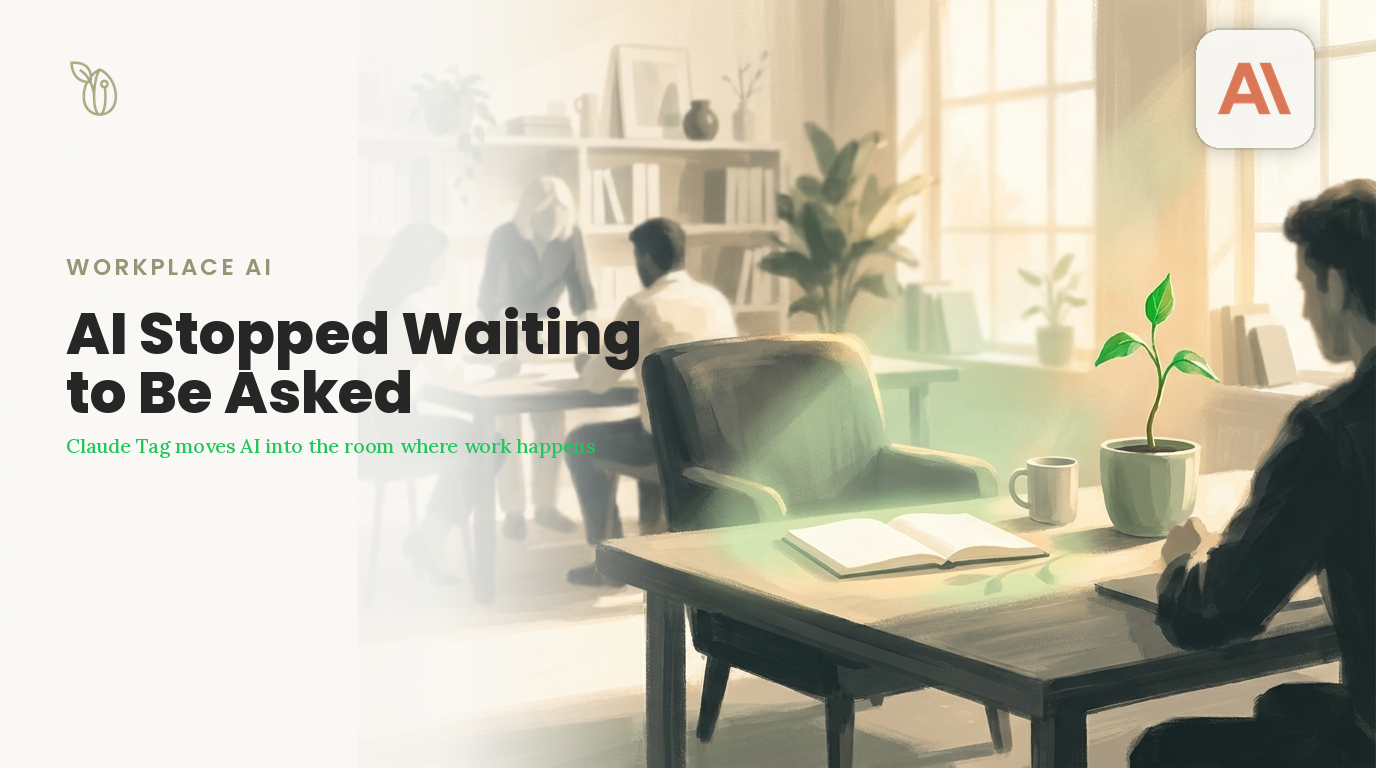
The Day AI Stopped Waiting to Be Asked
For about three years, the deal with AI at work was simple and a little lonely. You opened a tab, you typed a question, you got an answer, and you closed the tab. The AI sat in its own little room and waited for you to come visit. You did the carrying. You hauled the context in, you hauled the answer back out, and you pasted it wherever it actually needed to go. This week Anthropic took that room and knocked the wall down.
On Tuesday the company launched Claude Tag, an AI agent that lives directly inside Slack. You pull it into any channel by typing @Claude, you hand it a task the way you would hand one to a coworker, and then you go do something else. It reads the thread, breaks the job into steps, does the work, and reports back in the open where the whole team can watch it happen. It is in beta for Enterprise and Team customers, and it runs on Anthropic’s newest model, Claude Opus 4.8. Plenty of outlets are filing this under new feature. That undersells it. This is not a better answer box. It is a change in where the AI sits and what it does while you are not looking.
From a Tool You Visit to a Teammate That Stays
The old AI was single player. You had a private chat, nobody else could see it, and every new conversation started from a blank page. Claude Tag is the opposite of all three. It has one shared identity in a channel, so anyone on the team can hand it work, watch its progress, and pick up where a colleague left off. Slack’s general manager, Rob Seaman, framed the shift plainly, saying the agent shows up in the open instead of in a private back and forth. The work stops being a secret transaction between one person and a chatbot and starts being something the whole team can see and build on.
It also remembers. Because the agent follows a channel over time, it builds context about the project living there, which means people stop re-explaining the same background every single morning. And here is the part that should make you sit up. It does not wait to be asked. In what Anthropic calls ambient mode, the agent watches the flow of a channel on its own, surfaces updates that matter, and follows up on tasks and threads that have gone quiet. Anthropic’s own head of product for Claude Code described wiring the agent into her email so it reads her inbox, flags the messages that actually matter, and drops those alerts into Slack where she is more likely to act on them. Read that again. The AI is now the one doing the noticing.
None of this is a free for all. Administrators decide which channels and tools the agent can touch, set spending limits, and test it in a private channel before it goes live. This is governed infrastructure, not a toy bolted onto chat. Which is exactly why it matters, and exactly why the skill it demands is bigger than the one most people have been practicing.
Like what you’re reading? Get insights like this delivered daily.
The Fluency Gap Just Moved Again
Two days ago in this space we wrote about Samsung handing AI to every employee, and the hard lesson buried in that news. Access is the floor, not the ceiling. Owning the tool was never the advantage. Knowing how to wield it was. Claude Tag is that same lesson coming at you from the other direction, and faster.
When the AI waited politely in a tab, the skill of the moment was prompting. Ask a sharper question, get a sharper answer. That was the whole game. Now that the AI lives in the room and takes action on its own, prompting is table stakes. The skill that separates the fluent from the faking is delegation. Knowing what to hand off and what to keep. Knowing how to frame a task so an autonomous helper does not wander off a cliff. Knowing when to trust the output and when to check it with a skeptical eye. Knowing where to draw the boundary so the thing stays useful instead of becoming a liability. That is a harder skill than prompting, and most people have not started building it.
How serious is this shift? Anthropic says a large majority of its own product team’s code is now produced by the internal version of this tool. That number is not a brag about robots replacing engineers. It is a preview of what fluent delegation looks like running at full speed, inside the company that builds the thing. The rest of the working world is about to get the same invitation, ready or not.
What This Means If Slack Is Not Your World
Maybe you teach. Maybe you run a small shop. Maybe you are just a curious person trying to keep your footing in a fast year. Claude Tag is enterprise software you may never personally touch, and it would be easy to file this under someone else’s problem. That instinct is backward. Anthropic already said it plans to bring this always present agent to other platforms in the coming weeks. The agent that lives in the room is not a Slack feature. It is the next default, and it is heading for the tools you already use.
Educators feel this one first and hardest. Your students are going to graduate into workplaces where the AI is a standing member of the team, and the bar will not be can you write a prompt. The bar will be can you manage an autonomous helper without losing control of the work. That is a literacy, and like every literacy it is built, not announced. A school can buy a thousand licenses on Monday and have a thousand people on Tuesday who can summon an agent and have no idea how to direct it. The summoning was never the hard part.
SeedStacking: How You Build Delegation Before It Is Handed to You
Here is the good news, and it is genuinely good. You do not need Claude Tag to start practicing the skill Claude Tag demands. You need a method, and the method is smaller than you think. At Harvest Kernel we call it SeedStacking, and it was built for exactly this moment.
Plant a seed. Pick one real task this week and delegate the entire thing to an AI tool you already have, start to finish, instead of just asking it a question. Let it sprout. Repeat that same handoff until it feels natural and you can spot when the result is off without thinking hard about it. Grow it. Stack a harder, multi step task on top, the kind of job you would normally guard and keep for yourself. Harvest. The day you trust a handoff enough to walk away and then check the result with a quick, practiced, skeptical eye, you are doing the exact thing an agent like Claude Tag will ask of every knowledge worker. Then you stack again.
That is the quiet truth underneath all of this week’s noise. The tool changed. The skill it rewards is one you can start building right now, on free tools already sitting on your phone, one small stack at a time, long before anyone tags an agent into your channel.
The Takeaway
Anthropic did not just ship a smarter chatbot. It moved AI out of its tab and into the room where work actually happens, as a teammate that acts on its own. The skill that used to matter was writing a clever prompt. The skill that matters now is delegating with judgment, and that one is built through small daily handoffs, not handed to you with a login.
The AI is not waiting in its own little room anymore. It is in the channel, in the thread, in the meeting, doing work while you do other work. That is a gift to anyone fluent enough to direct it well and a quiet threat to anyone who never learned how. The skill is learnable starting today, on the tools you already have, one seed at a time. Plant the first one before the agent shows up tagged into your Tuesday.
Ready to go beyond reading and start building AI fluency?
Join the free Harvest Kernel community for practical guidance, fresh ideas, and tools that help you make AI useful in real life.