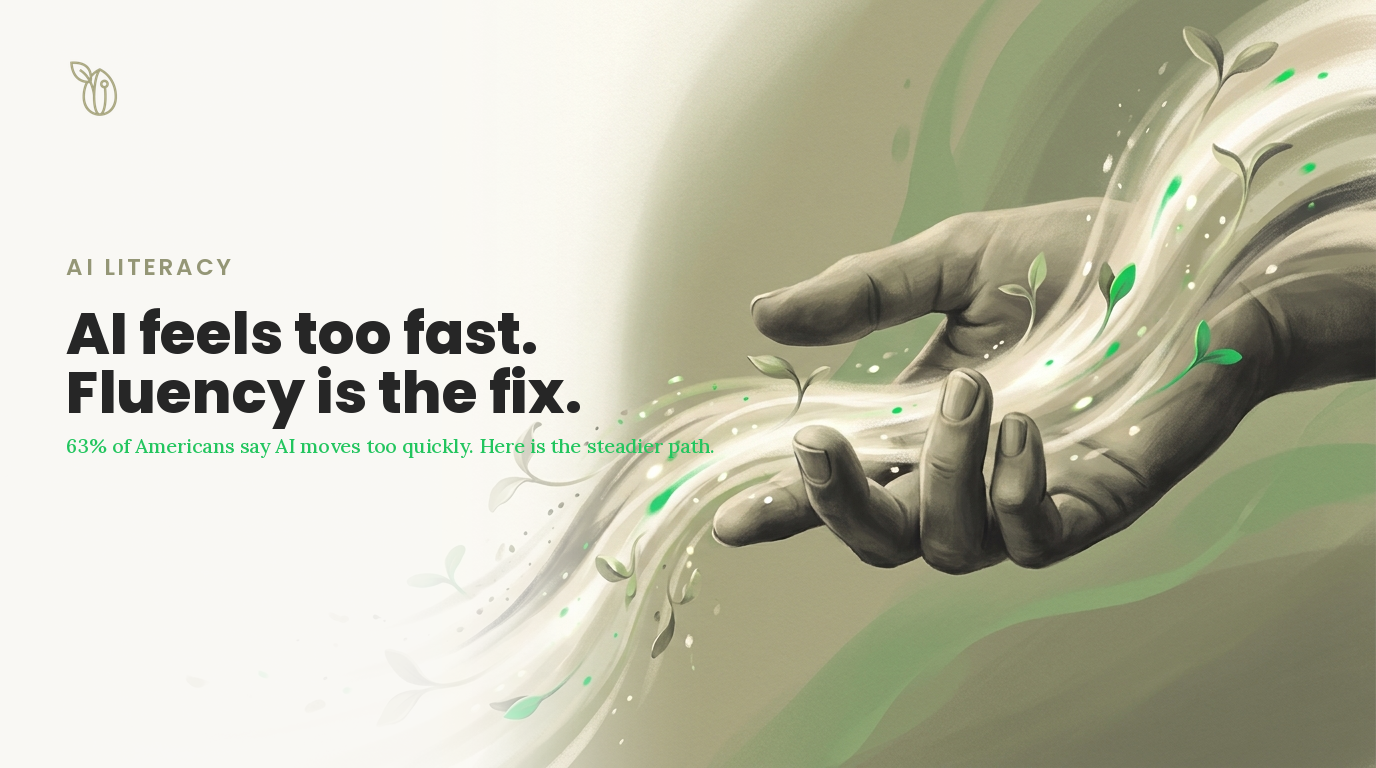
Most Americans Say AI Moves Too Fast. Here Is the Fix
Half of the country now opens an AI chatbot the way it once opened a search engine. And most of the country thinks that is a problem.
A new Pew Research Center survey, released June 17, found that 63 percent of U.S. adults believe artificial intelligence is advancing too quickly. Only 19 percent say the pace feels right, and a rounding-error 2 percent say it is moving too slow.1 Yet the same study found that 49 percent of adults now use chatbots like ChatGPT, Gemini, or Copilot, up from just 33 percent in 2024, with roughly one in four reaching for them every single day.1
The dashboard light most people are ignoring
Read those two numbers together and you get the defining tension of this moment. We are using the thing we say is moving too fast. That is not hypocrisy. It is a warning light on the dashboard, and most people are driving with it on.
Here is what the Pew data is really telling us. The unease is not coming from people who refuse to touch AI. It is coming from people who use it and still feel like passengers. They feel the speed, but they do not feel the steering wheel. That gap, between using a tool and actually controlling it, is the thing worth naming.
You might be thinking the obvious fix is to slow the technology down. Reasonable instinct. It is also a fantasy. The companies building these tools are in a capability race that no individual educator, parent, or professional gets a vote in. Waiting for the world to hit the brakes is a plan to stay anxious indefinitely.
Why slowing down was never the real option
The Pew numbers carry a second layer that explains the dread. Only 16 percent of Americans expect AI to have a positive effect on society over the next two decades, and 71 percent believe it will make their personal information less secure.1 Younger adults, the heaviest users at 66 percent adoption under age 30, are actually the most pessimistic of anyone.1 Familiarity is not breeding comfort. It is breeding a very specific kind of fear: the fear of a force you handle every day but do not understand.
That distinction matters more than any headline percentage. People are not afraid of AI because they have used too much of it. They are afraid because they have used a lot of it without ever learning how it actually works, where it fails, and how to make it answer to them instead of the other way around. Speed is the symptom. The missing piece is fluency.
The Fluency Dividend, and why it compounds
Call it the Fluency Dividend. Every small, deliberate skill you build with AI pays you back twice. Once in the task you just finished faster, and again in the anxiety you no longer carry into the next one. Confidence is not a personality trait here. It is a return on investment, and the investment is small reps done consistently.
This is the whole idea behind SeedStacking. You do not become AI fluent by reading one more think piece about the apocalypse or the utopia. You become fluent by planting one seed, a single small skill, then stacking the next one on top of it tomorrow. Verify a chatbot’s answer instead of trusting it. Write one prompt that names your goal, your audience, and your format. Catch one confident-sounding hallucination before it reaches your boss or your students. None of these take an hour. All of them compound.
We have made this case before in plain terms: the goal is not to use AI more, it is to use it with judgment. If you want the longer argument, our piece on using AI to build judgment rather than erode it is the natural next step, as is the one on spotting AI-generated content, which is fast becoming a basic literacy.
The seed for today
The cure for feeling like AI is moving too fast is not a slower world. It is a steadier you. Pick one small AI skill this week, practice it twice, and notice how much of the dread was really just unfamiliarity wearing a costume.
What fluency looks like for the three people reading this
For the educator, fluency is not handing students a tool and hoping. It is modeling how you interrogate an AI answer out loud, so your classroom learns discernment instead of dependence. That is also why we keep saying AI will not replace great teachers, it will expose the difference between teaching content and teaching thinking.
For the professional, fluency is the difference between being the person who fears the layoff memo and the person who quietly became the most useful human in the room. The Pew data shows 38 percent of employed adults already use chatbots for work tasks.1 The dividing line in your office is no longer who uses AI. It is who uses it well.
For the lifelong learner, fluency is permission to be curious without being naive. You can marvel at what these tools do and still keep your hand firmly on the wheel. Wonder and skepticism are not opposites. Together they are exactly what an informed adult brings to anything powerful.
Start before you feel ready
The 63 percent who feel AI is moving too fast are not wrong about the speed. They are wrong about the remedy. You cannot control the pace of the industry. You can absolutely control the pace of your own competence, and that is the only pace that ever decided whether a new technology helped you or happened to you.
Plant one seed this week. Stack another next week. Anxiety hates a person with a habit.
Ready to go beyond reading and start building AI fluency?
Join the free Harvest Kernel community for practical guidance, fresh ideas, and tools that help you make AI useful in real life.

Dean helps educators, professionals, and lifelong learners build real AI fluency through small, compounding daily wins. Join the free community.
Sources: 1. Pew Research Center, “Americans and AI 2026: Chatbots, Smart Devices and Views on Impact,” released June 17, 2026 (survey of 5,119 U.S. adults, Feb 17 to 23, 2026). https://www.pewresearch.org/internet/2026/06/17/americans-and-ai-2026-chatbots-smart-devices-and-views-on-impact/