When Ford’s Robots Got It Wrong, Humans Got the Call
Here is a headline that should make every AI evangelist pause. Ford was just named the top mainstream automaker in JD Power’s Initial Quality Study, its first time at the top since 2010. A genuine comeback for a company that had become the most recalled carmaker in America. Then Ford did something rare. It explained how.
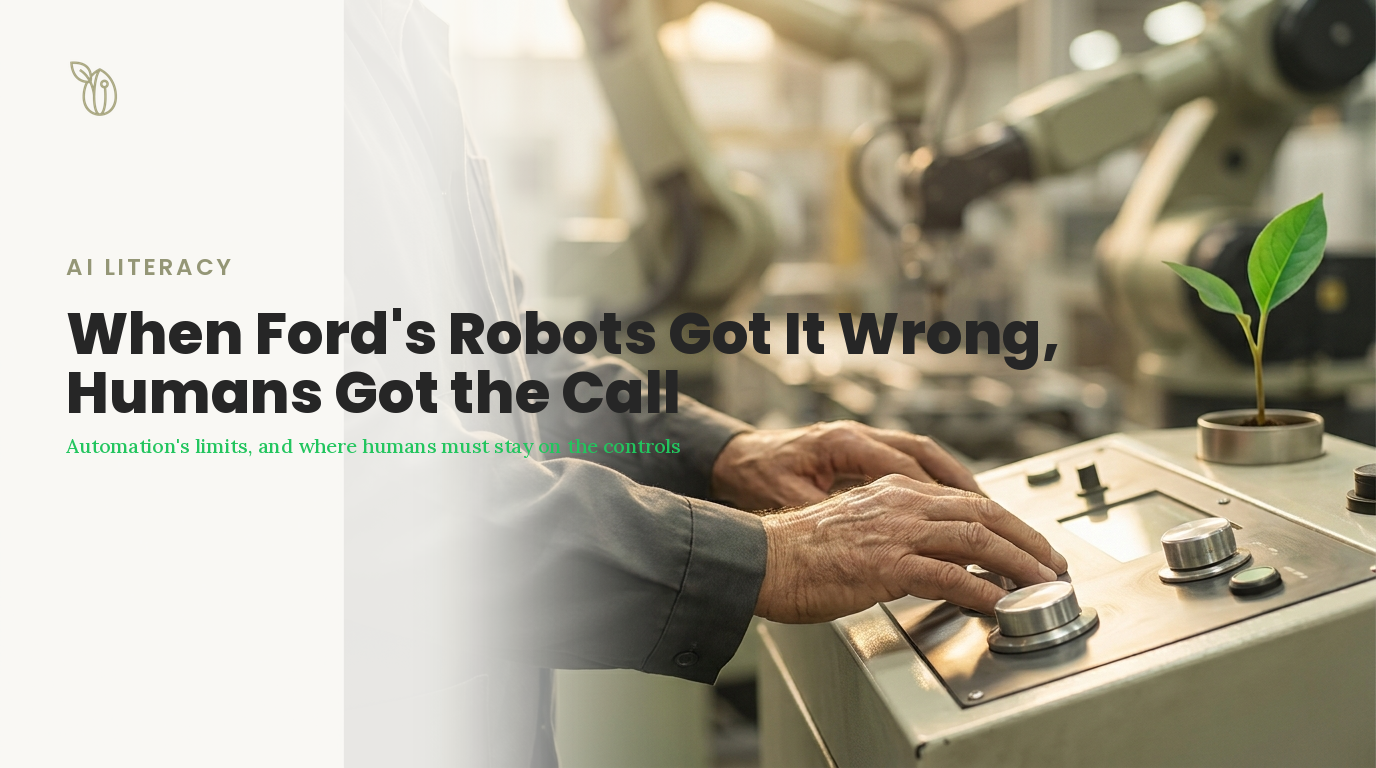
The fix was not a smarter model. It was not more data. Over the last three years Ford hired, promoted, or brought back more than 350 veteran engineers, many of them former employees, to clean up mistakes its automated systems had made. The company leaned hard into AI assisted design and algorithmic decision making, watched quality slide anyway, and reversed the slide by putting experienced humans back on the controls.
Ford did not automate its way to quality. It automated its way into a hole, then climbed out with people.
What actually broke
The tempting read is “AI failed.” That is not what happened, and the real story is more useful. Ford’s leaders say they assumed that feeding artificial intelligence into existing design requirements would produce a high quality vehicle on its own. Charles Poon, Ford’s VP of vehicle hardware engineering, admitted the company was simply mistaken about that. The systems were not as robust as advertised.
Two failures stacked on top of each other. First, the automated tools were trained on incomplete and fragmented data, so they confidently produced work that looked finished but was not. Second, and quietly worse, the veterans who could have caught those errors had already left, taking decades of hard won judgment with them before it was ever encoded into the tools meant to replace them. Ford’s COO Kumar Galhotra describes the deeper cause as structural. Departments ran in silos, and the company defaulted to a reactive find and fix habit, catching each defect after it shipped rather than preventing the next one.
The Oversight Gap
Name a thing and you can manage it, so here is the name for what bit Ford. The Oversight Gap is the distance between what an automated system promises and what it actually delivers, and that distance is only closed by a human who knows enough to notice the difference. Automation does not invent quality. It amplifies whatever you hand it. Feed it clean data and sound judgment and it scales your strengths. Feed it gaps and silos and it scales those just as fast, with a confident face that makes the gaps harder to see.
The part that should stay with you is why human expertise mattered so much. The knowledge Ford’s veterans carried was tacit. It lived in intuition built over decades, the kind of “that does not look right” that fires before anyone can explain why. That layer is exactly what current AI systems struggle to absorb, because nobody wrote it down. When it walked out the door, the models had no way to reconstruct it.
Here is the nuance most takes are missing. Ford did not retreat from automation. While it was rehiring those engineers, it also added more than 100,000 AI driven validation tests and stood up a dedicated 40 person software quality team. The company did not pick humans over machines. It stopped pretending the machines could run unattended. That is the whole lesson in one move. The goal was never less AI. It was AI with a hand on the wheel.
Like what you are reading? Harvest Kernel is a free community for educators, professionals, and lifelong learners who want to use AI with judgment, not blind trust.
This is not just a Ford problem
You do not run an assembly line, so it would be easy to file this under “big company news” and move on. Do not. The Oversight Gap shows up the moment any of us hands real work to a tool we do not fully understand. A teacher who lets an AI grader score essays inherits the grader’s blind spots. A small business owner who ships AI written client work inherits whatever the model guessed wrong. A student who pastes in an answer without checking it inherits an error they cannot even see, because the output reads fluent and sure.
That is the trap. AI rarely fails loudly. It fails fluently. The output looks polished, the tone is confident, and the mistake hides in plain sight until someone with real understanding looks twice. Ford had to spend three years and rebuild a whole engineering bench to learn that lesson at industrial scale. You can learn it this afternoon, for free, and apply it to the next thing you delegate to a machine.
Keep humans on the controls
So where do you keep a human in the loop, and where is it safe to let the tool run? Guessing is expensive. A simple check is cheaper. Here is the one we teach inside SeedStacking, built on the four phases our members already use to grow any new skill.
Seed
Name the stakes
Ask what breaks if the output is wrong and nobody catches it. A misspelled caption is cheap. A graded transcript, a medical summary, or a shipped product is not. High stakes means a human stays on the controls, every time.
Sprout
Check the inputs
Look at what the tool was trained or prompted on. Garbage in does not announce itself. If you cannot vouch for the data or the source, treat every output as a draft, not an answer.
Grow
Keep a tacit check
Put someone with real experience between the machine and the decision. Their job is the gut level “that does not look right” that the model cannot feel. This is the exact role Ford had to rehire.
Harvest
Build the loop back in
Every error a human catches should teach the system. Feed it back into the data, the prompt, or the process so the gap closes over time instead of repeating. Oversight is not a one time review. It is a habit.
The Seed
Ford’s comeback is not a story about machines beating humans or humans beating machines. It is proof that the winners pair the two. The companies, classrooms, and careers that pull ahead will not be the ones that automate the most or the fastest. They will be the ones who know exactly where human judgment is irreplaceable, and refuse to give that ground away. Plant the judgment. Cultivate the oversight. The results follow.
Ready to go beyond reading and start building AI fluency?
Harvest Kernel gives educators, professionals, and lifelong learners a place to build real AI judgment together. Weekly challenges, a working library, and people who care about doing this well.