Who Holds the Pen When AI Enters the Classroom
This week, 150 people sat down in a Google office in New York and started sketching what your classroom looks like in 2030. Educators were in the room. Hiring managers were in the room. The question on the table was the one every teacher has been circling for two years: how do we get today’s students ready for careers that AI keeps reshaping?
Google hosted the summit with the New York Jobs CEO Council and Urban Assembly, and the official recap reads like a press release, all handshakes and hands-on demos. But buried in the pleasantries is a message educators should take personally. The people doing the hiring just told the people doing the teaching exactly what they want. And the answer was not more software. I call it the Human Skills Dividend, and once you see it, you cannot unsee it: the more routine work AI absorbs, the more the market pays for adaptability, collaboration, and critical judgment. The robots are raising the value of being human.
What actually happened in that room
The summit brought together 150 education and industry leaders for a day of working sessions, not keynote theater. Educators ran hands-on workshops like aiEDU’s Vibe Coding session and Google’s Meet LEA demo, and they stress-tested tools like AI Mode and NotebookLM against a practical question: can this spark curiosity and build real AI literacy, or is it another shiny thing that dies by October? According to Google’s own recap, the theme that kept surfacing was that AI’s true impact is the problem-solving it enables, not the features on the box.
The location matters more than the catering. New York City runs the largest school district in the country, over a million students, and its AI decisions ripple outward to every district watching. This is the same system that banned ChatGPT in early 2023 and then reversed course months later. Now, three years on, its educators are in the room where the tools get shaped. That arc, from ban to reversal to a seat at the table, is the whole story of AI in education compressed into one city.
That recap is nice to know. But the reason this summit matters to a teacher in Wisconsin or a trainer in Texas has nothing to do with New York.
The Human Skills Dividend, straight from the people who hire
Here is the part worth printing out. Industry leaders at the summit, the ones who sign offer letters, told the room that as AI streamlines workflows, human skills become essential. Adaptability. Collaboration. Critical judgment. Not one of those shows up in a software license, yet teachers build all three in classrooms.
Now, you might be thinking: teachers have been saying this for a decade, so what changed? What changed is who is saying it. When educators defend human skills, it reads as turf protection. When hiring managers say it inside a tech company’s own building, it becomes market data. The dividend is real and it is already being paid. The World Economic Forum projects AI’s role in education will grow into a 112 billion dollar industry by 2034, and the majority of high school and college students already use AI for schoolwork. The tools are here. The differentiator is what students do around them, and that is judgment, and judgment is taught.
This connects to something we saw in the Ford story: when the automation got it wrong, the call went to a human with judgment. The pattern repeats everywhere AI lands. Most coverage stops at the feel-good quote, though. The next piece is the one that decides whether your school wins or loses this decade.
With schools, not around them
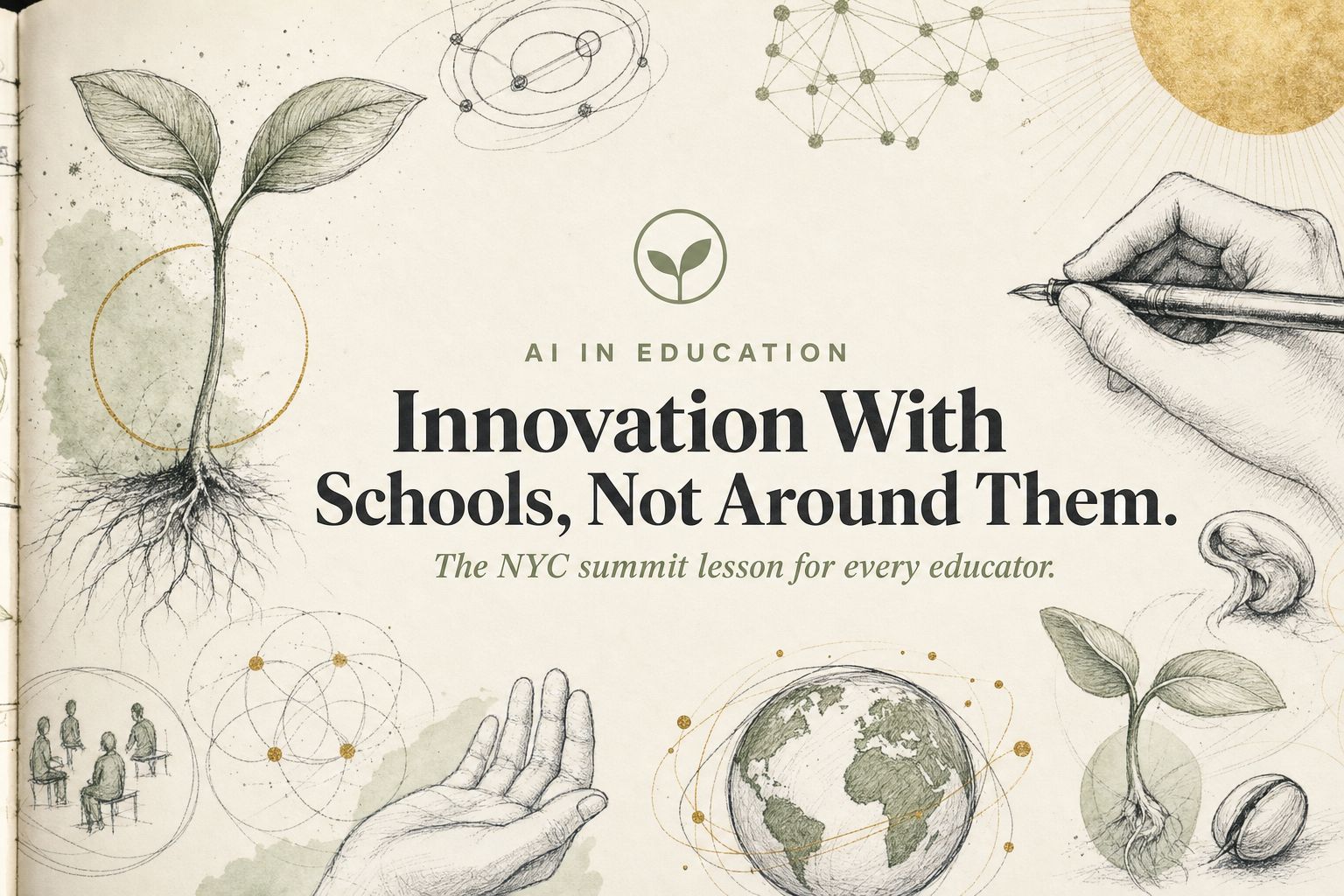
The summit’s closing takeaway was five words: innovation must happen “with schools, not around them.” That sounds like a courtesy. It is actually a warning with the polarity flipped. Because the default path, the one that happens when nobody fights it, is exactly the opposite. Ed tech gets built in an office, piloted on a sales call, and dropped into classrooms with a login sheet and a prayer. Around, not with. Every teacher reading this has lived that rollout at least once.
The question that comes up here is the honest one: how does a regular educator, not one of the 150 in that room, get a say? The answer is uncomfortable and empowering at the same time. You get a seat at the table by being fluent enough to hold one. Nobody invites the person who needs the tool explained to them to help design the tool. They invite the teacher who can say, this feature will die in third period and here is why. Fluency is the price of admission, and the mistake that keeps educators voiceless is waiting for permission or a workshop before building it.
Fluency is built in small daily reps.
That is exactly what SeedStacking does: one small AI habit at a time, stacked until you are the most fluent voice in the building.
See the SeedStacking methodThe guardrails the room agreed on
One more signal from the summit deserves attention, because consensus between educators and industry is rare enough to notice. Attendees agreed that classroom AI must remain uncompromising on two things: student data privacy and equitable access. Google has skin in this game, with over 150 million dollars committed to AI literacy efforts and an educator training series built with ISTE and ASCD aimed at reaching millions of K-12 teachers and higher ed faculty. Take the corporate motives with whatever salt you like. The guardrails themselves are the right ones, and educators should hold every vendor to them, Google included.
Privacy and equity are also where the with-versus-around distinction gets teeth. A tool built around schools treats student data as exhaust and assumes every kid has a device and bandwidth. A tool built with schools gets interrogated by people who know better, before the contract is signed. That interrogation only happens when the educator in the room understands what the tool actually does. Yet fluency without a plan is just trivia, so here is the plan.
How to claim your dividend, the SeedStacking way
You do not need an invitation to a Google office to start. You need four moves, run in order, starting this week.
- Seed. Pick one tool from the summit’s own table, NotebookLM is a fine start, and use it on one real task from your week. Not a demo. A real lesson plan, a real reading packet.
- Sprout. Write down where it helped and where it fumbled. Two columns, five minutes. That page is the beginning of professional judgment no vendor can hand you.
- Grow. Bring your notes to one colleague or one department meeting. The moment you can explain a tool’s limits out loud, you have become the fluent voice in the building.
- Harvest. When the district forms its next AI committee, and it will, volunteer with your notes in hand. That is how with-not-around happens at your school: someone fluent shows up.
Want this as a guided tool?
The Hold the Pen Fluency Kit walks you through all four phases and assembles your notes into a Committee Card you can bring to your school’s next AI conversation.
Open the Fluency KitThe Seed
The future of the classroom is being drafted in rooms like that one, and the pen goes to whoever shows up fluent. The summit’s message, once you strip the polish, is that the Human Skills Dividend is real, the hiring side will pay it, and the educators who build their own AI fluency get to decide how these tools meet their students. Innovation with schools is not something tech companies grant. It is something teachers claim. Start with one seed this week, and when the conversation about AI in your building finally happens, make sure you are holding the pen.
Ready to go beyond reading and start building AI fluency?
Join the free Harvest Kernel community for practical guidance, fresh ideas, and tools that help you make AI useful in real life. The article gives you the what. The community gives you the how.
Join the Free Community
Dean Le Blanc
Founder of Harvest Kernel. Dean teaches educators, professionals, and lifelong learners how to turn AI from a buzzword into a practical, repeatable skill using the SeedStacking method. Straight talk, no hype, no jargon.
Book a working session with Dean