The Thinking Is the Point: Using AI Without Outsourcing Your Judgment
Your students already use generative AI. So do your coworkers, your neighbors, and if we are honest, most of us. The debate about whether people would lean on these tools is over. A harder question has taken its place, and it is quieter. When a machine can produce a clean answer in seconds, what happens to the thinking that used to produce it?
A recent essay in Times Higher Education framed the tension with unusual honesty. The author watched capable students turn in work that looked sharp on the surface and stood on nothing underneath. The polish was genuine. The reasoning behind it was rented. That gap is the real story of AI literacy right now, and it stretches far beyond any classroom.
The Trap Hiding Inside a Good Answer
For a long time, school rewarded the fast and tidy output. Fill the blank. Produce the essay. Land the right number. Generative AI walked in and did all of that faster than any person could, and in doing so it exposed something we had been sidestepping for years. We built too much of learning around answer production and too little around thinking.
The author gave the symptom a sharp name. Students hand in what she calls pseudo polished reasoning. The writing reads as if a mind worked through it. Push one layer deeper and the structure gives way, because the person never built that structure in the first place. They lean on scaffolding the tool provided. They freeze the moment the format shifts. They treat not knowing as a verdict rather than the ordinary starting line of real learning. None of that is a failure of character. It is a predictable result of tools that reward speed over understanding, aimed at people who were never shown the difference.
From Prompt and Answer to a Real Loop
Here is the shift the essay proposes, and it is worth stealing for your own work. The way most people use AI looks like this. Prompt, then answer. You ask, it delivers, you move on. Nothing in that loop asks you to think.
The better pattern is longer on purpose. You explore, then you structure, then you prototype, then you test, then you revise, then you reflect. AI has a role in every one of those steps, but as a partner in reasoning, not a vending machine for conclusions. You use it to widen your options, to stress test a draft, to find the weak joint in your own logic. The thinking stays with you. The tool makes your thinking faster and braver, not absent. The difference is not how much you use AI. It is where you stand while you use it.
Want to practice thinking with AI, not around it?
The free Harvest Kernel community runs on this exact idea. Real people, real prompts, real reasoning out loud.
Join the Free CommunityThis Is Not Only a Classroom Problem
It is tempting to file this under education and move on. Do not. The same trap waits in every office that now runs on AI. The analyst who pastes a prompt and forwards the output without reading it. The manager who lets a model draft the strategy and never asks why it chose that path. The parent who watches a child outsource a book report and senses, correctly, that something important is being skipped.
The skill that protects you is the same in each case. You have to stay the author of your own reasoning. The people who thrive over the next five years will not be the ones who can summon the most polished output on demand. They will be the ones who can still think clearly when the tool is switched off, and who use the tool to reach further than they could reach alone. That is a skill you can build. It is also a skill you can lose, quietly, one skipped step at a time.
Notice what this reframes. The worry is not that people use AI too much. The worry is that they hand over the one part of the work that was theirs to keep. A calculator did not make us worse at reasoning, because we still decided what to calculate and why. The danger arrives when the tool starts making those decisions for us and we let it, because letting it feels like progress. Staying in charge is quiet work. It rarely shows up on the surface of the output, which is exactly why it is so easy to skip.
Seven Ways to Keep the Thinking in the Loop
The essay offers seven shifts for educators. They translate cleanly for anyone who works with AI, whether you teach a room, run a team, or just want to keep your own edge.
- Judge the reasoning, not the output. Before you accept an answer, ask how it was built and where it could be wrong.
- Make your thinking visible. Sketch how the ideas connect before you let AI fill the gaps for you.
- Sequence on purpose. Build your own first understanding, then bring in AI to accelerate, never to begin.
- Use AI to explore, not to conclude. Prototype three options and test them. Do not marry the first draft.
- Design backward from thinking. Start from the reasoning you want to grow, then choose the task that grows it.
- Reward productive uncertainty. Treat iteration and the phrase I am not sure yet as signs of learning, not weakness.
- Stay cognitively active. Build, test, and defend your understanding out loud. A mind that argues its case is a mind that grows.
Why We Call This SeedStacking
At Harvest Kernel we have a name for this way of working. We call it SeedStacking, and the metaphor is not decoration. A seed does not become a harvest because you wish it so. It moves through stages. You plant it, it sprouts, it grows, and only then do you harvest. Skip a stage and nothing holds.
AI tempts you to jump straight to harvest. Type the prompt, grab the yield, walk away. SeedStacking asks you to keep the earlier stages honest. Plant the idea yourself. Let it sprout in your own words. Grow it with the tool as a partner. Then harvest something you actually understand and can defend in a room full of skeptics. The output can look similar either way. The person who did the work is not the same person at all.
The essay from Times Higher Education ends on a line worth carrying with you. The issue is no longer whether people use AI. They already do. The issue is whether we keep designing our work and our classrooms around passive answer production, while the world starts to reward judgment, systems thinking, and the courage to reason in the open.
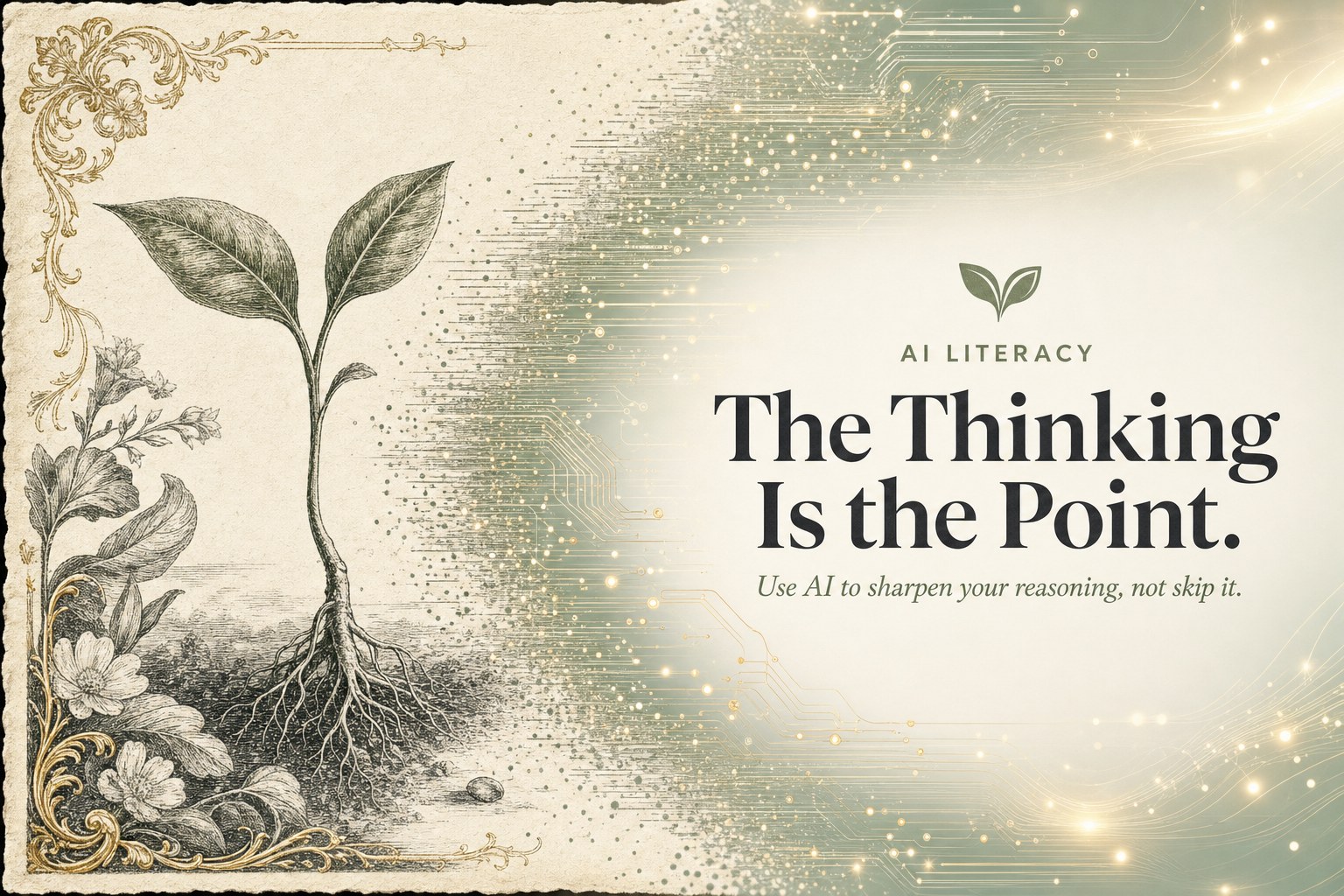
The thinking is the point. The tool is only ever as good as the mind still holding the pen.
Keep your edge as the tools get sharper
Start where it costs nothing, then go as deep as you like.
Join the Free Community Explore SeedStacking Book a Free Call