AI Detection Tools Are Failing. Here’s What Replaces Them.
Every semester a professor pastes a nervous student’s essay into an AI detector, watches the meter climb to ninety percent, and feels certain. That certainty is the most dangerous thing in the room. The tool that produced it cannot show its work, cannot explain its verdict, and has a documented habit of flagging honest students who happen to write cleanly or learned English second. We built a machine to catch cheating and quietly handed it the power to accuse.
The institutions paying closest attention have already reached a verdict of their own. They are switching the detectors off.
The Detection Reflex is failing in public
Call it the Detection Reflex: the belief that the answer to AI in the classroom is better software to catch it. It feels responsible. It is quietly falling apart, and the people pulling the plug are not fringe voices. Vanderbilt University disabled Turnitin’s AI writing detector and said so openly, walking through the math that should stop every administrator cold.
Here is the number that did it. Turnitin advertised a false positive rate of roughly one percent. That sounds like a rounding error until you multiply it by a real university’s output. At Vanderbilt’s submission volume, one percent meant about seven hundred and fifty student papers wrongly flagged as machine written in a single year. Seven hundred and fifty conversations that start with an accusation the software cannot defend.
Now you might be thinking that one percent is a price worth paying to catch the real cheaters. That is exactly the trade the detector is quietly asking you to make, and it gets worse when you see who lands in that one percent. Detectors flag writing from students who learned English as a second language at far higher rates, because clear, simple, grammatically tidy prose reads as machine written to a model trained on the messiness of native speakers. The tool is not neutral. It has a bias, and it points that bias at the students least equipped to fight an accusation.
What the detector actually measures
An AI detector does not detect AI. It measures how predictable your sentences are, then converts that guess into a confidence score dressed up to look like evidence. The model that writes the essay and the model that judges it are cut from the same statistical cloth, so the arms race is unwinnable by design. Every time a student runs their AI draft through a humanizer, the detector loses a step. Every time an honest student writes plainly, the detector gains a false target.
That is the trap. The score looks like proof, so it ends academic integrity cases before a human ever exercises judgment. Transparency is gone too, because no major detector will tell you how it reached its verdict. You are asked to accuse a student on the word of a black box that cannot be cross examined.
A detector gives you a number that feels like certainty. Your judgment gives a student a process that survives an appeal. Only one of those holds up.
The Harvest Kernel view
None of this means students get a free pass. It means the surveillance approach was the wrong tool for a design problem, and there is a better one sitting right in front of us.
The Trust Shift: from catching to designing
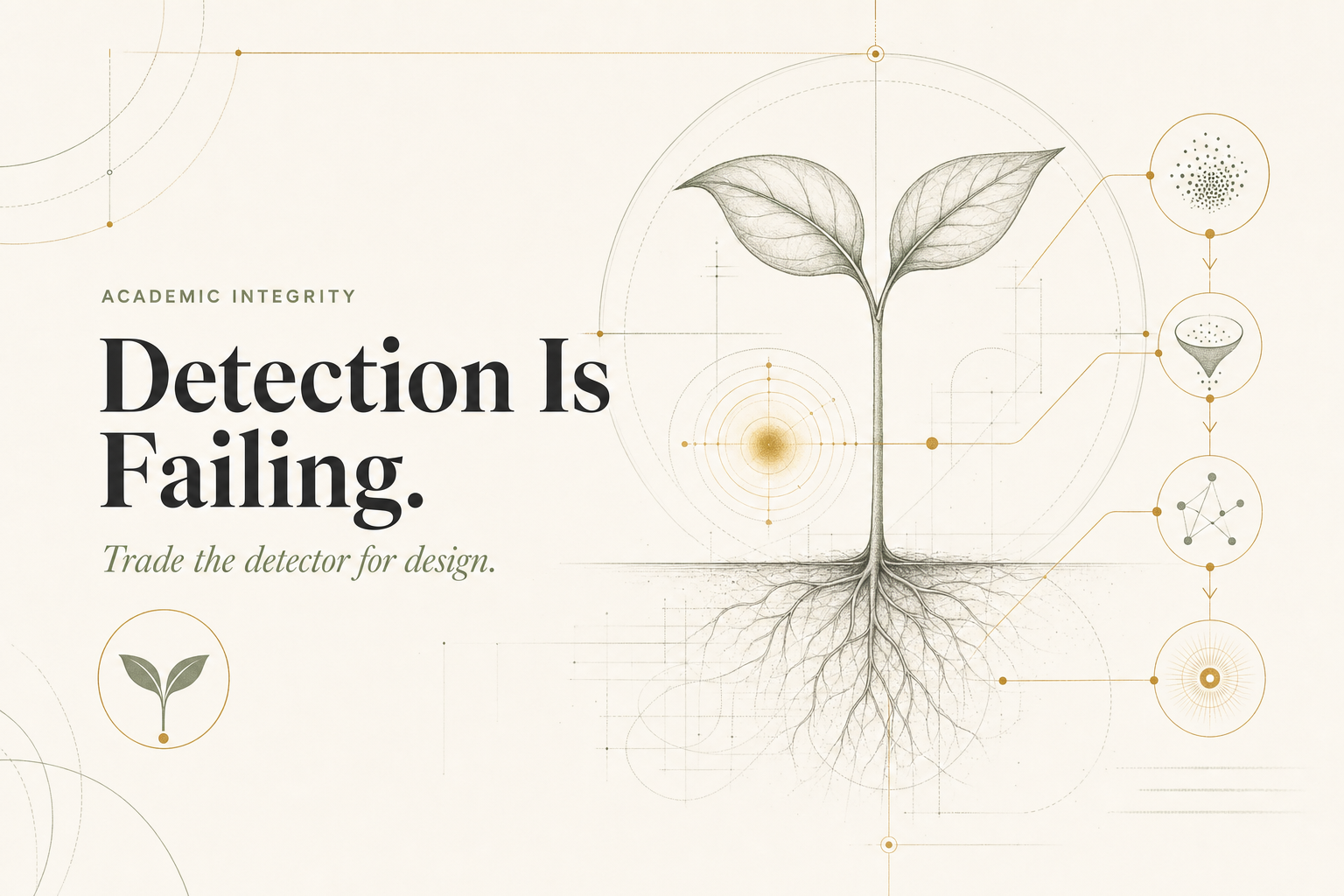
Here is the reframe that changes everything. Integrity in the AI era is not a policing problem you solve with software. It is a design problem you solve once, at the assignment level. We call the move the Trust Shift, and it runs on four steps that map cleanly onto SeedStacking. You do not need a new platform or a budget line. You need one assignment and about an hour.
Like what you’re reading? Get insights like this delivered daily.
Seed: retire the detector and write the policy
Turn the detector off for one assignment and replace it with a single sentence of your own: here is exactly where AI is welcome on this task, and here is where it stays out. Students do not cheat more when the rules are clear. They cheat more when the rules are a mystery and the stakes are an accusation. Naming the boundary is the first honest rep, and it costs you nothing but a paragraph.
Sprout: require the receipt
Ask for the work behind the work. Alongside the final draft, students submit a short disclosure: the prompts they used, the output they got, and what they changed. Call it the Trust Receipt. It flips the entire dynamic. Instead of you proving they used AI, they show you how they used it, and the thinking becomes visible instead of hidden. A student who cannot produce a coherent receipt is telling you something no detector ever could.
Grow: grade the judgment, not the typing
Build a short rubric that rewards what the student added on top of the machine. Did they catch the AI’s factual error? Did they push past the generic first answer? Did they make a choice the model would not have made? When your rubric prizes judgment, a slick AI draft stops being a shortcut and starts being a starting line. The students who only copied score low, not because a detector caught them, but because there is nothing of theirs to grade.
Harvest: let them defend it out loud
Close the loop with a two minute checkpoint. A quick oral question, an in class paragraph, a live walkthrough of one choice they made. No humanizer survives a follow up question about why the third paragraph says what it says. This is the part no software can fake and no student can outsource, and it takes minutes, not a plagiarism tribunal.
The Harvest Kernel takeaway
Stop buying certainty from a black box that cannot defend its verdict. Trade detection for design: name the boundary, require the receipt, grade the judgment, and let students defend their work out loud. You fix a few assignments once instead of policing every student all semester, and the integrity you build actually holds up.
Why this is the better life
The Detection Reflex asks you to be a prosecutor every week, chasing scores you cannot explain against students you would rather trust. The Trust Shift asks you to be a designer once. One is exhausting and legally shaky. The other is durable, fair, and honestly a lot more like teaching. The universities switching off their detectors are not going soft. They are refusing to outsource their judgment to a tool that was never as sure as it looked.
Your students already use AI. Your job was never to catch them. It was to teach them to use it in a way they can stand behind and show their work on. That is not a policy you announce. It is a rep you run, one assignment at a time, the same way we teach every skill worth having.
Ready to go beyond reading and start building AI fluency?
Join the free Harvest Kernel community for practical guidance, fresh ideas, and tools that help you make AI useful in real life.
Sources
Vanderbilt University, Guidance on AI Detection and Why We Are Disabling Turnitin’s AI Detector: vanderbilt.edu. Reporting on AI detector accuracy, false positives, and bias against non native English writers, 2026: ToHuman, GradPilot.