Samsung Just Handed AI to Every Employee. The Real Story Is the Gate.
Three years ago, Samsung caught one of its engineers pasting confidential source code into ChatGPT, and the company did what a lot of cautious organizations did in 2023. It banned generative AI outright. No tools, no exceptions, doors closed. This week the doors did not just reopen. They came off the hinges.
On June 21, OpenAI announced that Samsung Electronics is rolling out ChatGPT Enterprise and Codex to every employee in Korea and to its entire Device eXperience division worldwide. OpenAI is calling it one of the largest enterprise deployments it has ever done. That is a headline number, and the headlines are all chasing the size of it. The size is not the story. The story is hiding in one small detail near the bottom of the announcement, and that detail is the most important thing any working professional or educator will read this month.
Samsung Did Not Just Buy Software. It Bought a Head Start.
Look at what Samsung actually did, not what the press release shouted. Before the company handed out a single login, it ran a two month bake off with 2,500 employees testing ChatGPT against Google Gemini and Anthropic Claude side by side. Then it built a control system that grants access only to staff who complete an internal AI security training course first. You do not get the tool until you prove you can hold it without cutting yourself.
Now look at what the tool does once it is in their hands. Codex started life as a coding assistant for engineers, but Samsung is not pointing it at engineers alone. Marketing teams, product designers, manufacturing staff, anyone with a repetitive workflow is in scope. The reporting is blunt about the implication. An employee with zero coding background can describe what they want in plain language and get working software back. Internal dashboards, automated workflows, small custom tools, all built by people who could not write a line of code last year.
This is the same pattern we traced when the job market split into two tracks. The companies moving fastest are not waiting for a generation of coders to retire. They are handing the leverage to the people they already employ and watching who picks it up.
The Access Illusion
Here is the trap, and it is worth naming so you can see it coming. Call it the Access Illusion. It is the quiet belief that getting the tool is the same as gaining the advantage. Your company buys the enterprise license, your school district signs the contract, the login lands in your inbox, and a little voice says you are now covered. You are not behind anymore. You have AI.
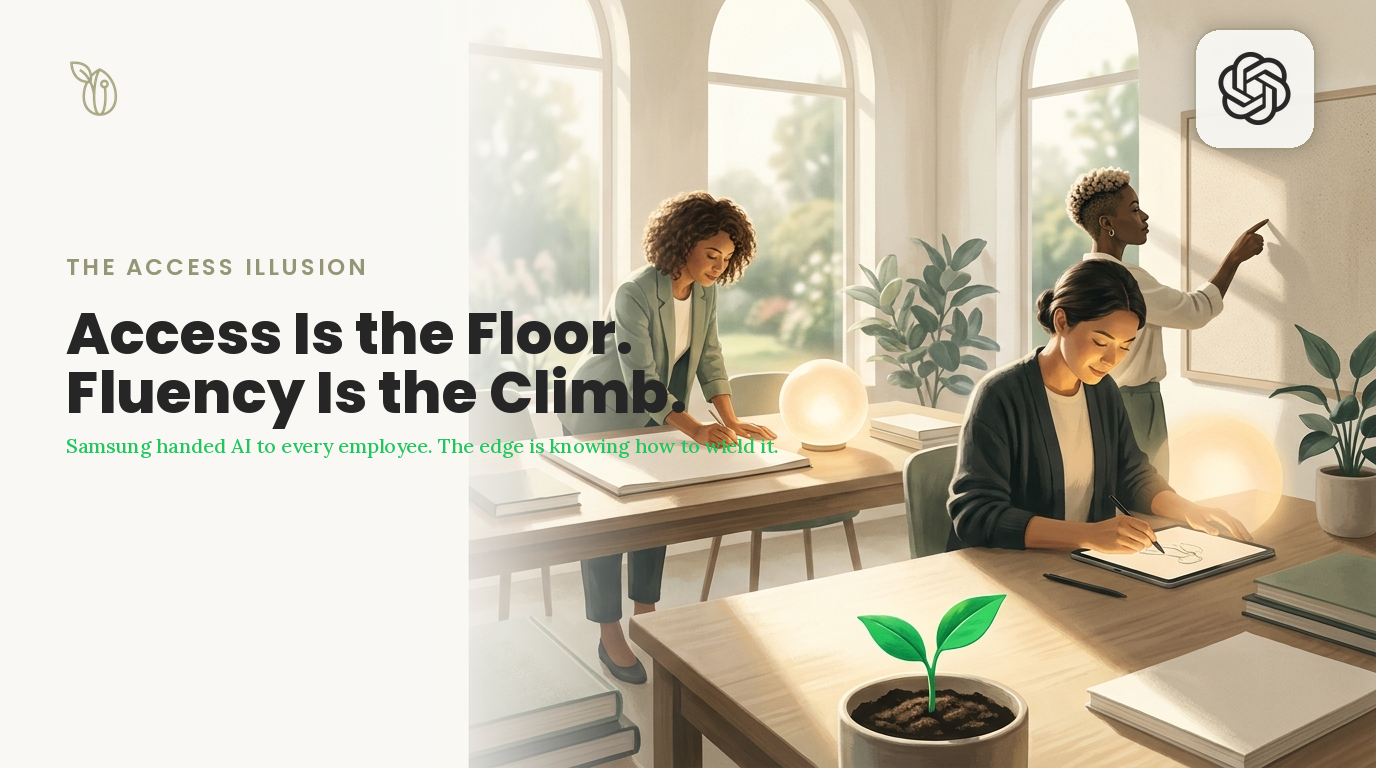
Except access was never the differentiator. Samsung just proved it in front of a global audience. If a login were the win, Samsung would have skipped the 2,500 person bake off and the mandatory training and simply flipped the switch. It did not, because the company understands something most individuals have not caught up to yet. The tool is now the floor, not the ceiling. Everyone in that division will have the same ChatGPT and the same Codex. The raises, the promotions, the interesting projects will not go to the people with access. They will go to the people who learned to direct it with judgment.
That is the part that should land in your stomach a little. The arrival of the tool does not close the gap. It moves the gap somewhere harder to see. The new dividing line is not who has AI and who does not. It is who is fluent and who is faking it. We made this same case when we argued that AI skills alone will not save your career, and Samsung just turned that argument into a corporate policy for hundreds of thousands of people.
Like what you’re reading? Get insights like this delivered daily.
What This Means If You Do Not Work at Samsung
You might be thinking that this is a big company problem, interesting from a distance but not your Tuesday. That instinct is exactly backward. Samsung is not the exception. Samsung is the preview.
The same week as the Samsung news, Seoul National University handed ChatGPT Edu to all 47,000 of its students, faculty, and staff. LG, Toss, Krafton, and a long list of others are rolling out the same enterprise tools across Korea. This is not a single deal. It is a wave, and waves do not check your job title before they reach you. If you teach, the access conversation is coming to your campus. If you work in an office, it is coming to your team. If you are simply a curious person trying to keep your footing in a fast year, it is already in the apps you use every day.
The educators feel this most sharply, because they are about to be handed the tool and asked to teach with it in the same breath. That is why we keep saying AI literacy is built, not announced. A district can buy a thousand licenses on Monday and have a thousand confused teachers on Tuesday. The license is not the literacy. The training Samsung required is the part everyone wants to skip and nobody can afford to.
SeedStacking: How You Build the Floor Before Someone Hands It to You
So what do you actually do with this, today, before your employer or your school turns the Samsung playbook on you? You do not need a corporate training department. You need a method, and the method is smaller than you think.
At Harvest Kernel we call it SeedStacking, and it runs on a simple truth. Fluency is not a course you complete. It is a stack of small wins that compound. You plant one seed, a single real task you do with AI this week. You let it sprout by repeating it until it is automatic. You grow it by stacking a slightly harder task on top. You harvest when the thing that used to take an hour now takes ten minutes and you barely think about it. Then you stack again.
That is how a non technical Samsung employee will go from intimidated to building their own dashboard with Codex. Not in one heroic leap, but in a quiet series of small stacks. The same path is open to you right now, with the free tools already on your phone, and you do not have to wait for anyone to grant you access to start.
The Takeaway
Samsung did not make its people more valuable by buying them a tool. It made them more valuable by requiring them to learn it first. Access is now the floor. Fluency is the climb. The person who can direct these systems with judgment is the one who gets the raise, and that person is built one small win at a time, not handed a login.
Samsung spent three years going from a total ban to one of the largest AI deployments on the planet. The lesson is not that AI won. The lesson is that the company stopped fearing the tool and started building the fluency to wield it. You can make that same turn this week, on a much smaller budget, starting with a single seed. The door is open. The only question left is whether you walk through it fluent or just curious.
Ready to go beyond reading and start building AI fluency?
Join the free Harvest Kernel community for practical guidance, fresh ideas, and tools that help you make AI useful in real life.