85% of Seniors Use AI. Entry-Level Jobs Are Still Disappearing.
Here is what the data says: 85 percent of college seniors now use AI tools. More than a third use them every single day. Adoption is not the problem anymore. It has not been the problem for months.
Here is what the job market says: entry-level postings are still declining. Nearly 43 percent of recent graduates are underemployed, stuck in jobs that do not require the degree they just spent four years earning. That is the highest rate since the pandemic.
These two facts should not coexist. If students are learning AI and employers want AI skills, the path should be straightforward. It is not. And the reason it is not tells you everything you need to know about the difference between using a tool and understanding it.
The Handshake Data Is Not What It Looks Like
Handshake’s Class of 2026 report surveyed 1,248 graduating seniors from nearly 500 institutions. The headline numbers look like progress. AI adoption among seniors jumped 31 percentage points in two years. More than 10 percent of internships now mention AI skills. The share of full-time job postings referencing AI has nearly doubled year over year to 4.2 percent.
But here is the part that most people miss. Using AI is not the same as demonstrating competence with AI. A senior who asks ChatGPT to help polish a cover letter and a senior who can build a multi-step research workflow using Claude, NotebookLM, and a structured prompt library are both counted in that 85 percent. The gap between those two people is enormous, and employers can tell the difference in about 90 seconds.
BY THE NUMBERS
85% of seniors use AI tools (up 31pp in 2 years) | 4.2% of job postings reference AI (doubled YoY) | 43% of grads age 22-27 are underemployed | 23% wage premium for AI skills vs. 8% for a degree alone
The First Rung Problem
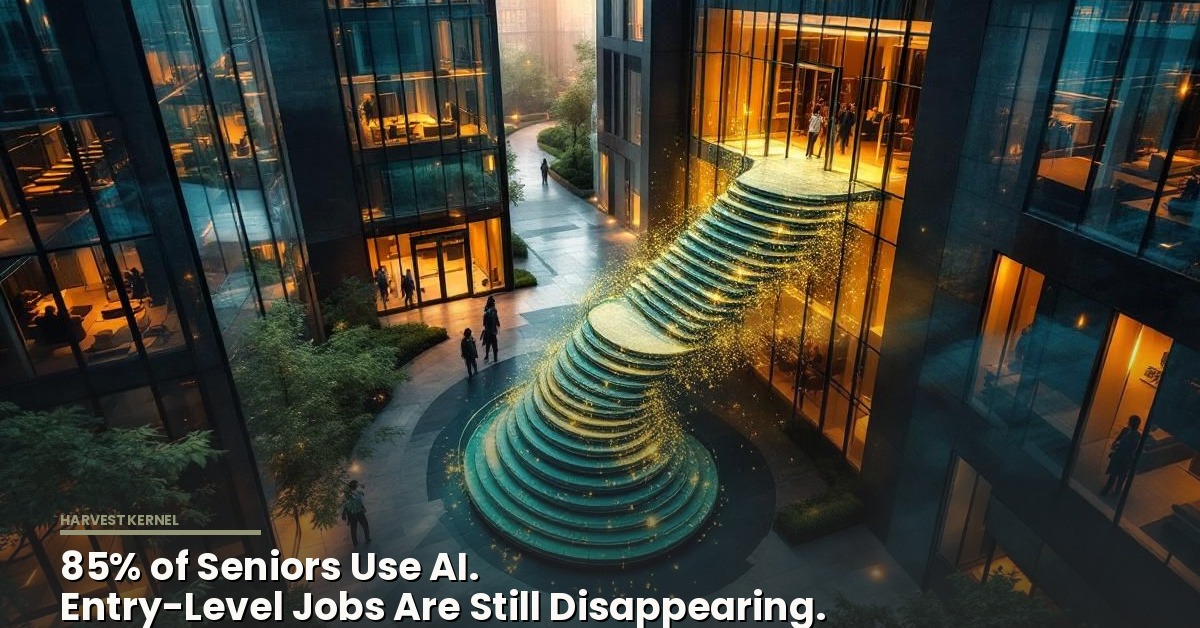
The World Economic Forum found earlier this year that AI skills now command a 23 percent wage premium, compared to just 8 percent for a bachelor’s degree in isolation. The Dallas Federal Reserve published research showing that AI is simultaneously reducing entry-level hiring while raising wages for experienced workers in the same occupations. The career ladder is not disappearing. The first rung is being removed.
Now you are probably thinking: if students are using AI and employers want AI skills, why are entry-level jobs still shrinking? The answer is that employers are not looking for AI users. They are looking for people who can work alongside AI systems to produce higher-value output from day one. The junior analyst who used to spend six months learning the ropes by doing basic data pulls no longer has that runway. AI handles the basic work. The expectation is that you arrive already capable of the work that comes after the basics.
This is what I call The Competence Compression Problem. The distance between entry-level and mid-level performance has collapsed. AI compressed it. And most graduates are standing on the wrong side of that compression, holding a tool they can operate but cannot leverage strategically.
Why Adoption Without Structure Fails
Consider two students applying for the same marketing analyst position. Both use AI daily. One uses it to generate social media captions and summarize articles. The other has built a systematic workflow: audience research prompts that extract actionable insights, competitive analysis frameworks that run in minutes instead of hours, and a content evaluation process that measures performance against specific KPIs.
The first student adopted AI. The second student developed AI literacy. The Handshake data counts them equally. The hiring manager does not.
This distinction matters because institutions are responding to the adoption data, not the competence data. When a university sees that 85 percent of students use AI, it checks a box. When it sees that entry-level jobs are still vanishing, it blames the economy. The actual problem sits between those two data points, in the gap between casual use and structured fluency.
Like what you are reading?
Get insights like this delivered to your feed. Free community, real discussion.
What the Data Actually Demands
Handshake’s own analysis points to the answer, even if it does not name it directly. The report found that while entry-level postings declined 2 percent year over year, that is a dramatic slowdown from last year’s 15 percent freefall. The market is not collapsing. It is restructuring. And the restructured version demands something specific: demonstrated AI competence that goes beyond checkbox adoption.
Nearly a third of tech job postings now mention AI, more than triple the share from two years ago. But mentioning AI in a job posting is not the same as requiring prompt engineering. Employers want people who understand how AI changes their specific domain. A marketing analyst who can build AI-augmented research workflows. A project manager who can use AI to compress timelines without losing quality. An educator who can redesign assignments around AI rather than banning it.
This is exactly what structured AI literacy looks like. Not learning how to use ChatGPT. Learning how to think with AI, systematically, in the context of your actual work.
The Institutional Response Gap
Handshake’s report includes a telling quote from Christine Cruzvergara, their chief education strategy officer: “It is going to be very difficult for higher ed, based on the way it is structured, to keep up with the pace of change around AI.” She is not wrong. But difficulty is not an excuse for inaction.
The institutions that will produce employable graduates in 2027 are the ones building AI literacy into existing curricula right now. Not as a standalone “intro to AI” elective. Not as a workshop during orientation week. As a systematic approach to developing competence over time, starting with small wins and building toward genuine fluency.
That is the operating principle behind SeedStacking. Small daily AI wins that compound into real competence. It is not about learning everything at once. It is about building a skill stack that employers can see, measure, and trust. Because the data is clear: adoption alone is not enough. The 85 percent number is a ceiling, not a floor. The question is no longer whether students are using AI. It is whether they are using it in a way that translates to professional value.
THE SEED
The Handshake data proves that AI adoption is nearly universal. It also proves that adoption alone does not create employable graduates. The missing ingredient is not more tools or more exposure. It is structured literacy: the ability to move from using AI to thinking with it. That is the rung the career ladder actually needs.
Ready to go beyond reading and start building AI fluency?
Join educators, professionals, and lifelong learners who are building real AI skills through SeedStacking. Free courses. Daily discussion. A community that actually helps you grow.