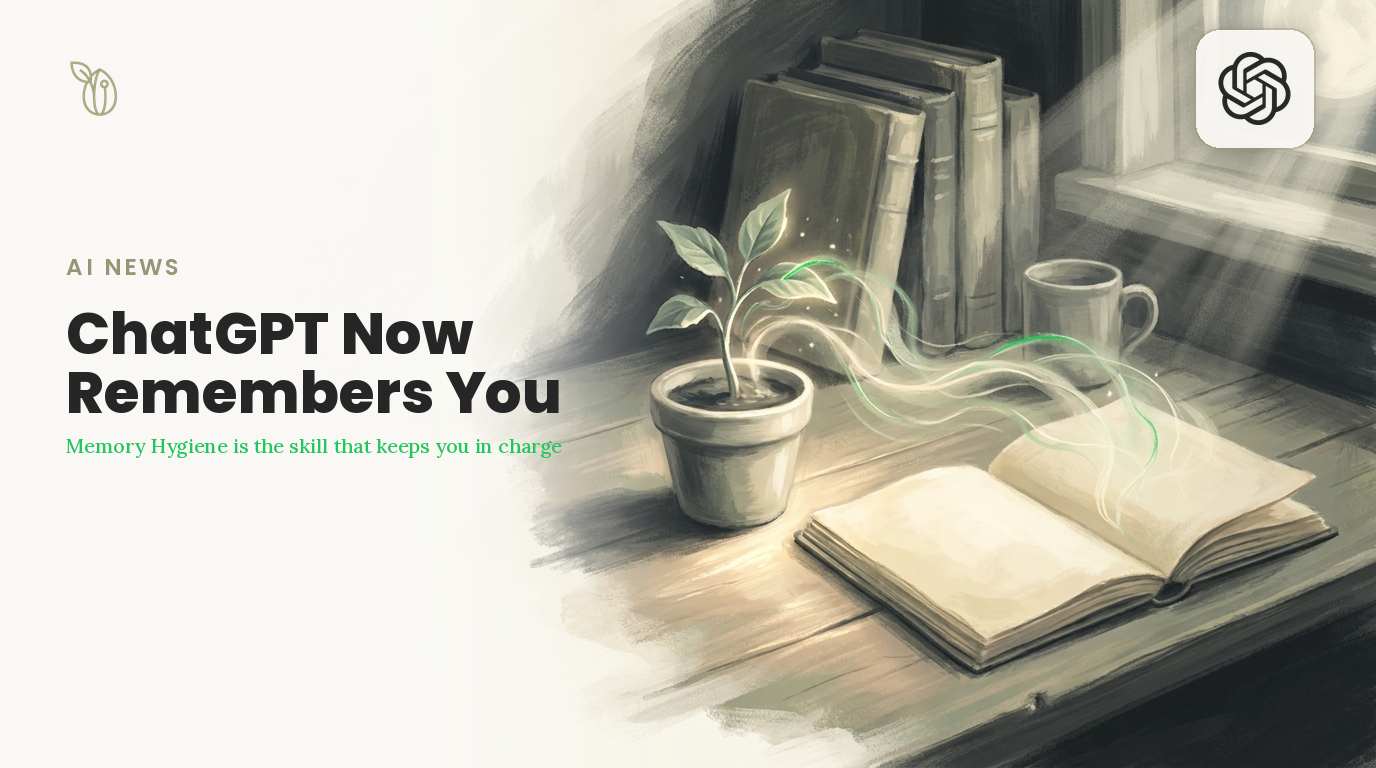
ChatGPT Now Remembers You. Memory Hygiene Is the Skill That Keeps You in Charge
On June 4, OpenAI flipped a switch that changes the relationship between you and your AI. ChatGPT’s memory system, rebuilt on an architecture the company calls Dreaming, now quietly studies your conversations in the background and carries what it learns into every new chat.1 You will not see a new button. You will simply notice that the tool starts answering like someone who knows you.
That sounds like pure convenience, and mostly it is. But there is a skill hiding inside this update that almost nobody is talking about, and it is the difference between an AI that works for you and an AI that quietly works from a flawed picture of you. At Harvest Kernel we call that skill Memory Hygiene: the small, regular practice of reviewing, correcting, and directing what your AI remembers. This post breaks down what shipped, why it matters, and exactly how to build the habit.
What actually shipped on June 4
Memory in ChatGPT is not new. The first version arrived in April 2024 as saved memories, which only worked when you gave the model a strong cue like a direct instruction to remember something.2 A year later, OpenAI added the first version of Dreaming, a background process that let the model pick up context from your chats without being told. What launched this week is the third generation of that idea, and for the first time it stands on its own as the primary memory system.
Three things define the upgrade. First, the system synthesizes context across many conversations instead of leaning on a static list, which means it can connect what you said in March to what you ask in June. Second, you get a readable memory summary page where you can see what ChatGPT believes about you, correct it, add to it, and even tell it which topics to bring up and when.1 Third, memories now update with the passage of time, so the trip you finished or the job you left stops haunting your answers.
5x
The reduction in computing power OpenAI says it achieved to run Dreaming, which is what finally makes the feature practical for Free accounts. Plus and Pro users in the US get it now with doubled memory capacity, and Free users follow over the coming weeks.3
The rollout detail matters more than it looks. When persistent memory reaches the Free tier, it stops being a power user perk and becomes the default experience for hundreds of millions of people. That is the moment a feature becomes a literacy issue.
Why this is bigger than a feature update
Most coverage will file this under product news and move on. But the real story is a shift in what kind of tool you are using. A chatbot with no memory is a vending machine: every interaction starts from zero, and the quality of the output depends entirely on the quality of that single prompt. A chatbot with durable, self-updating memory is closer to a colleague. It builds a working model of you, and it uses that model whether or not you are thinking about it.
That cuts both ways. When the model of you is accurate, the payoff is real. A teacher who has mentioned her ninth grade biology classes all semester can ask for a review activity and get one pitched at the right level without restating her context. A small business owner who described his customer base in April gets marketing drafts in June that already sound like his brand. This is the carry forward effect OpenAI is explicitly optimizing for, alongside following your stated preferences and staying current as your life changes.1
Now, you might be thinking: if the system is this good at keeping itself fresh, why would I need to manage it at all? Here is the uncomfortable answer. A better memory is still an AI memory. It can merge two facts into one wrong one, hold onto a project you abandoned, or generalize from something you said once in frustration. The difference is that those errors no longer live in a single chat you can close. They compound, silently, across everything you do with the tool.
The set-and-forget mistake
This brings us to the warning. The biggest risk of this update is not the technology. It is the default human behavior around it. Most people will never open the memory summary page. They will let an automated background process build a permanent profile of their work, their family, their health questions, and their half-formed ideas, and they will never once audit it.
Treating AI memory as set-and-forget creates three concrete problems. Stale context produces confidently wrong answers tailored to a person you no longer are. Unexamined context means you cannot tell whether a recommendation is genuinely good or just an echo of something you said months ago. And unmanaged context is a privacy decision you made by accident: if the setting that lets OpenAI train on your conversations is on, what the model remembers about you can also become training material, which is exactly why the data controls in settings deserve five minutes of your attention.
Like what you are reading? Get insights like this, and the practical reps to go with them, inside the free Harvest Kernel community.
We have written before about what happens when people hand cognitive work to AI without keeping a hand on the wheel, in Your Brain Is Outsourcing Itself. Memory raises the stakes, because now the outsourcing includes the context itself. The fix is not avoidance. The fix is a habit.
Memory Hygiene: the five minute practice
Memory Hygiene is simple enough to do on a Friday afternoon and valuable enough to change how well your AI serves you. Four moves, in order.
1. Review. Open the memory summary page and actually read what ChatGPT believes about you. Most people are surprised twice: once by how much it captured, and once by what it got slightly wrong.
2. Prune. Correct anything inaccurate and dismiss anything outdated. The new interface lets you fix or remove specific details right from the summary. Finished projects, old jobs, and one-time questions that do not represent you should go.
3. Direct. This is the step that separates passive users from fluent ones. You can now tell ChatGPT which topics to bring up and when. Give it standing instructions: always ask about my accessibility requirements when I plan lessons, never assume my budget, keep my side project separate from my day job.
4. Repeat on a cadence. Put a recurring fifteen minute block on your calendar, monthly is plenty, and treat it like clearing out a desk drawer. The model updates continuously; your audit should at least happen periodically.
If you are anything like most professionals we work with, your first reaction is that this sounds like one more chore. It is actually the opposite. Every minute of Memory Hygiene removes dozens of future minutes of re-explaining yourself and correcting answers aimed at the wrong version of you. Small rep, compounding return. That is the entire AI literacy playbook in miniature, and it is exactly how we structure skill building inside SeedStacking.
I built a free interactive tool for this: The Memory Hygiene Audit. 16 questions, 4 minutes, and it tells you exactly which phase of the habit to build next.
This skill travels beyond ChatGPT
One more reason to build the habit now: ChatGPT is not alone. Claude, Gemini, and Copilot are all racing toward persistent, personalized memory, each with its own review controls. The interfaces will differ. The practice will not. Review, prune, direct, repeat works everywhere, which makes Memory Hygiene one of the rare AI skills with a long shelf life. Learn it once on whatever tool you use most, and you carry it into every assistant you will ever work with.
The Seed
Your AI now keeps a running model of who you are, and it updates that model whether you participate or not. Memory Hygiene, the habit of reviewing, pruning, and directing what it remembers, is how you turn that from a quiet liability into your biggest productivity advantage.
Sources
1 OpenAI, Dreaming: Better memory for a more helpful ChatGPT, June 4, 2026
2 Engadget, ChatGPT’s memory is getting better, especially if you’re on the free tier, June 4, 2026
3 9to5Mac, OpenAI says ChatGPT’s memory feature is getting smarter and coming to free users, June 4, 2026
Ready to go beyond reading and start building AI fluency?
The article gives you the what. The community gives you the how. Join free educators and professionals building real AI judgment one rep at a time, with the SeedStacking method, weekly challenges, and people who are figuring this out alongside you.

Dean helps educators and professionals build practical AI fluency through SeedStacking, small daily reps that compound into real skill. Join the free community.